Deadwood type and tree diversity structure saproxylic Hymenoptera host-parasitoid communities
Description
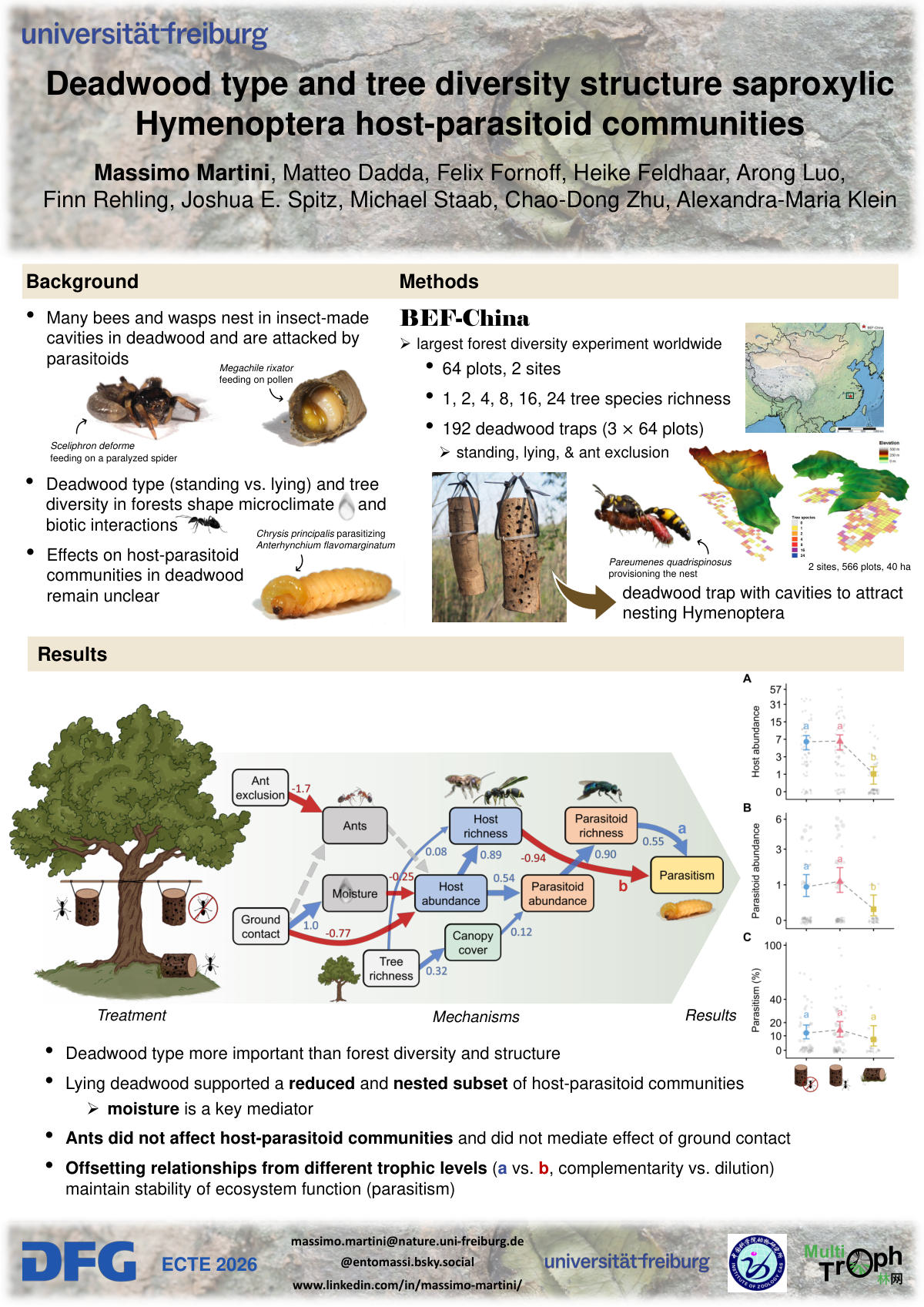
This poster investigates the effects of deadwood type and tree diversity on deadwood cavity-nesting Hymenoptera host-parasitoid communities. The study was conducted in a large forest diversity experiment ("BEF-China"). The results show that deadwood position (standing or lying) is more important than forest tree diversity and stand structure in shaping the nesting communities. Lying deadwood supported less diverse and abundant communities that were largely a nested subset of those occupying standing deadwood while retaining approximately twice as much moisture, suggesting that substrate moisture is an important factor limiting bee and wasp communities nesting in deadwood. By contrast, neither ant exclusion nor observed ant occurrence was associated with host or parasitoid responses in our study.
Conference Information
European Conference of Tropical Ecology
Funding Information
Deutsche Forschungsgemeinschaft (DFG)
Grant: 452861007/FOR 5281
Authors
Massimo Martini
University of Freiburg
ORCID: https://orcid.org/0000-0002-1855-9334
Matteo Dadda
University of Bayreuth
Felix Fornoff
University of Freiburg
Heike Feldhaar
University of Bayreuth
Arong Luo
Institute of Zoology, Chinese Academy of Sciences
Finn Rehling
University of Freiburg
Joshua E. Spitz
Leuphana University of Lüneburg
Michael Staab
Leuphana University of Lüneburg
Chao-Dong Zhu
Institute of Zoology, Chinese Academy of Sciences
Alexandra-Maria Klein
University of Freiburg