Description
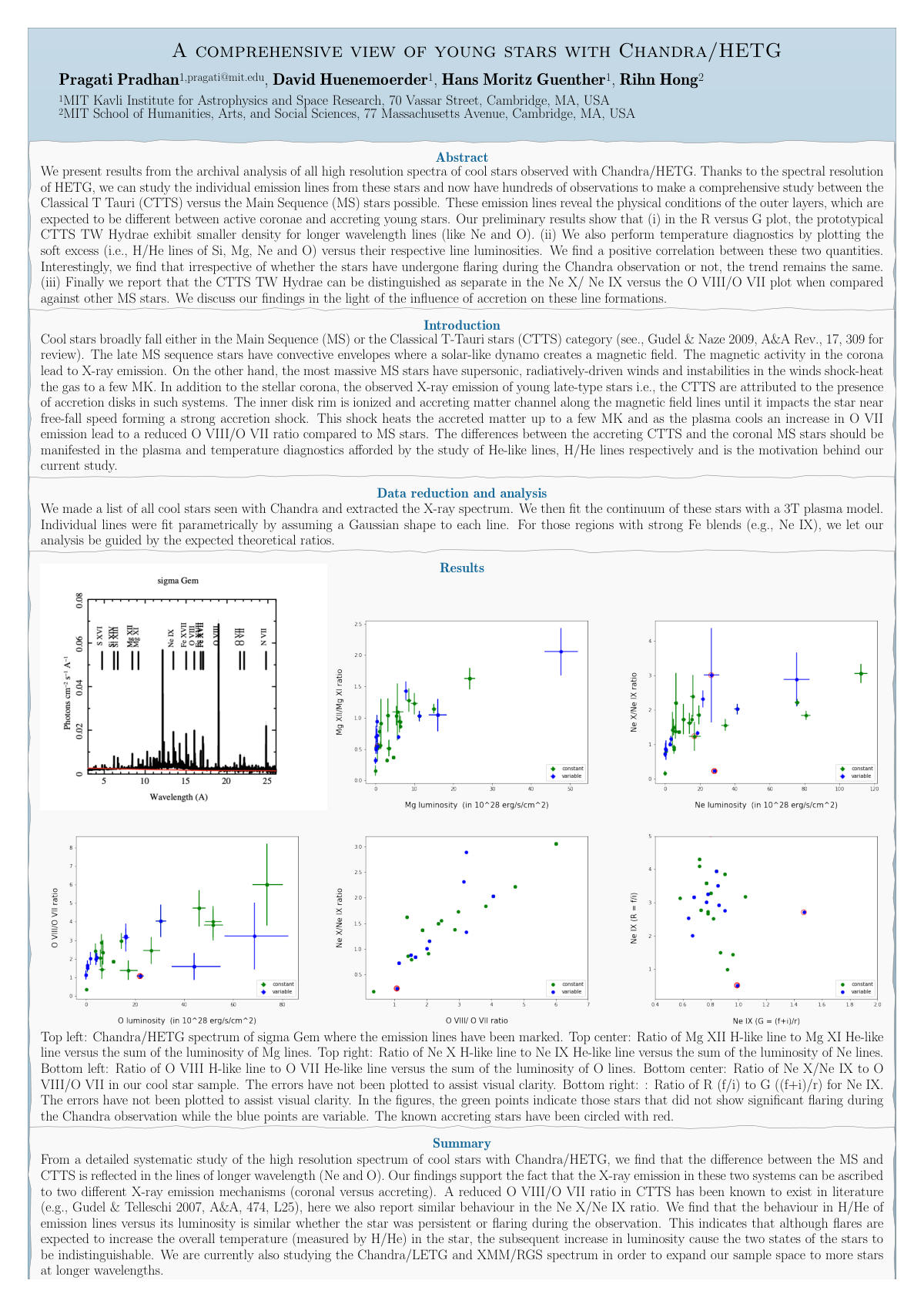
Abstract We present results from the archival analysis of all high resolution spectra of cool stars observed with Chandra/HETG. Thanks to the spectral resolution of HETG, we can study the individual emission lines from these stars and now have hundreds of observations to make a comprehensive study between the Classical T Tauri (CTTS) versus the Main Sequence (MS) stars possible. These emission lines reveal the physical conditions of the outer layers, which are expected to be different between active coronae and accreting young stars. Our preliminary results show that (i) in the R versus G plot, the prototypical CTTS TW Hydrae exhibit smaller density for longer wavelength lines (like Ne and O). (ii) We also perform temperature diagnostics by plotting the soft excess (i.e., H/He lines of Si, Mg, Ne and O) versus their respective line luminosities. We find a positive correlation between these two quantities. Interestingly, we also find that irrespective of whether the stars have undergone flaring during the Chandra observation or not, the trend remains the same. (iii) Finally, we report that the CTTS TW Hydrae can be distinguished as separate in the Ne X/ Ne IX versus the O VIII/O VII plot when compared against other MS stars. We discuss our findings in the light of the influence of accretion on these line formations.
Conference Information
L A T E X Tik Zposter
Identifiers
Authors
Pragati Pradhan
MIT Kavli Institute for Astrophysics and Space Research
ORCID: https://orcid.org/0000-0002-1131-3059
David Huenemoerder
MIT Kavli Institute for Astrophysics and Space Research
ORCID: https://orcid.org/0000-0002-3860-6230
Hans Moritz Guenther
MIT Kavli Institute for Astrophysics and Space Research
ORCID: https://orcid.org/0000-0003-4243-2840
Rihn Hong
MIT School of Humanities, Arts, and Social Sciences