Description
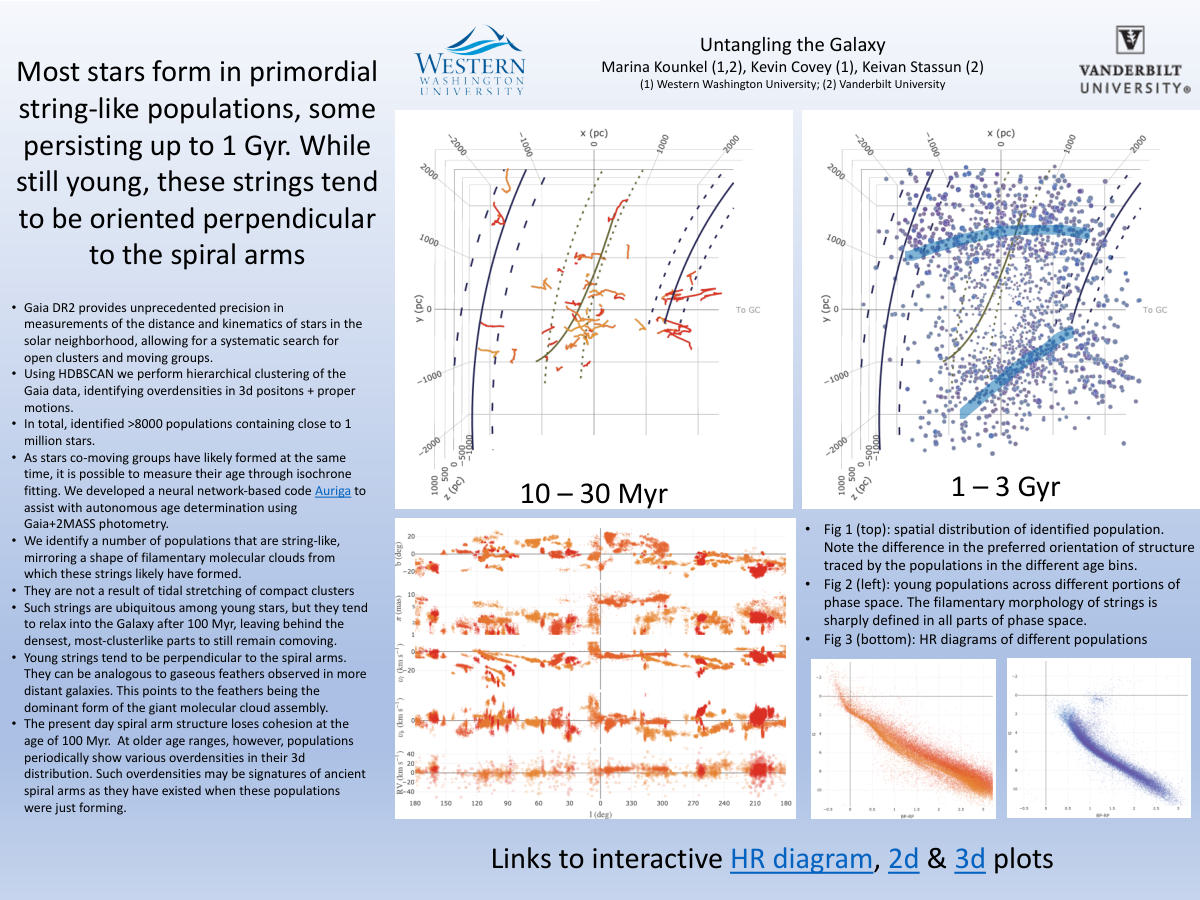
Gaia DR2 provides unprecedented precision in measurements of the distance and kinematics of stars in the solar neighborhood. Through applying hierarchical clustering on 5D data set (3D position + 2D velocity), we identify a number of clusters, associations, and comoving groups within 3 kpc. Through leveraging machine learning techniques, we can estimate the ages of these stars with pseudo-isochrone fitting. Furthermore, supervised learning then allows for identification of isolated pre-main sequence stars that cannot be recovered through clustering. With these efforts combined, we can produce to date the largest catalog of stars with known ages, allowing for investigation of star formation history of the solar neighborhood. Most of the young stars are commonly found to be filamentary or string-like populations, oriented in parallel to the Galactic plane, and some span hundreds of parsec in length. Most likely, these strings are primordial, tracing the morphology of filamentary clouds that produced them, rather than the result of tidal stripping or dynamical processing. The youngest strings (<100 Myr) tend to be orthogonal to the Local Arm. Stars in a string tend to persist as comoving for time scales of ~300 Myr, after which most dissolve into the Galaxy. These data shed a new light on the local galactic structure and a large-scale cloud collapse.
Conference Information
Untangling the Galaxy
Identifiers
Authors
Marina Kounkel
Vanderbilt University
ORCID: https://orcid.org/0000-0002-5365-1267
Kevin Covey
Western Washington University
ORCID: https://orcid.org/0000-0001-6914-7797
Keivan Stassun
Vanderbilt University
ORCID: https://orcid.org/0000-0002-5365-1267