The Orion Radio All-Stars: Radio census and proper motions with the VLA and nonthermal variability with ALMA and the VLBA
Description
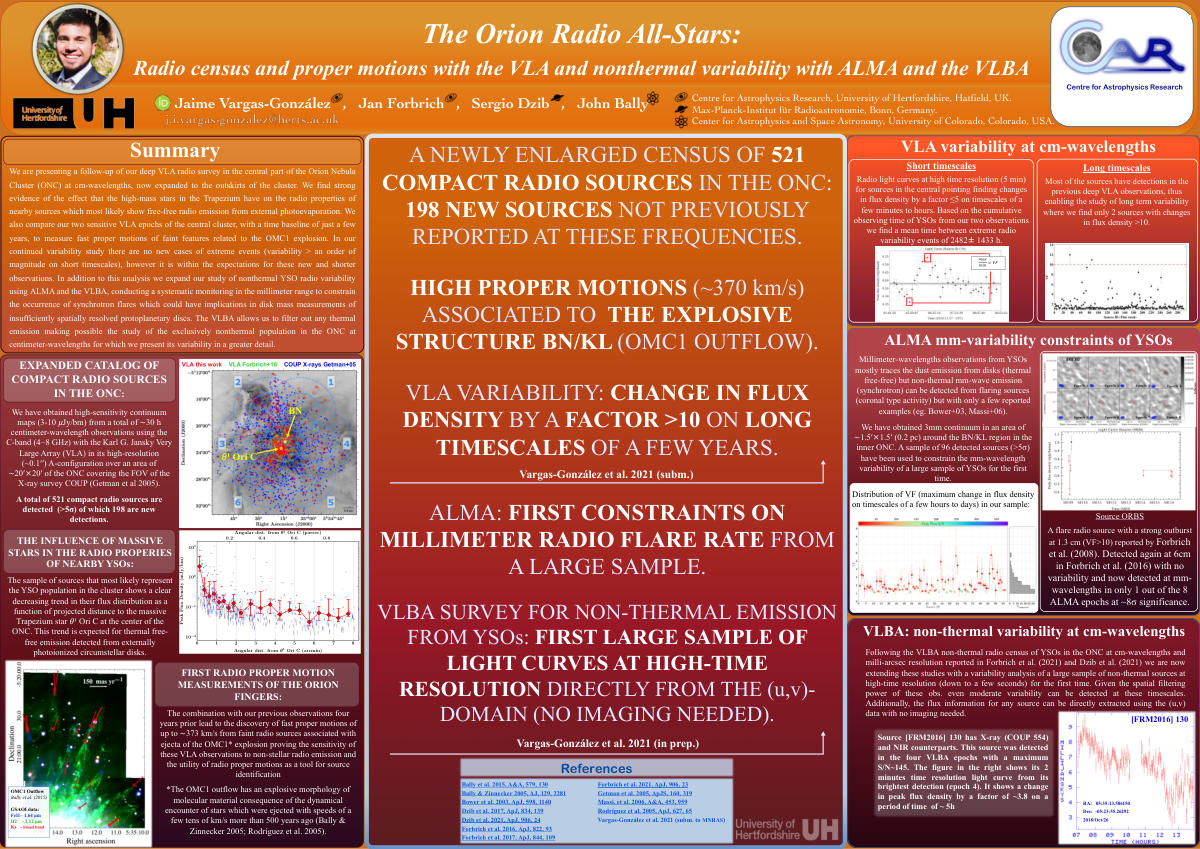
We are presenting a follow-up of our deep VLA radio survey in the central part of the Orion Nebula Cluster (ONC) at cm-wavelengths, now expanded to the outskirts of the cluster. We find strong evidence of the effect that the high-mass stars in the Trapezium have on the radio properties of nearby sources which most likely show free-free radio emission from external photoevaporation. We also compare our two sensitive VLA epochs of the central cluster, with a time baseline of just a few years, to measure fast proper motions of faint features related to the OMC1 explosion. In our continued variability study there are no new cases of extreme events (variability greater than an order of magnitude on short timescales), however it is within the expectations for these new and shorter observations. In addition to this analysis we expand our study of nonthermal YSO radio variability using ALMA and the VLBA, conducting a systematic monitoring in the millimeter range to constrain the occurrence of synchrotron flares which could have implications in disk mass measurements of insufficiently spatially resolved protoplanetary discs. The VLBA allows us to filter out any thermal emission making possible the study of the exclusively nonthermal population in the ONC at centimeter-wavelengths for which we present its variability in a greater detail.
Conference Information
The 20.5th Cambridge Workshop on Cool Stars, Stellar Systems, and the Sun
Identifiers
Authors
Jaime Vargas-González
University of Hertfordshire
ORCID: https://orcid.org/0000-0003-4329-3299
Jan Forbrich
University of Hertfordshire
ORCID: https://orcid.org/0000-0001-8694-4966
Sergio Dzib
Max-Planck-Institut für Radioastronomie
ORCID: https://orcid.org/0000-0001-6010-6200
John Bally
University of Colorado
ORCID: https://orcid.org/0000-0001-8135-6612