Description
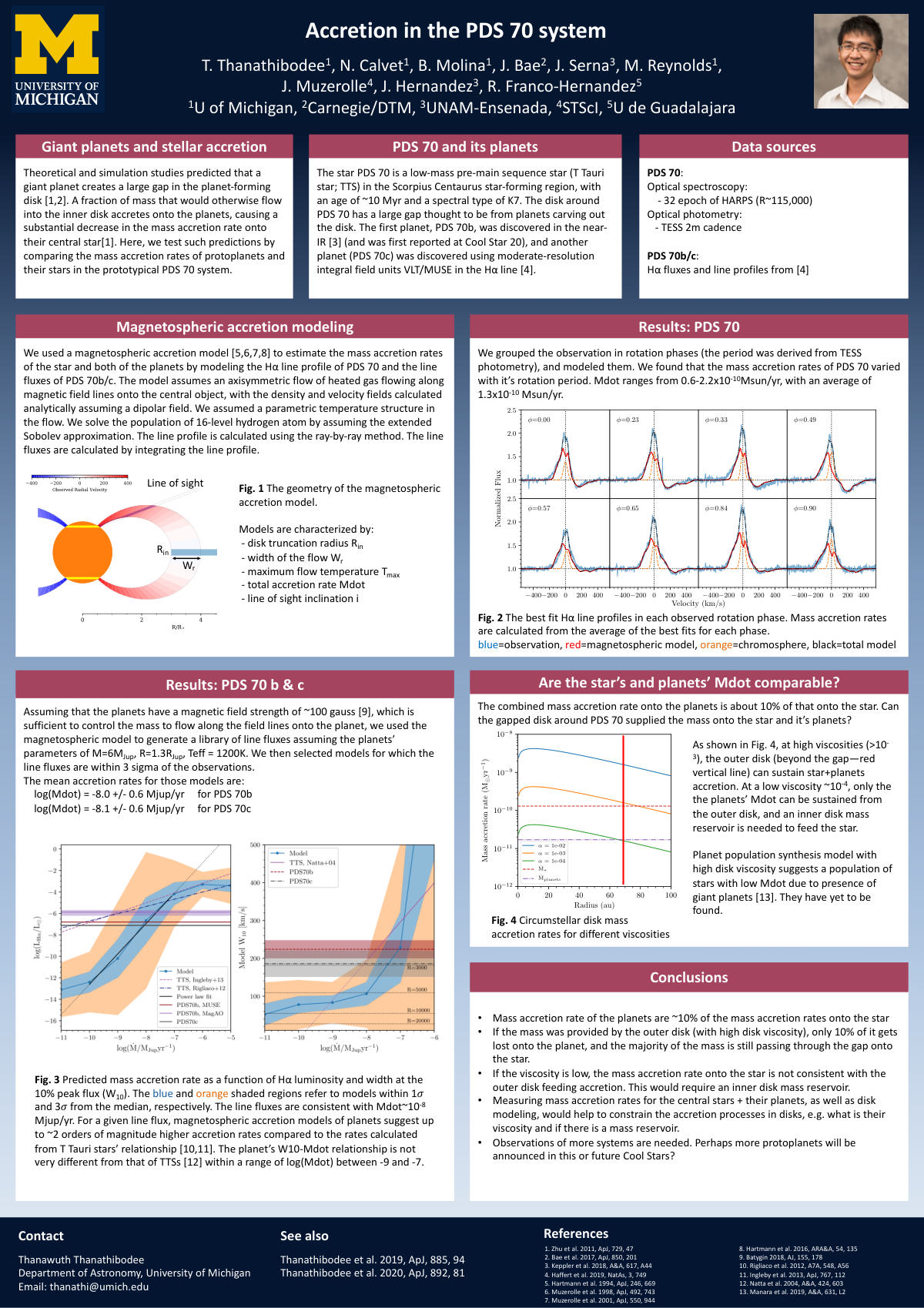
Theoretical studies and simulations suggest that giant planets can create gaps in circumstellar disks around young, pre-main-sequence stars. As a result, the mass accretion rate from the disk onto the star decreases significantly. Here, we evaluate that prediction and its implications by measuring the mass accretion rates onto the star PDS 70 and its proto-planets. We applied magnetospheric models to fit the multi-epoch H-alpha profiles of PDS 70 and the H-alpha fluxes of PDS 70 b/c. We found that the star's mass accretion rate varies with its rotation period, with an average of 1.3x10⁻¹⁰ Msun/yr. The total mass accretion rate onto the planets is only 10% of that of the star. Given the size of the gap in the disk around PDS 70, these estimates of the mass accretion rate are consistent with: (1) the disk has a high viscosity, or (2) the disk has an inner mass reservoir and a low viscosity. More observations of systems with young, accreting planets are needed to discern between these scenarios.
Conference Information
The 20.5th Cambridge Workshop on Cool Stars, Stellar Systems, and the Sun
Identifiers
Authors
Thanawuth Thanathibodee
University of Michigan
ORCID: https://orcid.org/0000-0003-4507-1710
Nuria Calvet
University of Michigan
Brandon Molina
University of Michigan
Jaehan Bae
Carnegie Institution for Science
Javier Serna
Universidad Nacional Autónoma de México
Mark Reynolds
University of Michigan
James Muzerolle
Space Telescope Science Institute
Jesús Hernández
Universidad Nacional Autónoma de México
Ramiro Franco Hernández
Universidad de Guadalajara