Surface rotation and magnetic activity for 55,000+ Kepler solar-type stars
Description
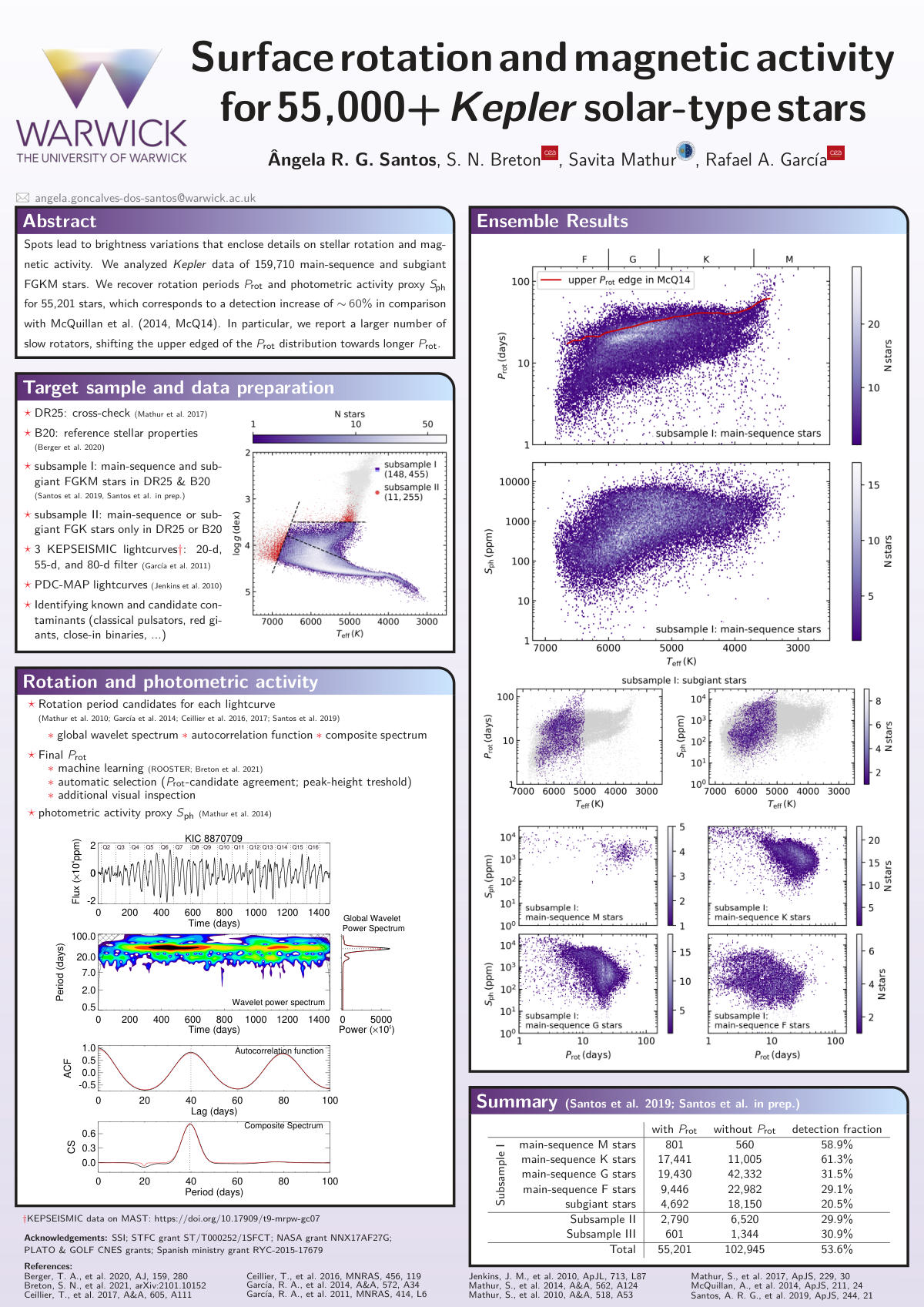
Dark magnetic spots co-rotating with the stellar surface lead to quasi-periodic brightness variations, which enclose relevant information on stellar rotation and magnetic activity properties. In this work, we analyzed the Kepler long-cadence data of 159,710 main-sequence and subgiant FGKM stars. Rotation-period candidates are obtained by combining wavelet analysis with autocorrelation function of light curves. The final rotation periods Prot are selected via a machine learning algorithm, automatic selection, and complementary visual inspection. We successfully recover average rotation periods and photometric activity proxy Sph for 55,201 stars, which corresponds to an increase in detections of more than 60% in comparison with McQuillan et al. (2014). The rotation-period distribution is confirmed to be bimodal for the Kepler solar-type targets showing a slow- and a fast-rotating branches. While the rotation period generally decreases with increasing effective temperature Teff, the Sph behavior is more complex. For main-sequence GKM stars, Sph spans a wider range of values with increasing Teff, while F stars tend to have smaller Sph values in comparison with cooler stars. Overall, for main-sequence GKM stars, fast rotators are photometrically more active than slow rotators. For K stars, the slow- and fast-rotating branches are almost parallel in the Sph-Prot diagram, whereas for G stars the fast-rotating branch corresponds to a Sph saturated regime. Detecting Prot for a larger number of slow rotators, the upper edge of the Prot distribution is found to be located at longer periods than found previously.
Identifiers
Authors
Ângela R. G. Santos
Department of Physics, University of Warwick
ORCID: https://orcid.org/0000-0001-7195-6542
Sylvain N. Breton
IRFU, CEA, Université Paris-Saclay, France
Savita Mathur
Instituto de Astrofisica de Canarias, Spain
ORCID: https://orcid.org/0000-0002-0129-0316
Rafael A. García
IRFU, CEA, Université Paris-Saclay, France
ORCID: https://orcid.org/0000-0002-8854-3776