Description
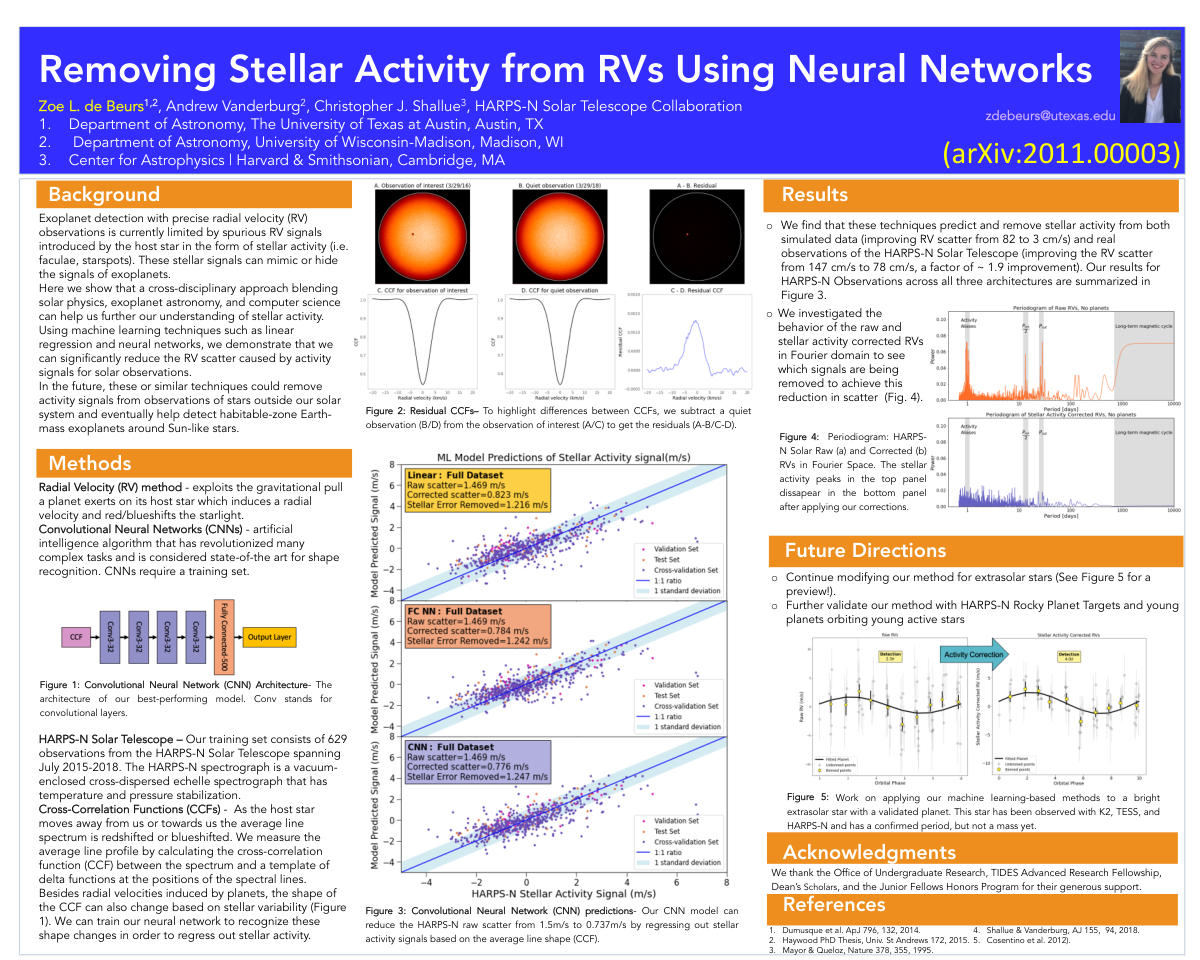
Exoplanet detection with precise radial velocity (RV) observations is currently limited by spurious RV signals introduced by the host star in the form of stellar activity (i.e. faculae, starspots). Here we show that a cross-disciplinary approach blending solar physics, exoplanet astronomy, and computer science can help us further our understanding of stellar activity signals. Using machine learning techniques such as linear regression and neural networks, we demonstrate that we can significantly reduce the activity signals (primarily starspots/faculae) from real center-of-mass RV shifts. Previous efforts have focused on carefully filtering out activity signals in time using Gaussian process regression (e.g. Haywood et al. 2014). Instead, we separate activity signals from true center-of-mass RV shifts using only changes to the average shape of spectral lines, and no information about when the observations were collected. We have trained our machine learning models on both simulated data (generated with the SOAP 2.0 software; Dumusque et al. 2014) and observations of the Sun from the HARPS-N Solar Telescope (Dumusque et al. 2015; Phillips et al 2016; Collier Cameron et al. 2019). We find that these techniques can successfully predict and remove stellar activity from approximately 700 observations taken nearly daily over three years with the HARPS-N Solar Telescope, reducing the RV scatter from 1.47 m s-1 to 0.78 m s-1 (a 47% or factor of ~ 1.9 improvement). For the simulated data, these techniques can predict the stellar activity signal nearly exactly, reducing the RV scatter from 82.0 cm s-1 to 3.1 cm s-1 which suggests that we may be able to achieve more precise velocities when applied to data from newer stabilized spectrographs like ESPRESSO. In the future, these or similar techniques could remove activity signals from observations of stars outside our solar system and eventually help detect habitable-zone Earth-mass exoplanets around Sun-like stars.
Conference Information
The 20.5th Cambridge Workshop on Cool Stars, Stellar Systems, and the Sun
Identifiers
Authors
Zoe L. de Beurs
University of Texas at Austin
ORCID: https://orcid.org/0000-0002-7564-6047
Andrew Vanderburg
University of Wisconsin–Madison
ORCID: https://orcid.org/0000-0001-7246-5438
Christopher J Shallue
Center for Astrophysics Harvard & Smithsonian