Description
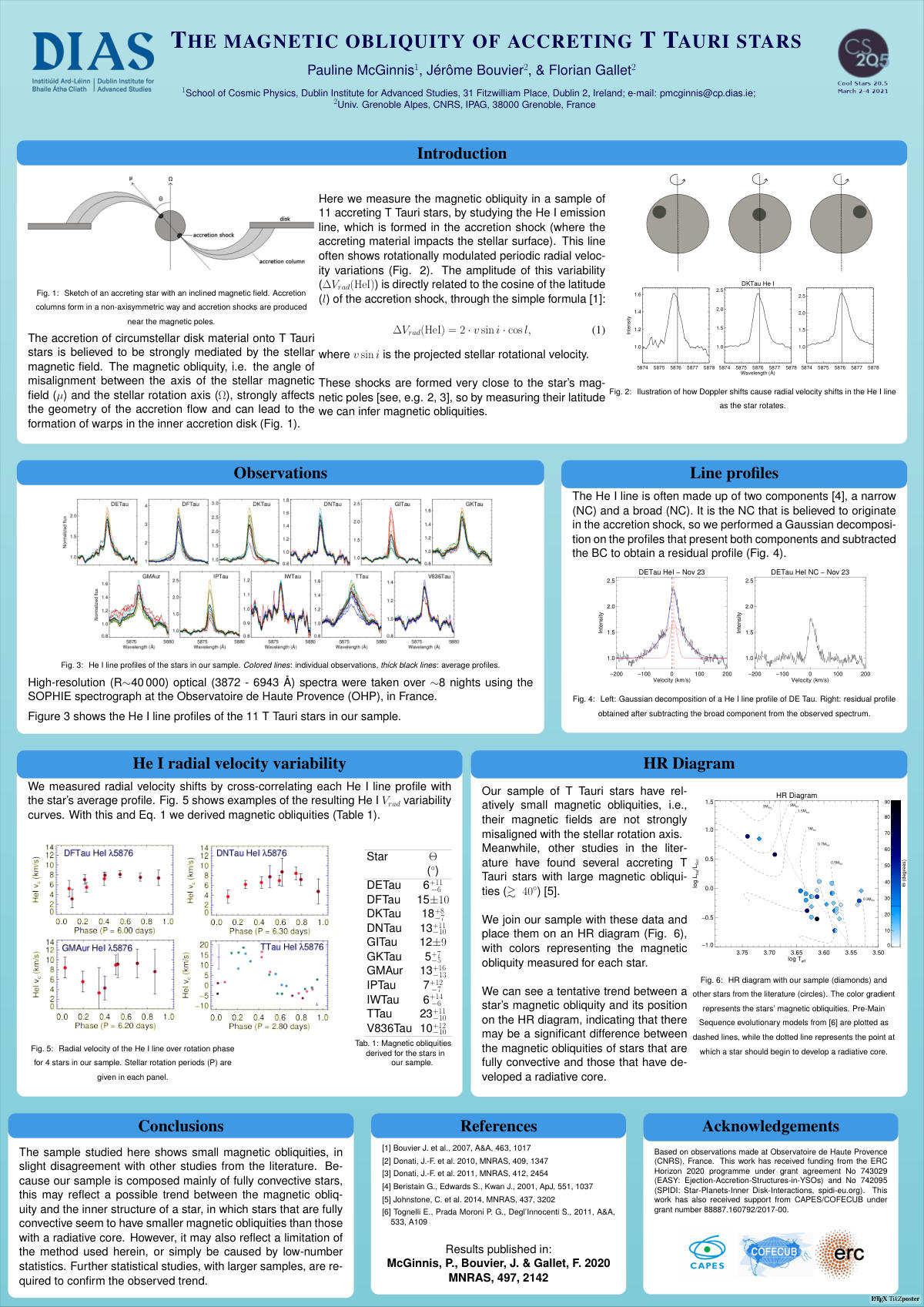
Classical T Tauri stars (CTTS) accrete material from their disk through their magnetosphere. The geometry of the accretion flow strongly depends on the magnetic obliquity, i.e., the angle between the rotational and magnetic axes. In this work, we derive the distribution of magnetic obliquities in a sample of 11 accreting T Tauri stars, by monitoring the radial velocity variations of the HeI\(\lambda 5876\)Å line in their spectra along their rotational cycle. HeI is produced in the accretion shock, close to the magnetic pole. When the magnetic and rotational axes are not aligned, the radial velocity of this line is modulated by stellar rotation, with an amplitude that is related to the star's projected rotational velocity (vsini) and the latitude of the hotspot. By deriving vsini and HeI radial velocity curves from our spectra we thus obtain an estimate of the magnetic obliquities. In our sample, we find an average obliquity of 11.4(\(\pm\)5.4)\(^{\circ}\). The magnetic axis thus seems nearly but not exactly aligned with the rotational axis in these stars, somewhat in disagreement with studies of spectropolarimetry, which have found a significant misalignment (\(\gtrsim 20^{\circ}\)) for several CTTS. This difference compared to previous studies could simply be an effect of low number statistics, or it may be due to a selection bias of our sample. From their positions on the HR diagram, we note that most of the stars in our sample should still be fully convective. We find tentative evidence that the magnetic obliquity may vary according to the stellar interior and that there may be a significant difference between fully convective and partly radiative stars.
Conference Information
The 20th (and a half) Cambridge Workshop on Cool Stars, Stellar Systems, and the Sun
Identifiers
Funding Information
Authors
Pauline McGinnis
Dublin Institute For Advanced Studies
ORCID: https://orcid.org/0000-0001-7476-7253