Description
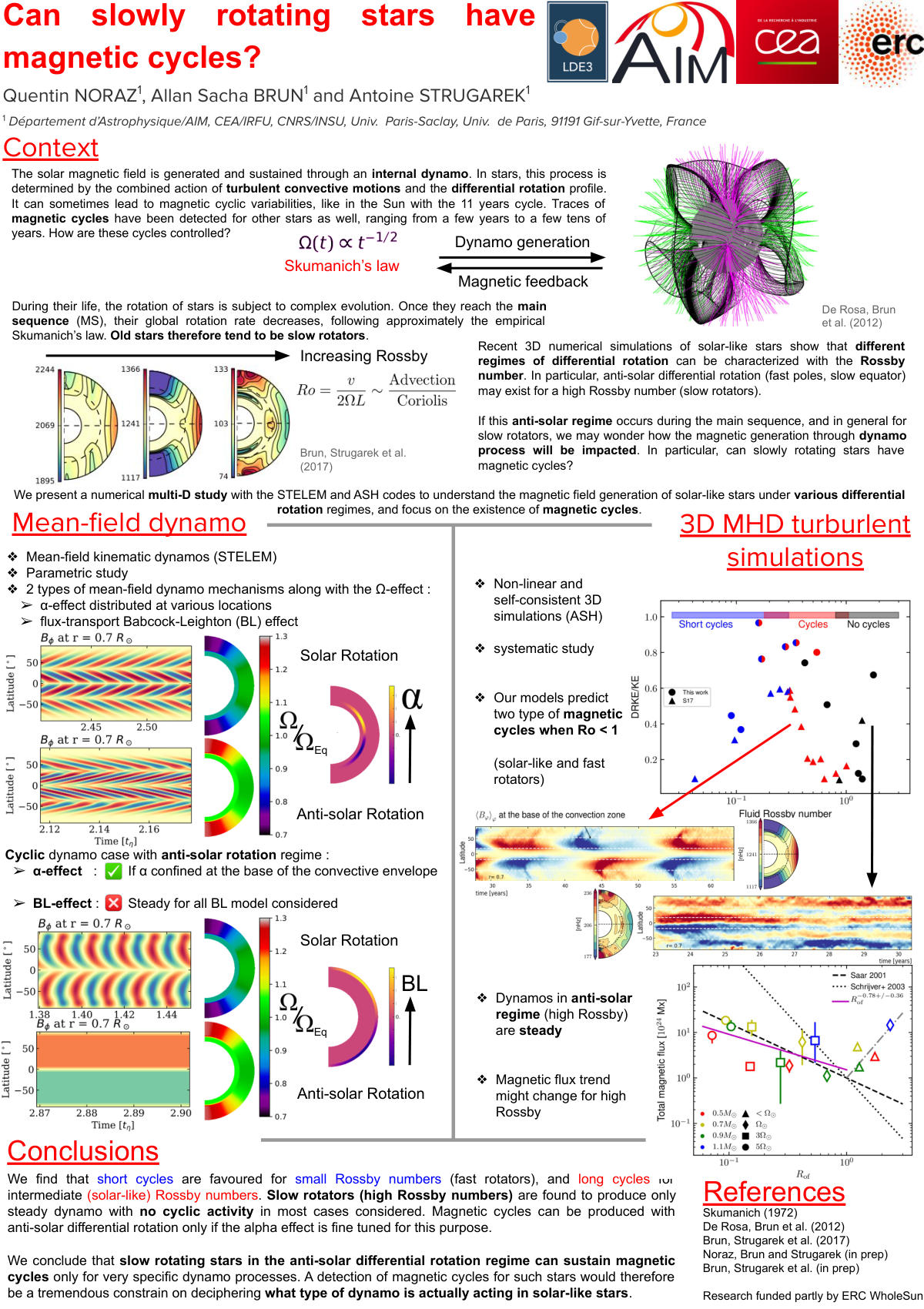
The solar magnetic field is generated and sustained through an internal dynamo. In stars, this process is determined by the combined action of turbulent convective motions and the differential rotation profile. It can sometimes lead to magnetic cyclic variabilities, like in the Sun with the 11 years cycle. Traces of magnetic cycles have been detected for other stars as well, ranging from a few years to a few tens of years. How are these cycles controlled? During their life, the rotation of stars is subject to complex evolution. Recent 3D numerical simulations of solar-like stars show that different regimes of differential rotation can be characterized with the Rossby number. In particular, anti-solar differential rotation (fast poles, slow equator) may exist for a high Rossby number (slow rotators). If this regime occurs during the main sequence, and in general for slow rotators, we may wonder how the magnetic generation through dynamo process will be impacted. In particular, can slowly rotating stars have magnetic cycles? We present a numerical multi-D study with the STELEM and ASH codes to understand the magnetic field generation of solar-like stars under various differential rotation regimes, and focus on the existence of magnetic cycles. We find that short cycles are favoured for small Rossby numbers (fast rotators), and long cycles for intermediate (solar-like) Rossby numbers. Slow rotators (high Rossby numbers) are found to produce only steady dynamo with no cyclic activity in most cases considered. Magnetic cycles can be produced with anti-solar differential rotation only if the alpha effect is fine tuned for this purpose. We conclude that slow rotating stars in the anti-solar differential rotation regime can sustain magnetic cycles only for very specific dynamo processes. A detection of magnetic cycles for such stars would therefore be a tremendous constrain on deciphering what type of dynamo is actually acting in solar-like stars.
Conference Information
WholeSun
Identifiers
Authors
Quentin Noraz
Département d'Astrophysique/AIM, CEA/IRFU, CNRS/INSU, Univ. Paris-Saclay, Univ. de Paris, 91191 Gif-sur-Yvette, France
ORCID: https://orcid.org/0000-0002-7422-1127
Allan Sacha Brun
Département d'Astrophysique/AIM, CEA/IRFU, CNRS/INSU, Univ. Paris-Saclay, Univ. de Paris, 91191 Gif-sur-Yvette, France
ORCID: https://orcid.org/0000-0002-1729-8267
Antoine Strugarek
Département d'Astrophysique/AIM, CEA/IRFU, CNRS/INSU, Univ. Paris-Saclay, Univ. de Paris, 91191 Gif-sur-Yvette, France
ORCID: https://orcid.org/0000-0002-9630-6463