Description
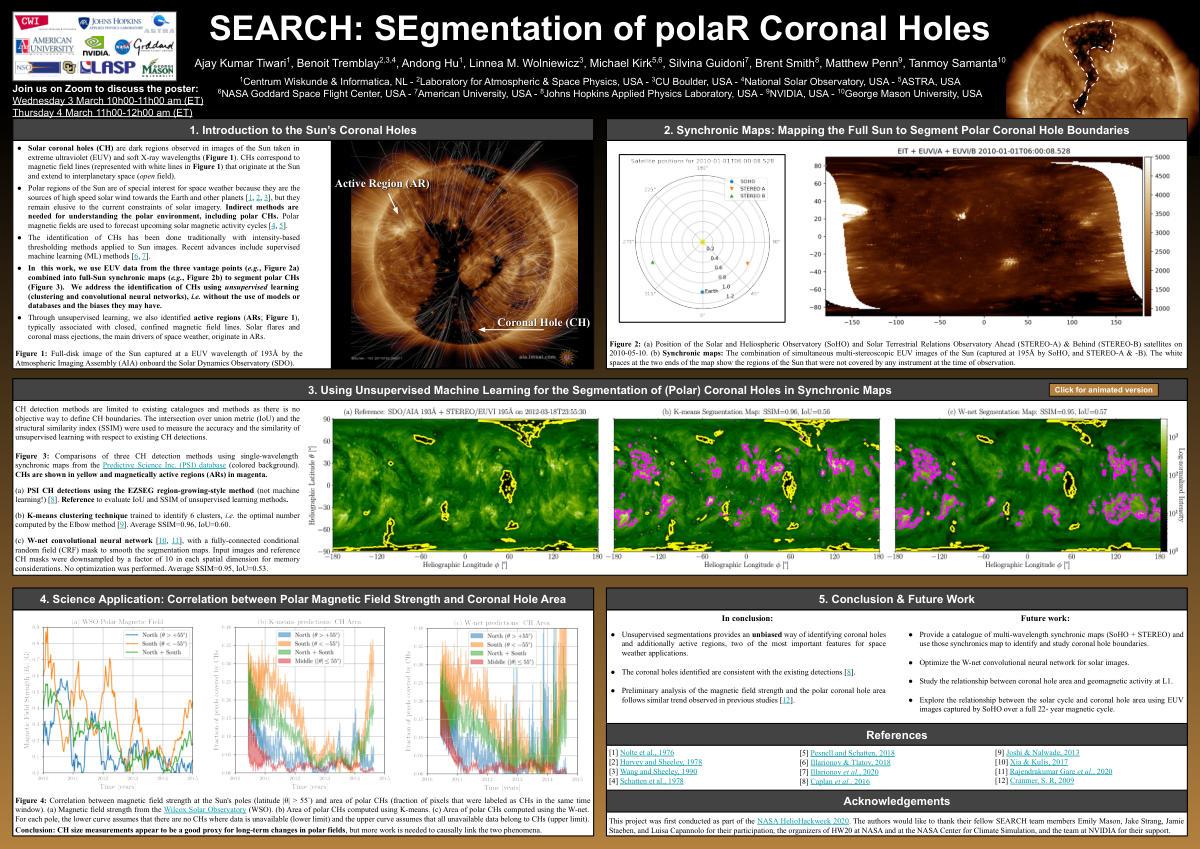
The identification of solar coronal holes (CHs) observed in Extreme Ultraviolet (EUV) intensity images of the Sun is key in improving our understanding of their association with solar magnetic fields and heliophysics. In particular, CHs at the poles of the Sun are a notorious source of fast solar wind and thus warrant further study, most notably in the context of space-weather forecasting. This has consequently led to the development of various segmentation methods for their identification, including supervised machine learning. We introduce the SEARCH project to combine EUV data from the three vantage points (e.g., STEREO-A, STEREO-B, and SoHO) during the 2010-2014 epoch to produce synchronic maps and apply unsupervised learning methods including clustering and convolutional neural networks for the segmentation of CHs. SEARCH segmentation maps provide a venue to explore the relationship between CH pole areas, geomagnetic activity, and the magnetic activity cycle (dynamo process) of the Sun and Sun-like stars. Finally, in addition to CHs, the unsupervised learning methods we tested identified features consistent with active regions.
Conference Information
Thirty-fourth Conference on Neural Information Processing Systems
Identifiers
Authors
Ajay Kumar Tiwari
Centrum Wiskunde & Informatica
Benoit Tremblay
Laboratory for Atmospheric & Space Physics, Boulder, CO, USA
Andong Hu
Centrum Wiskunde & Informatica, Amsterdam, NL
Linnea M. Wolniewicz
University of Colorado Boulder, U.S.
ORCID: https://orcid.org/0000-0002-2087-1634
Michael Kirk
ASTRA, Louisville, CO, USA
Silvina Guidoni
American University, Washington, DC, USA
Brent Smith
Johns Hopkins Applied Physics Laboratory, Laurel, MD, USA
Matthew Penn
NVIDIA, Santa Clara, CA, USA
Tanmoy Samanta
George Mason University, Fairfax, VA, USA