Description
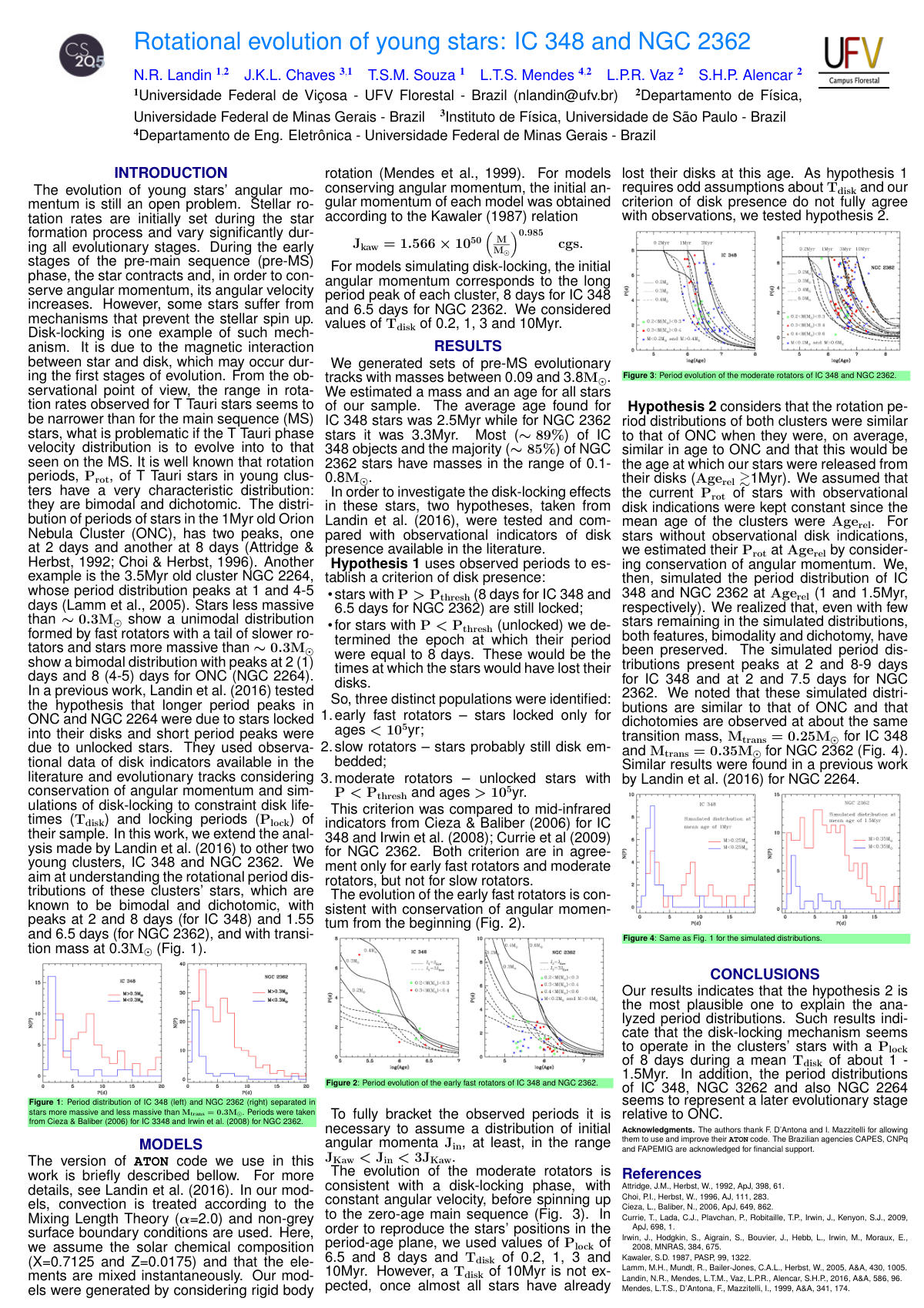
Evolution of young stars' rotation is investigated by using evolutionary tracks considering conservation of angular momentum and simulations of disk-locking. By assuming that the disk-locking mechanism prevents the expected spin up in the pre-main sequence, we used evolutionary models and observational data to constraint disk lifetimes and locking periods of low-mass stars in the young clusters IC 348 and NGC 2362. We aim at understanding the rotational period distributions of these clusters' stars, which are known to be bimodal and dichotomic. The evolution is supposed to occur conserving angular momentum for fast rotators and conserving angular velocity before spinning up to the ZAMS for moderate rotators. We generated sets of evolutionary tracks and estimated a mass and an age for all stars. We found a mean age of 2.5Myr for IC 348 and 3.3Myr for NGC 2362. Most of stellar masses were found to be in the ranges of 0.1-0.8M\({\odot}\) for both clusters. In order to investigate the disk-locking effects in these stars, two hypotheses were tested and compared with observational disk indicators available in the literature. In hypothesis 1, we considered that peaks at longer periods are formed by stars with angular velocities locked to a circumstelar disk. Hypothesis 2 considers that rotation period distributions of both clusters were similar to that of Orion Nebula Cluster (ONC) when they had, on average, the same age as ONC (\(\gtrsim\)1Myr). This scenario implies that some of stars of IC 348 and NGC 2362 were kept locked in their disks during their first million years, and, after that, they evolved conserving their angular momentum. We, then, simulated period distributions for IC 348 and NGC 2362 at about 1Myr and realized that they were similar to that of ONC. Our results favors hypothesis 2 and indicate that the disk-locking mechanism seems to operate in young stars with a locking period of 8 days during a mean disk lifetime of about 1-1.5Myr.
Identifiers
Authors
Natália Rezende Landin
Universidade Federal de Vicosa - UFV Florestal - Brazil
Jéssica Kerollayne Lemos Chaves
Instituto de Fisica, Universidade de Sao Paulo - Brazil
Thaís Suelen Marques Souza
Universidade Federal de Vicosa - UFV Florestal - Brazil
Luiz Themystokliz Sanctos Mendes
Departamento de Engenharia Eletrônica - Universidade Federal de Minas Gerais - Brazil
Luiz Paulo Ribeiro Vaz
Departamento de Física - Universidade Federal de Minas Gerais - Brazil
Silvia Helena Paixão Alencar
Departamento de Física - Universidade Federal de Minas Gerais - Brazil