Description
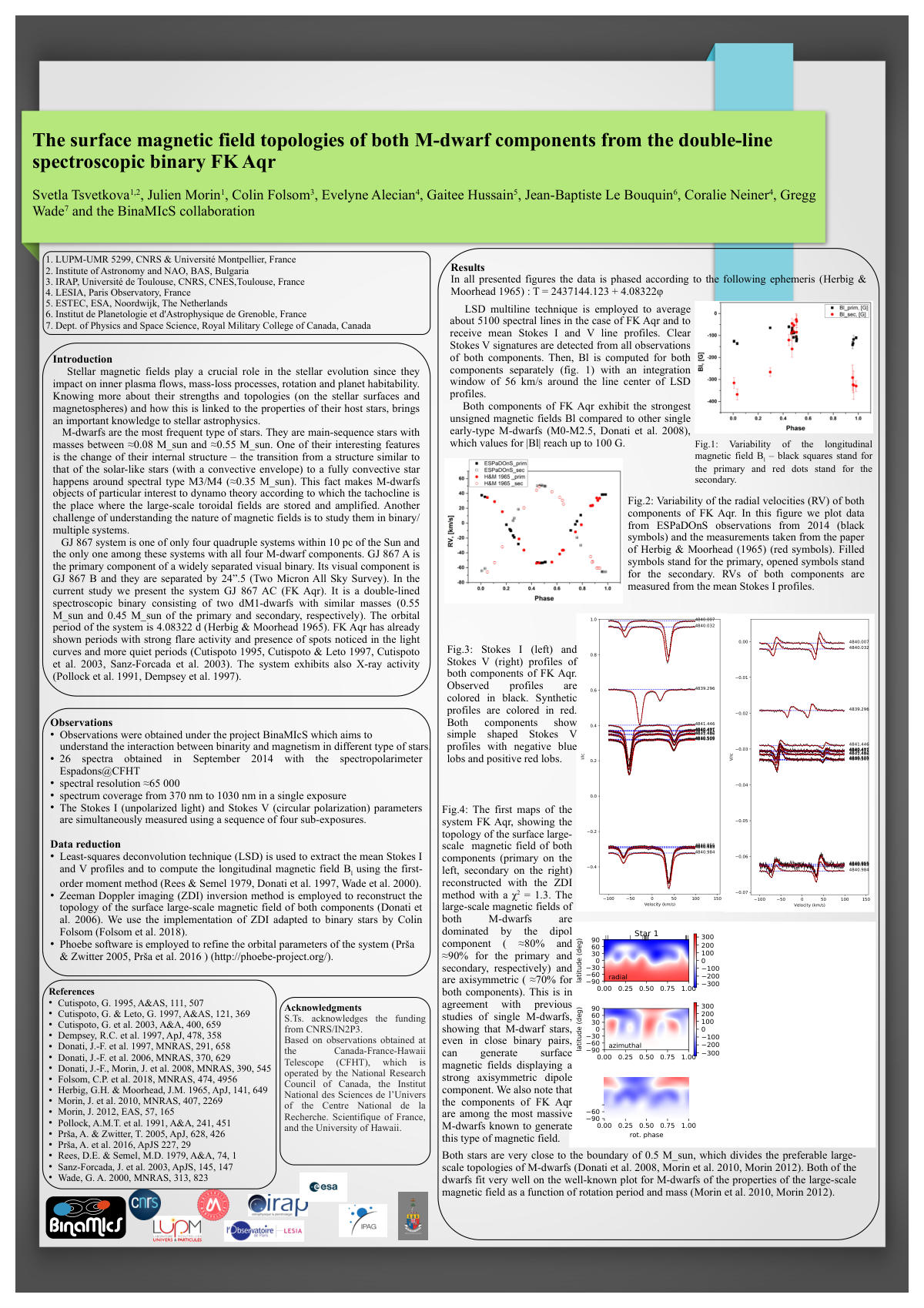
This study is part of the BinaMIcS project which aims to understand the interaction between binarity and magnetism in different type of stars. Here, we present FK Aqr (GJ 867 A) – a double-line spectroscopic binary system consisting of two dM1-dwarfs with similar masses (0.55 Msun and 0.45 Msun for the primary and secondary, respectively). We were able to reconstruct the first maps of the surface magnetic field topologies of both components by employing the Zeeman Doppler imaging method. The data were obtained with ESPaDOnS spectropolarimeter at CFHT. Clear Stokes V signatures are detected from all observations of both components. The longitudinal magnetic field of the secondary is two times stronger than the primary’s one. The reconstructed maps show that both M-dwarfs have dipolar structures of their large-scale magnetic fields. This is in agreement with previous studies showing that M-dwarf stars, even in close binary pairs, can generate surface magnetic fields displaying a strong axisymmetric dipole component. We also note that the components of FK Aqr are among the most massive M-dwarfs known to generate this type of magnetic field. Orbital parameters of the system are refined employing the PHOEBE software based on the measurements of the radial velocities of both components from the mean Stokes I profiles.
Conference Information
The 20.5th Cambridge Workshops of Cool Stars, Stellar Systems and the Sun
Identifiers
Authors
Svetla Tsvetkova
LUPM-UMR 5299, CNRS & Université Montpellier, France
Julien Morin
LUPM-UMR 5299, CNRS & Université Montpellier, France
Colin Folsom
IRAP, Université de Toulouse, CNRS, CNES,Toulouse, France
Evelyne Alecian
LESIA, Paris Observatory, France
Gaitee Hussain
ESTEC, ESA, Noordwijk, The Netherlands
Jean-Baptiste Le Bouquin
Institut de Planetologie et d'Astrophysique de Grenoble, France
Coralie Neiner
LESIA, Paris Observatory, France
Gregg Wade
Dept. of Physics and Space Science, Royal Military College of Canada, Canada
the BinaMIcS collaboration