Description
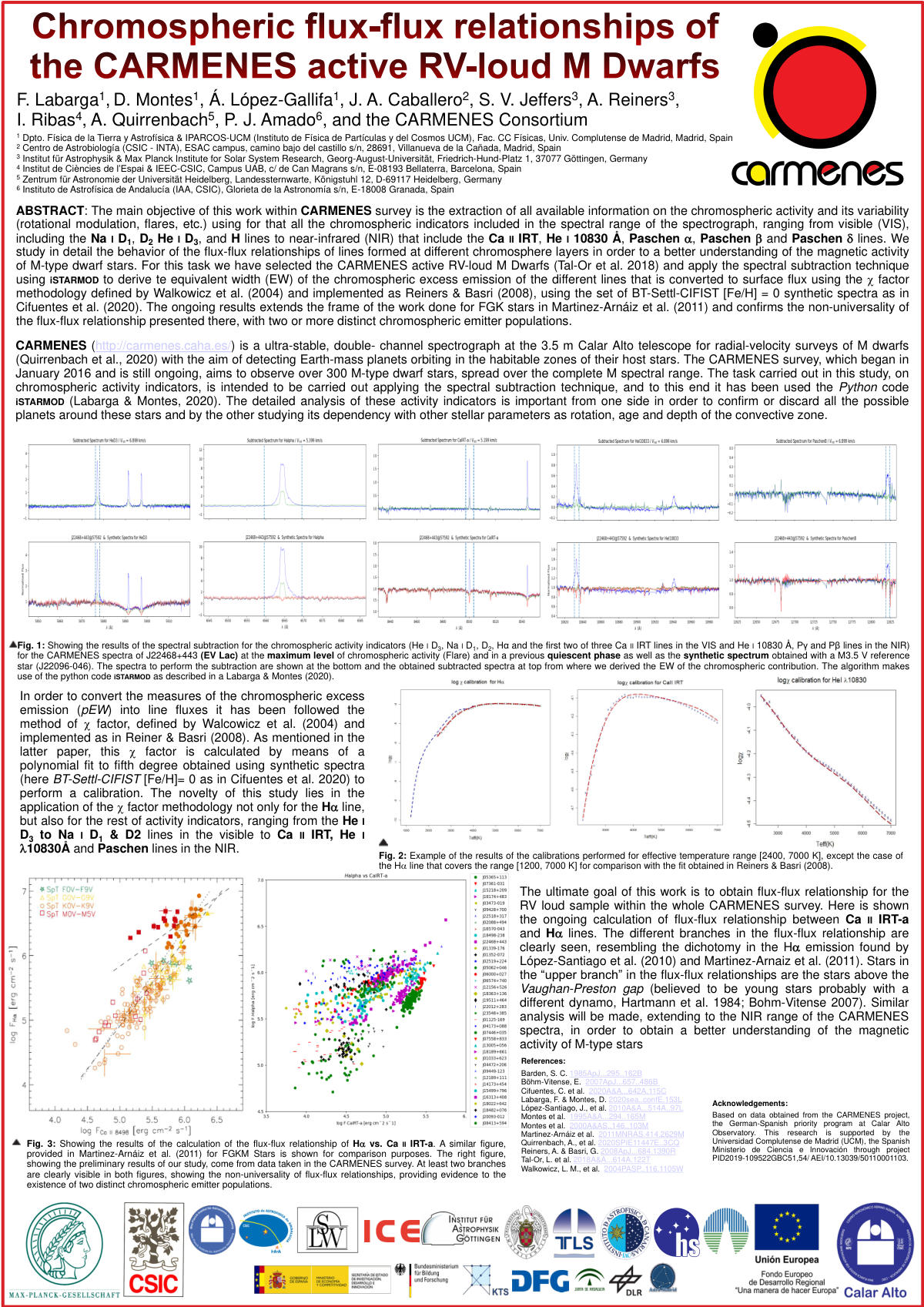
The main objective of this work within CARMENES survey is the extraction of all available information on the chromospheric activity and its variability (rotational modulation, flares, etc.) using for that all the chromospheric indicators included in the spectral range of the spectrograph, ranging from visible (VIS), including the Na I D1, D2 He I D3, and H lines to near-infrared (NIR) that include the Ca II IRT, He I 10830 Å, Paschen a, Paschen b and Paschen d lines. We study in detail the behavior of the flux-flux relationships of lines formed at different chromosphere layers in order to a better understanding of the magnetic activity of M-type dwarf stars. For this task we have selected the CARMENES active RV-loud M Dwarfs (Tal-Or et al. 2018) and apply the spectral subtraction technique using iSTARMOD to derive te equivalent width (EW) of the chromospheric excess emission of the different lines that is converted to surface flux using the c factor methodology defined by Walkowicz et al. (2004) and implemented as Reiners & Basri (2008), using the set of BT-Settl-CIFIST [Fe/H] = 0 synthetic spectra as in Cifuentes et al. (2020). The ongoing results extends the frame of the work done for FGK stars in Martinez-Arnáiz et al. (2011) and confirms the non-universality of the flux-flux relationship presented there, with two or more distinct chromospheric emitter populations.
Conference Information
The 20.5th Cambridge Workshop on Cool Stars, Stellar Systems and the Sun
Identifiers
Authors
F. Labarga
David Montes
Dpto. Física de la Tierra y Astrofísica & IPARCOS-UCM (Instituto de Física de Partículas y del Cosmos UCM), Fac. CC Físicas, Univ. Complutense de Madrid
ORCID: https://orcid.org/0000-0002-7779-238X
Alvaro Lopez-Gallifa
Dpto. Física de la Tierra y Astrofísica & IPARCOS-UCM (Instituto de Física de Partículas y del Cosmos UCM), Fac. CC Físicas, Univ. Complutense de Madrid
Jose A. Caballero
Centro de Astrobiología (CSIC-INTA)
Sandra V. Jeffers
Institut für Astrophysik, Georg-August-Universität & Max Planck Institue for Solar System Research
Ansgar Reiners
Institut für Astrophysik, Georg-August-Universität
Ignasi Ribas
Institut de Ciencies de l'Espai (CSIC-IEEC), Spain
Andreas Quirrenbach
Zentrum fur Astronomie der Universitat Heidelberg
Pedro J. Amado
Instituto de Astrofísica de Andalucía (IAA-CSIC)