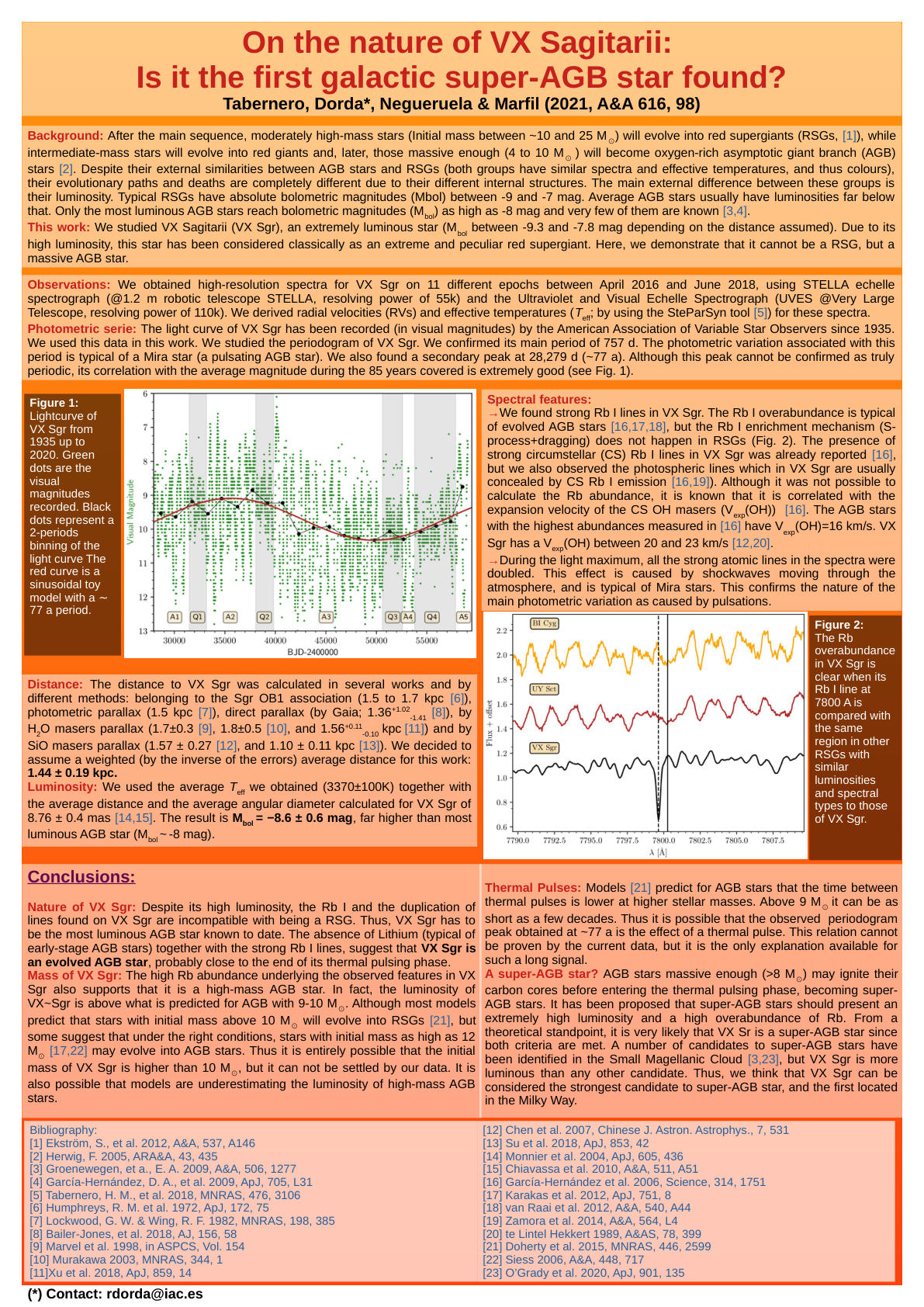
Description
Stars with initial masses above ~10 M⊙ have an internal evolution completely different from those in the range between 4 and ~10 M⊙. The former are able to ignite all the elements up to Fe in their cores without degeneration (becoming into red supergiants; RSGs). The latter are not, and they become into red giants first, and later into asymptotic branch giant (AGB) stars. Despite their internal differences, externally, both AGB stars and RSGs are evolved cool stars with similarly cool. The main difference between both groups is their luminosity, as typical RSGs have bolometric magnitudes in the range -9<Mbol< -7.8 mag and most luminous confirmed AGB stars have Mbol ~ -8 mag. However, according to theoretical predictions, AGB stars with masses above ~8 M⊙ (which can be even higher than ~10 M⊙ under the right conditions) can reach extremely high luminosities. In this context, we studied one of the most luminous (Mbol ~ -8.6 mag) galactic RSGs, VX Sgr, and we found clear proofs that it is not a RSGs. We examined the alternatives, and we found that its characteristic fit better with a AGB with unprecedentedly high mass (in the range between 10 and ~12 M⊙), making it a strong candidate (and the first identified in the Galaxy) to be a super-AGB star (an AGB star which has ignited its Carbon core). These findings are not only important for the understanding of the most massive AGB stars, because we provided one observational case, but also for the study of the most extreme RSGs, because one of them is in fact an AGB star, showing that there may be other high-mass AGB stars concealed among RSGs.
Conference Information
The 20.5th Cambridge Workshops on Cool Stars, Stellar Systems and the Sun
Identifiers
Authors
Hugo Tabernero
Instituto de Astrofisica e Ciencias do Espaco, Universidade do Porto, CAUP, Rua das Estrelas, 4150-762 Porto, Portugal
Ricardo Dorda
Departamento de Física, Ingeniería de Sistemas y Teoría de la Señal, Universidad de Alicante, Carretera de San Vicente s/n, E03690, San Vicente del Raspeig, Spain
Ignacio Negueruela
Departamento de Física Aplicada, Facultad de Ciencias, Universidad de Alicante, Carretera de San Vicente s/n, E03690, San Vicente del Raspeig, Spain
Emilio Marfil
Departamento de Física de la Tierra y Astrofísica & IPARCOS-UCM (Instituto de Física de Partículas y del Cosmos de la UCM), Facultad de Ciencias Físicas, Universidad Complutense de Madrid, E-28040 Madrid, Spain
Dorda Tabernero