Description
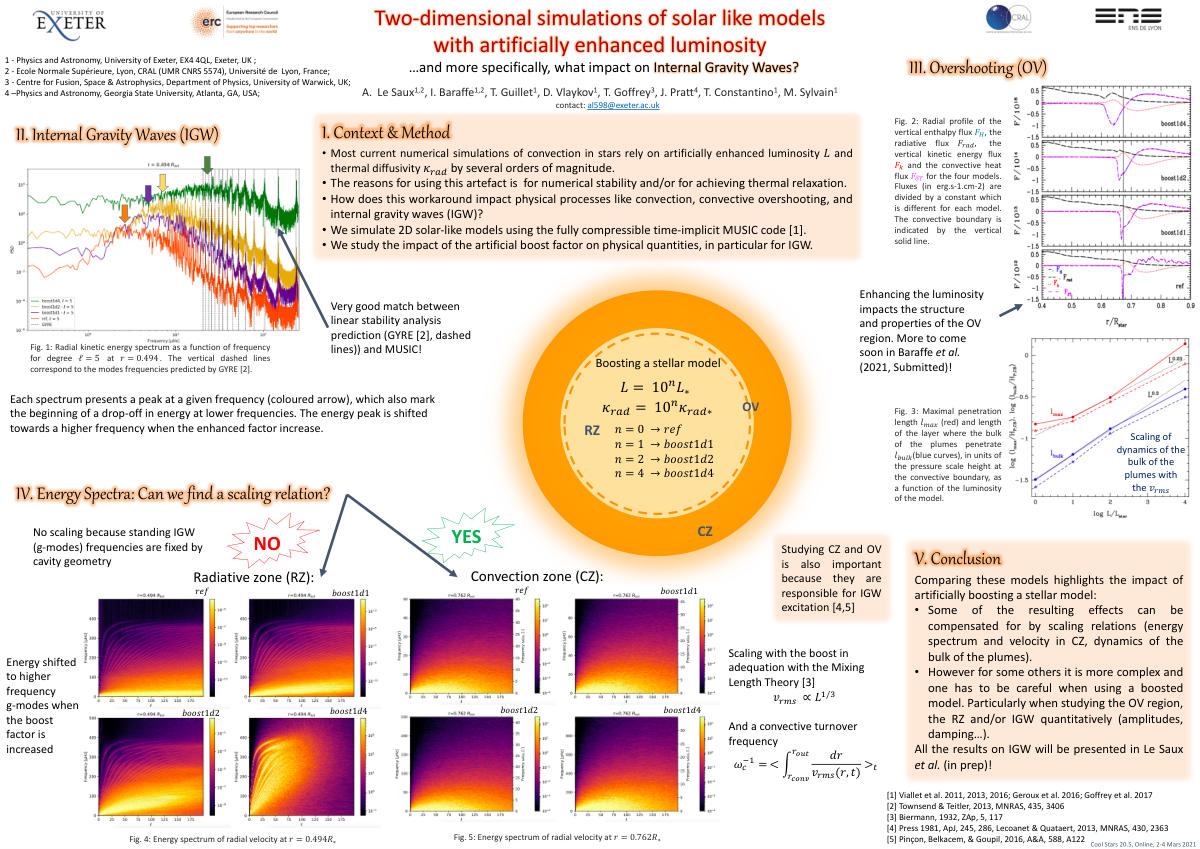
Hydrodynamical simulations are very efficient tools to study the internal structure of stars but the wide range of time and length scales that characterize it makes it difficult to model. To cope this difficulty a common practice when modelling stellar convection is to artificially increase luminosity and thermal diffusivity by several order of magnitude. The reasons for using this artefact is for numerical stability and/or for achieving thermal relaxation We perform fully compressible 2D simulations of solar-like models using the numerical time-implicit code MUSIC. This work focuses on the impact such a practice could have on physical process like convective penetration and internal gravity waves. To do so we compare solar-like models with different enhancement factors for the luminosity and thermal diffusivity.
Conference Information
The 20.5th Cambridge Workshop on Cool Stars, Stellar Systems and the Sun
Identifiers
Authors
Arthur Le Saux
University of Exeter
ORCID: https://orcid.org/0000-0002-6686-7956
Isabelle Baraffe
University of Exeter
Thomas Guillet
University of Exeter
Dimitar Vlaykov
University of Exeter
Tom Goffrey
University of Warwick
Jane Pratt
Georgia State University
Tom Constantino
University of Exeter
Mathieu Sylvain
University of Exeter