Description
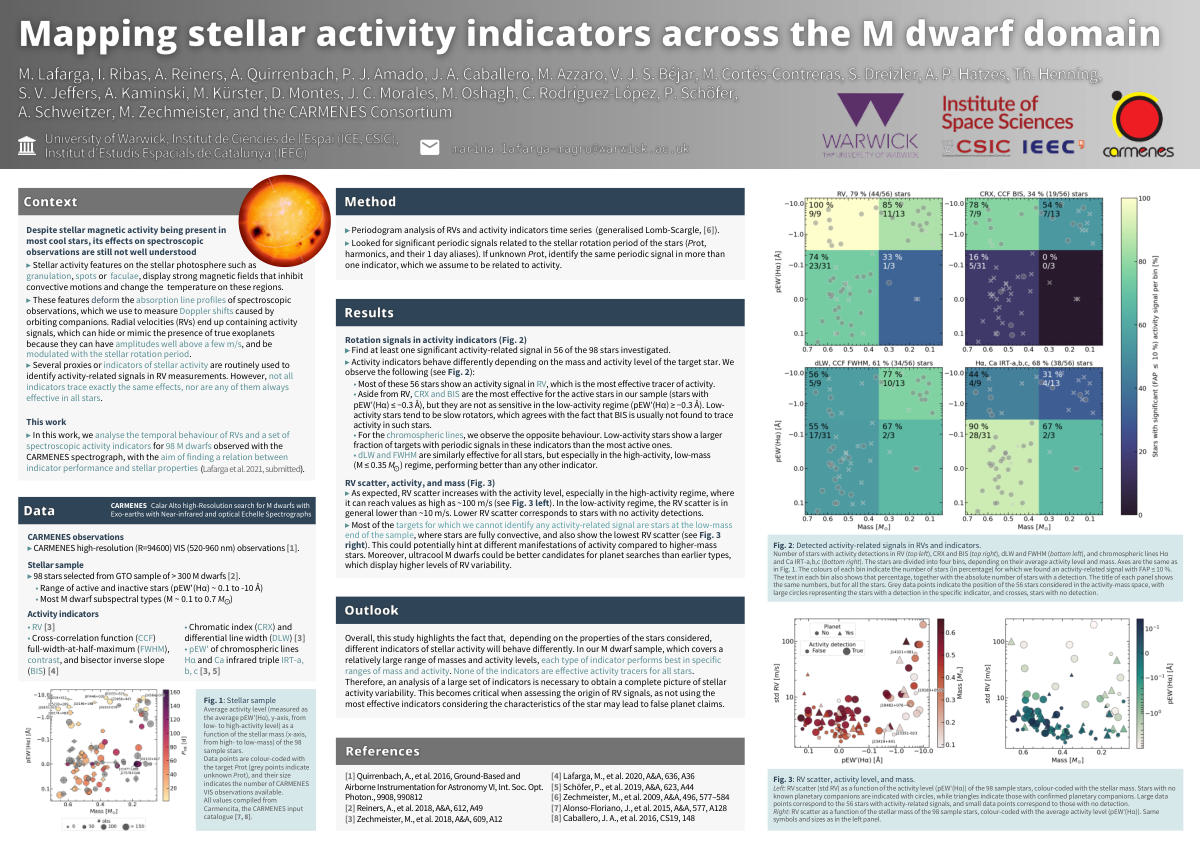
Despite stellar magnetic activity being present in most cool stars, its effects on spectroscopic observations are still not well understood. Several activity indicators are routinely used to identify activity-related signals in radial velocity (RV) measurements, but not all indicators trace exactly the same effects, nor are any of them always effective in all stars. This poses one of the main obstacles for the detection and characterisation of small exoplanets, as magnetic activity biases RV signals. In this work, we analyse the temporal behaviour of RVs and a set of spectroscopic indicators for 98 M dwarfs observed with CARMENES, with the aim of finding a relation between indicator performance and stellar properties. We find periodic signals related to activity for 56 sample stars. The activity indicators behave differently depending on the mass and activity level of the target star, e.g., cross-correlation function bisector inverse slope and chromatic index are effective activity tracers for the most active stars in the sample, especially stars with relatively high mass, while for less active stars, chromospheric lines perform best. Most of the targets for which we cannot identify any activity-related signal are stars at the low-mass end of the sample, where stars are fully convective, and also show the lowest RV scatter. This could potentially hint at different manifestations of activity compared to higher-mass stars. Moreover, ultracool M dwarfs could be better candidates for planet searches than earlier types, which display higher levels of RV variability. Our results show that none of the indicators are effective activity tracers for all stars. Therefore, an analysis of a large set of indicators seems necessary to obtain a complete picture of stellar activity variability. This becomes critical when assessing the origin of RV signals, as not using the most effective indicators considering the characteristics of the star may lead to false planet claims.
Conference Information
The 20.5th Cambridge Workshop on Cool Stars, Stellar Systems, and the Sun
Identifiers
Authors
Marina Lafarga
University of Warwick, Institut de Ciències de l'Espai (ICE, CSIC), Institut d'Estudis Espacials de Catalunya (IEEC)
ORCID: https://orcid.org/0000-0002-8815-9416
Ignasi Ribas
Institut de Ciències de l'Espai (ICE, CSIC), Institut d'Estudis Espacials de Catalunya (IEEC)
Ansgar Reiners
nstitut für Astrophysik, Georg-August-Universität
Andreas Quirrenbach
Landessternwarte, Zentrum für Astronomie der Universität Heidelberg
Pedro J. Amado
Instituto de Astrofísica de Andalucía (IAA-CSIC)
Jose A. Caballero
Centro de Astrobiología (CSIC-INTA)
Marco Azzaro
Centro Astronónomico Hispano Alemán
Víctor J. S. Béjar
Instituto de Astrofísica de Canarias, Departamento de Astrofísica, Universidad de La Laguna
Miriam Cortés-Contreras
Centro de Astrobiología (CSIC-INTA)
Stefan Dreizler
Institut für Astrophysik, Georg-August-Universität
Artie P. Hatzes
Thüringer Landesstenwarte Tautenburg
Thomas Henning
Max-Planck-Institut für Astronomie
Sandra V. Jeffers
Max-Planck-Institut für Sonnensystemforschung
A. Kaminski
Landessternwarte, Zentrum für Astronomie der Universität Heidelberg
Martin Kürster
Max-Planck-Institut für Astronomie
David Montes
Departamento de Física de la Tierra y Astrofísica & IPARCOS-UCM (Instituto de Física de Partículas y del Cosmos de la UCM), Facultad de Ciencias Físicas, Universidad Complutense de Madrid, E-28040 Madrid, Spain
Juan Carlos Morales
Institut de Ciències de l'Espai (ICE, CSIC), Institut d'Estudis Espacials de Catalunya (IEEC)
Mahmoud Oshagh
Instituto de Astrofísica de Canarias, Departamento de Astrofísica, Universidad de La Laguna
Cristina Rodríguez-López
Instituto de Astrofísica de Andalucía (IAA-CSIC)
Patrick Schöfer
Institut für Astrophysik, Georg-August-Universität
Andreas Schweitzer
Hamburger Sternwarte
Mathias Zechmeister
Institut für Astrophysik, Georg-August-Universität