Description
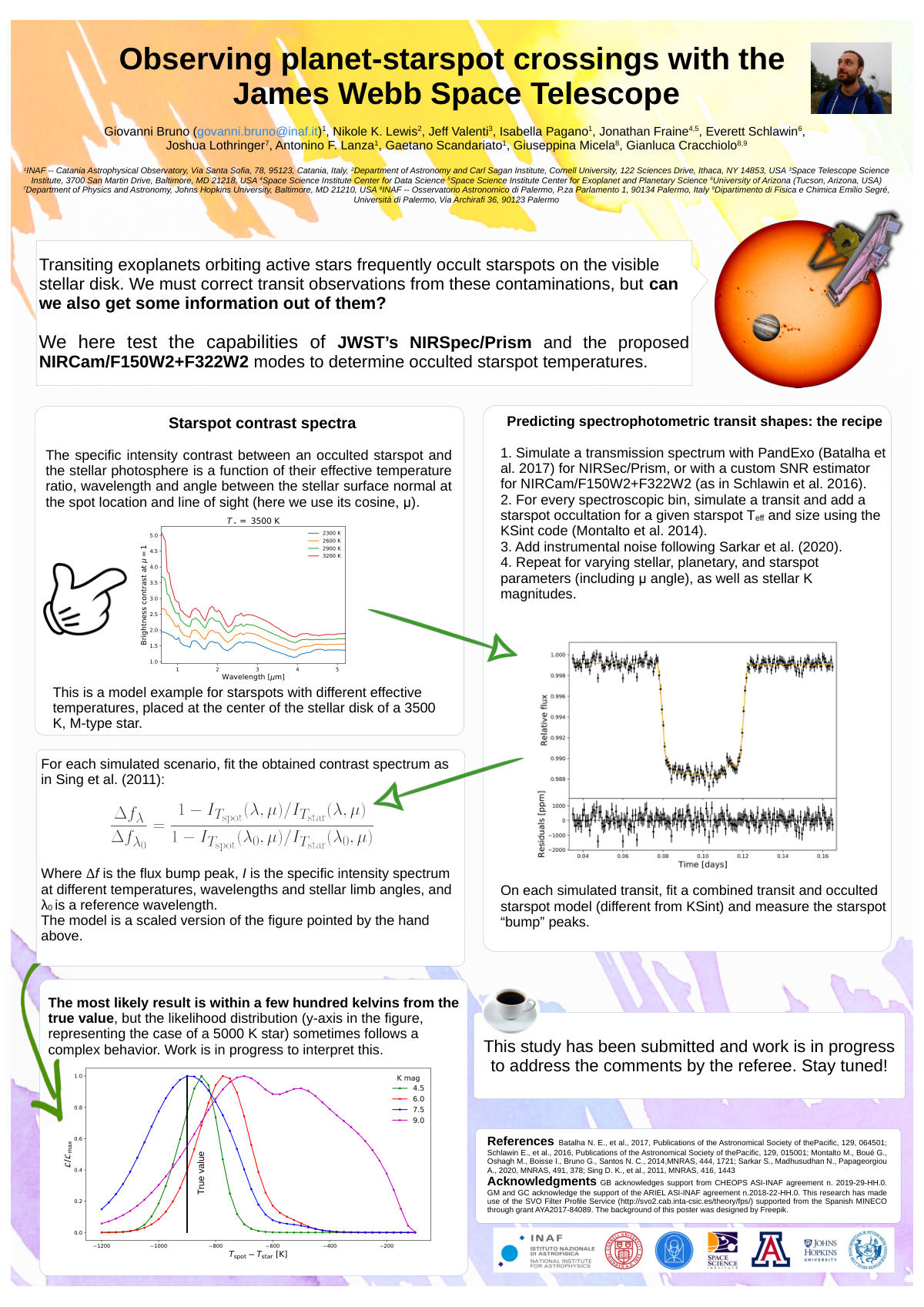
Transiting exoplanets orbiting active stars frequently occult starspots and faculae on the visible stellar disc. Such occultations can provide useful constraints to retrieve the temperature of active features and their effect on transmission spectra. We analyse the constraints that the James Webb Space Telescope will be able to place on the spectra of starspots, despite its lack of optical wavelength instruments on board. Focusing on K and M spectral types, we find that starspot temperatures can be determined to within a few hundred kelvins using NIRSpec/Prism and the proposed NIRCam/F150W2+F322W2’s broad wavelength capabilities.
Conference Information
The 20.5th Cambridge Workshop on Cool Stars, Stellar Systems, and the Sun
Identifiers
Authors
Giovanni Bruno
INAF - Catania Astrophysical Observatory
Nikole K. Lewis
Department of Astronomy and Carl Sagan Institute, Cornell University
Jeff Valenti
Space Telescope Science Institute
Isabella Pagano
INAF - Catania Astrophysical Observatory
Jonathan Fraine
Space Science Institute Center for Data Science, Space Science Institute Center for Exoplanet and Planetary Science
Everett Schlawin
University of Arizona
Joshua Lothringer
Department of Physics and Astronomy, Johns Hopkins University
Antonino F. Lanza
INAF - Catania Astrophysical Observatory
Gaetano Scandariato
INAF - Catania Astrophysical Observatory
Giuseppina Micela
INAF - Osservatorio Astronomico di Palermo
Gianluca Cracchiolo
INAF - Osservatorio Astronomico di Palermo, Dipartimento di Fisica e Chimica Emilio Segré, Università di Palermo