Description
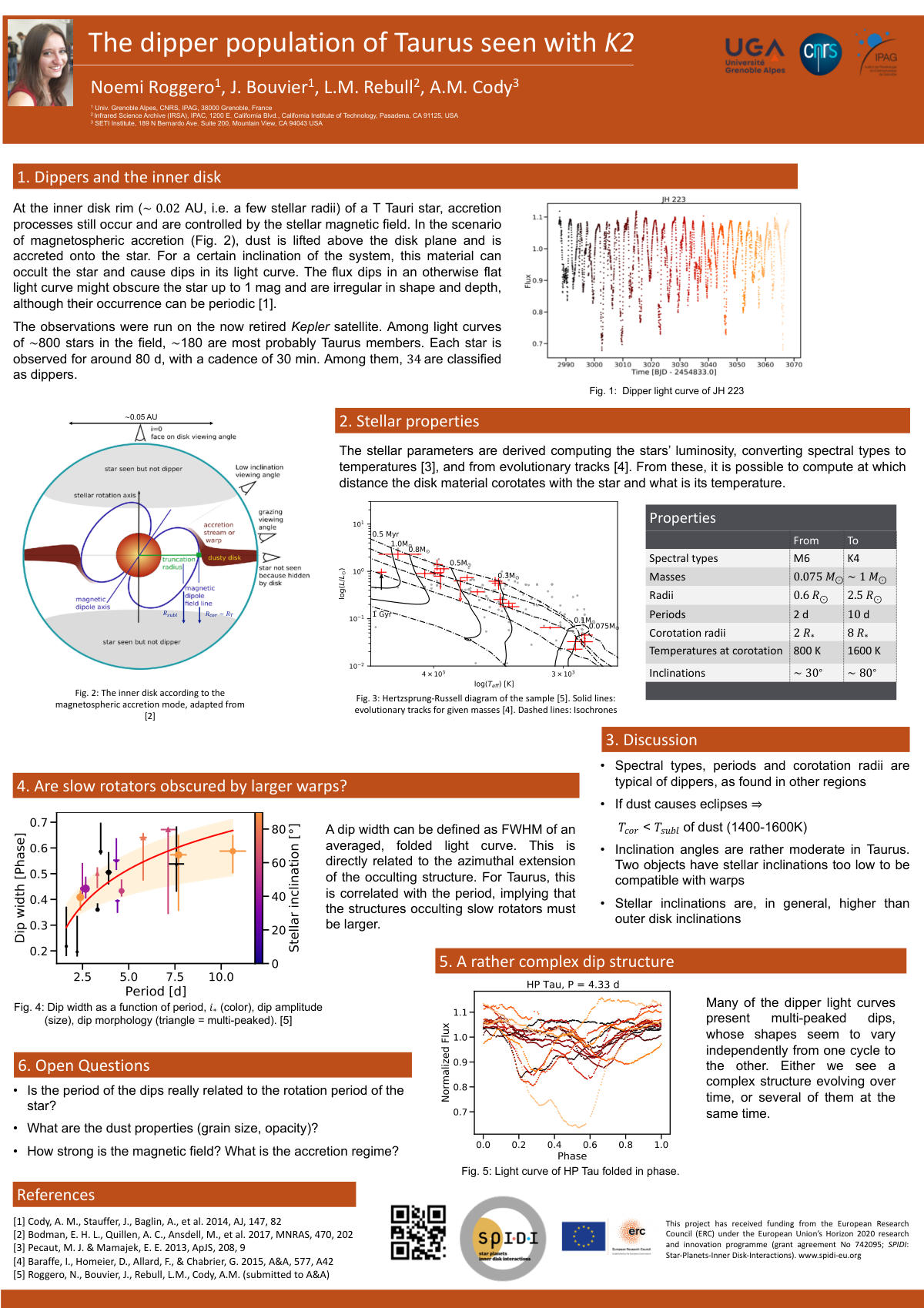
During the evolution of T Tauri stars and the formation of their planetary systems, accretion processes play a key role. However, the more complex interaction at the rim of the inner region of the disk is still not well understood. Some young stars exhibit recurrent, quite irregular flux dips in their photometry (dippers). These can be explained as extinction events by dusty material from the protoplanetary disk, which is accreted onto the star. In the magnetospheric accretion scenario, the magnetic field of a young star truncates the disk where the magnetic field pressure is equal to the ram pressure of the accreting material. If the temperature close to this distance is low enough to avoid dust sublimation, dust might be lifted above the disk plane and obscure the star. The dataset for this study consists of K2 light curves of the Taurus region, that was observed continuously for $\sim$80 days. The periodicity of the eclipses delivers hints about a stable or unstable accretion regime. The stars classified as dippers have spectral types K4-M6, consistent with studies in other regions, and the mass range goes down to the brown dwarf limit. The co-rotation radii can be derived to a few stellar radii, with temperatures at co-rotation < 1600 K, that indicates that in most cases dust could survive at co-rotation. The range of derived inclinations suggests that, for some dippers, other phenomena than magnetospheric accretion might cause eclipses. We find that the angular extension of the dusty structure producing the dips correlates with the stellar period.
Conference Information
Cambridge Workshops of Cool Stars, Stellar Systems and the Sun
Identifiers
Funding Information
European Commission
Star-Planet-Inner Disk Interactions (SPIDI): unveiling the formation and evolution of inner planetary systems
Grant: 742095
Award detailsAuthors
Noemi Roggero
Univ. Grenoble Alpes, CNRS, IPAG, 38000 Grenoble, France
ORCID: https://orcid.org/0000-0003-4370-086X
J. Bouvier
Univ. Grenoble Alpes, CNRS, IPAG, 38000 Grenoble, France
L.M. Rebull
Infrared Science Archive (IRSA), IPAC, 1200 E. California Blvd., California Institute of Technology, Pasadena, CA 91125, USA
A.M. Cody
SETI Institute, 189 N Bernardo Ave. Suite 200, Mountain View, CA 94043 USA