Description
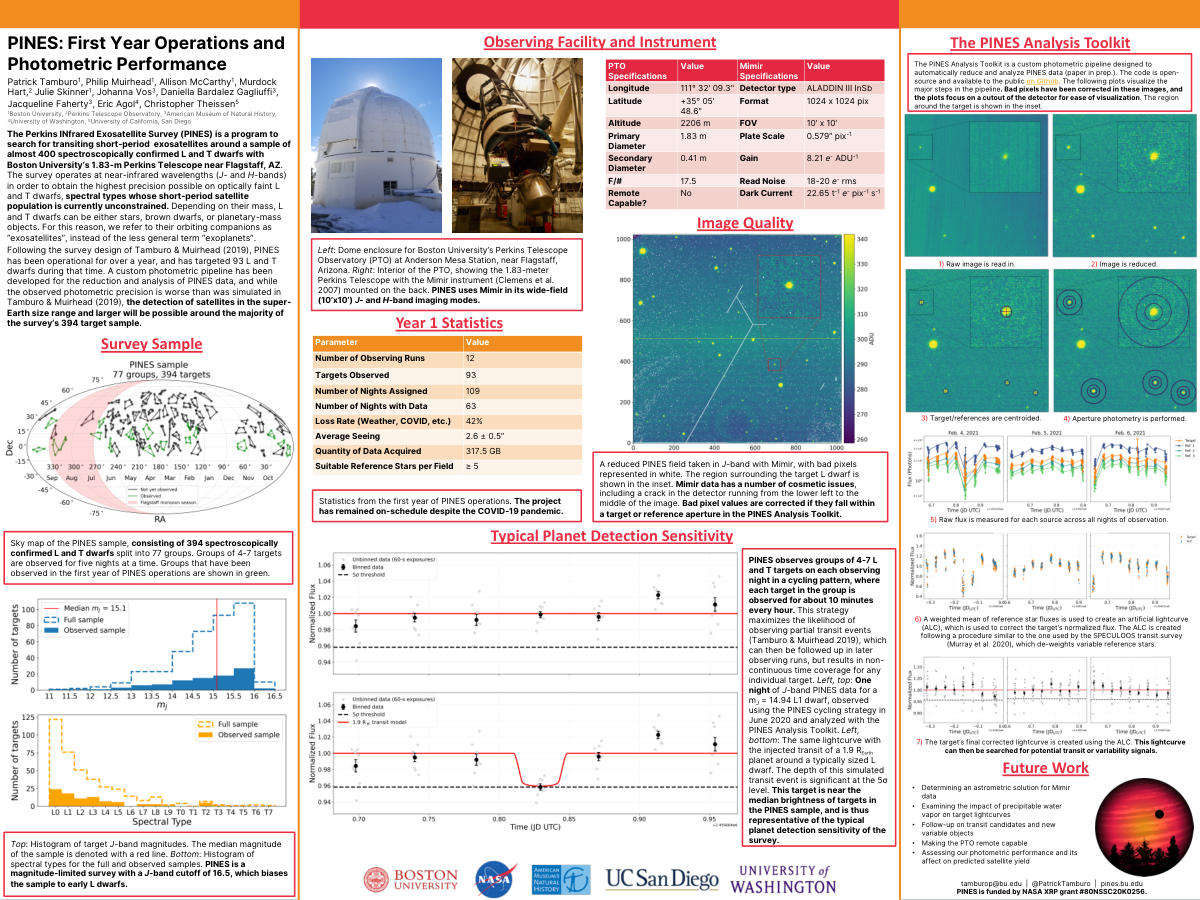
The Perkins INfrared Exosatellite Survey (PINES) is a search for transiting satellites (planets or moons) around a sample of almost 400 spectroscopically confirmed L- and T-type dwarfs. The survey is conducted with the 1.8-m Perkins telescope located in Anderson Mesa, Arizona, and utilizes near-infrared observations to enable the highest photometric precision possible on intrinsically faint L and T dwarfs. This is the most ambitious photometric monitoring campaign of L and T dwarfs to date, and a detailed simulation suggests that a handful of transiting companions will be detected over the course of the three-year survey. The survey will probe an unexplored region of exoplanet parameter space, and will potentially provide excellent targets for future atmospheric characterization. An overview of PINES is provided, focusing on the survey's target sample, telescope facility, and observational strategy. The first year of PINES observations is detailed, along with the custom photometric pipeline that we have built to generate lightcurves from raw PINES data. Finally, example lightcurves are shown, and typical planet detection sensitivity is estimated.
Conference Information
The 20.5th Cambridge Workshop on Cool Stars, Stellar Systems, and the Sun
Identifiers
Authors
Patrick Tamburo
Boston University
ORCID: https://orcid.org/0000-0003-2171-5083
Philip S. Muirhead
Boston University
ORCID: https://orcid.org/0000-0002-0638-8822
Allison McCarthy
Boston University
ORCID: https://orcid.org/0000-0003-2015-5029
Murdock Hart
Perkins Telescope Observatory
ORCID: https://orcid.org/0000-0002-0330-1648
Julie Skinner
Boston University
ORCID: https://orcid.org/0000-0002-4794-1591
Johanna Vos
American Museum of Natural History
ORCID: https://orcid.org/0000-0003-0489-1528
Daniella Bardalez Gagliuffi
American Museum of Natural History
ORCID: https://orcid.org/0000-0001-8170-7072
Jacqueline Faherty
American Museum of Natural History
ORCID: https://orcid.org/0000-0001-6251-0573
Eric Agol
University of Washington
ORCID: https://orcid.org/0000-0002-0802-9145
Christopher Theissen
University of California San Diego
ORCID: https://orcid.org/0000-0002-9807-5435