Magne&c Braking of Accre&ng T Tauri Stars: Effects of Mass Accre&on Rate, Rota&on, and Dipolar Field Strength
Description
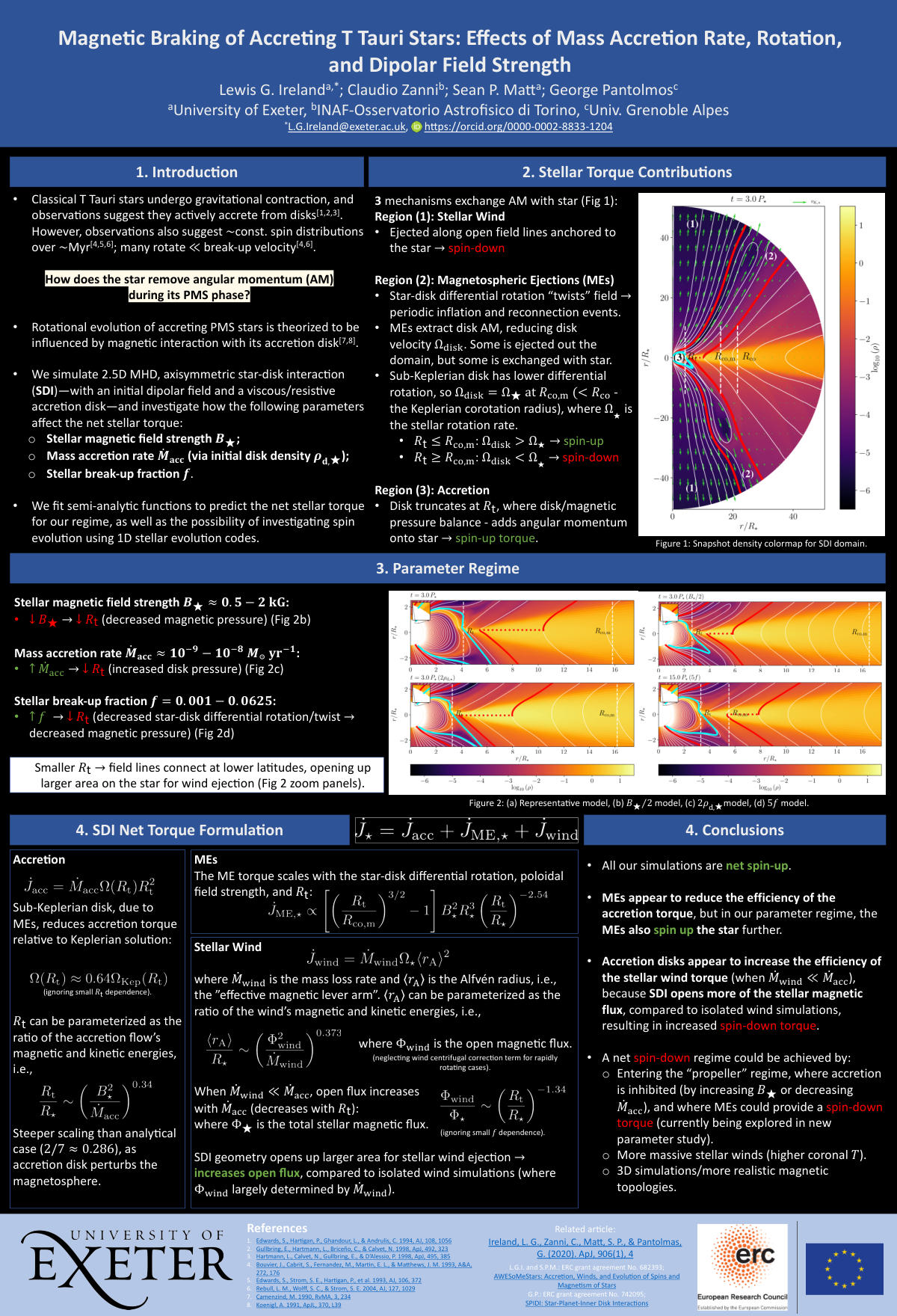
The rotational evolution of an accreting pre-main-sequence star is influenced by its magnetic interaction with its surrounding circumstellar disk. Using the PLUTO code, we perform 2.5D magnetohydrodynamic, axisymmetric, time-dependent simulations of star–disk interaction—with an initial dipolar magnetic field structure, and a viscous and resistive accretion disk—in order to model the three mechanisms that contribute to the net stellar torque: accretion flow, stellar wind, and magnetospheric ejections (periodic inflation and reconnection events). We investigate how changes in the stellar magnetic field strength, rotation rate, and mass accretion rate (changing the initial disk density) affect the net stellar torque. All simulations are in a net spin-up regime. We fit semi-analytic functions for the three stellar torque contributions, allowing for the prediction of the net stellar torque for our parameter regime, as well as the possibility of investigating spin evolution using 1D stellar evolution codes. The presence of an accretion disk appears to increase the efficiency of stellar torques compared to isolated stars, for cases with outflow rates much smaller than accretion rates, because the star–disk interaction opens more of the stellar magnetic flux compared to that from isolated stars. In our parameter regime, a stellar wind with a mass-loss rate of ≈1% of the mass accretion rate is capable of extracting <=50% of the accreting angular momentum. These simulations suggest that achieving spin equilibrium in a representative T Tauri case within our parameter regime, e.g., BP Tau, would require a wind mass-loss rate of ≈25% of the mass accretion rate.
Conference Information
The 20.5th Cambridge Workshop on Cool Stars, Stellar Systems, and the Sun
Identifiers
Funding Information
European Commission
Accretion, Winds, and Evolution of Spins and Magnetism of Stars
Grant: 682393
Award detailsAuthors
Lewis G. Ireland
University of Exeter
ORCID: https://orcid.org/0000-0002-8833-1204
Claudio Zanni
INAF - Osservatorio Astrofisico di Torino
ORCID: https://orcid.org/0000-0003-0204-8190
Sean P. Matt
University of Exeter
ORCID: https://orcid.org/0000-0001-9590-2274
George Pantolmos
Université Grenoble Alpes
ORCID: https://orcid.org/0000-0001-7788-3727
Sean P. Ma7