Description
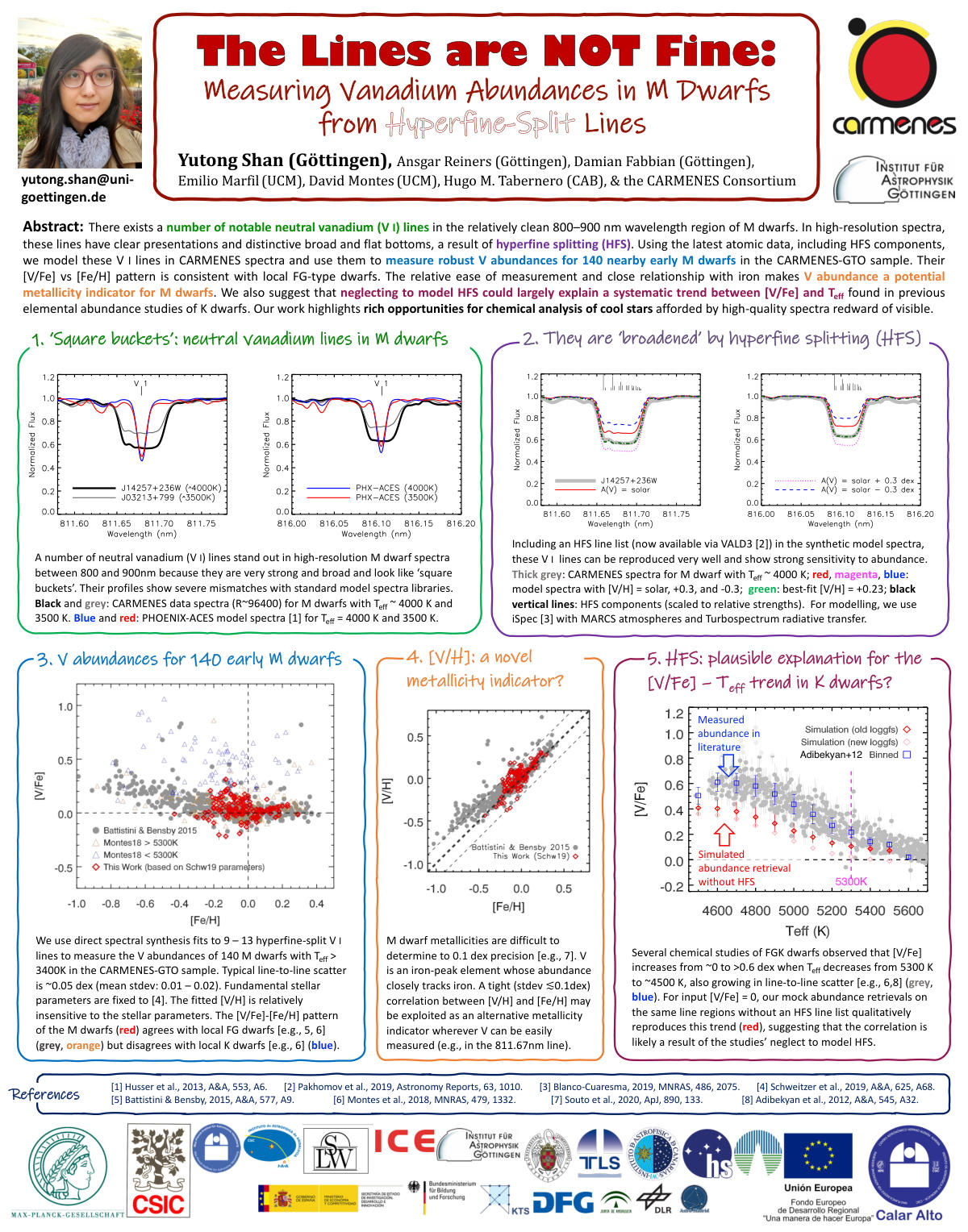
Cool star atmospheres present challenges to chemical abundance studies. To date, only a handful of elements have been quantified for a handful of M dwarfs. In high-resolution spectra from the CARMENES survey, we identify a series of dramatically hyperfine-split vanadium features between 800 and 910 nm, which have strong and clean profiles throughout the early M-dwarf range. These ‘bucket-shaped’ line regions can be well-modeled with standard model atmospheres combined with the latest atomic data from VALD. From these line regions, we measure vanadium abundances for 140 nearby early M dwarfs in the CARMENES GTO sample and confirm that they follow the same trend with metallicity as the FG-type stars in the solar neighborhood, i.e., significantly above predictions from galactic chemical evolution models. Exhibiting a tight correlation with iron, vanadium abundances show promise as a potential metallicity indicator for M dwarfs. We also present evidence that several well-known chemical studies of K dwarfs have systematically overestimated their vanadium abundances largely as a result of neglecting to model hyperfine structure, a bias that worsens with decreasing temperature. Our work highlights opportunities for robust chemical analysis of cool stars afforded by high-quality spectra redward of visible.
Conference Information
The 20.5th Cambridge Workshop on Cool Stars, Stellar Systems, and the Sun
Identifiers
Authors
Yutong Shan
Georg-August-Universität Göttingen
Ansgar Reiners
Georg-August-Universität Göttingen
Damian Fabbian
Georg-August-Universität Göttingen
Emilio Marfil
Universidad Complutense de Madrid
David Montes
Universidad Complutense de Madrid
Hugo M Tabernero
Centro de Astrobiología
Ignasi Ribas
Institut de Ciencias de l'Espai
Jose A. Caballero
Centro de Astrobiología
Andreas Quirrenbach
Universität Heidelberg
Pedro J. Amado
Instituto de Astrofísica de Andalucía
J. Aceituno
Centro Astronomico Hispano-Aleman
Victor J. S. Bejar
Instituto de Astrofísica de Canarias
Miriam Cortes-Contreras
Centro de Astrobiología
Stefan Dreizler
Georg-August-Universität Göttingen
Artie P. Hatzes
Thüringer Landessternwarte Tautenburg
Thomas Henning
Max-Planck-Institut für Astronomie
Sandra V. Jeffers
Max Planck Institute for Solar System Research
Adrian Kaminski
Universität Heidelberg
Martin Kürster
Max-Planck-Institut für Astronomie
Marina Lafarga
Institut de Ciencias de l'Espai
Juan Carlos Morales
Institut de Ciencias de l'Espai
Evangelos Nagel
Hamburg Sternwarte
Cristina Rodriguez-Lopez
Insituto de Astrofisica de Andalucia
Vera M. Passegger
Hamburg Sternwarte
Andreas Schweitzer
Hamburg Sternwarte
Mathias Zechmeister
Georg-August-Universität Göttingen
CARMENES Consortium