Rotation-Activity Relation of Ca II and Mg I Infrared Emission Lines of Young Stars
Description
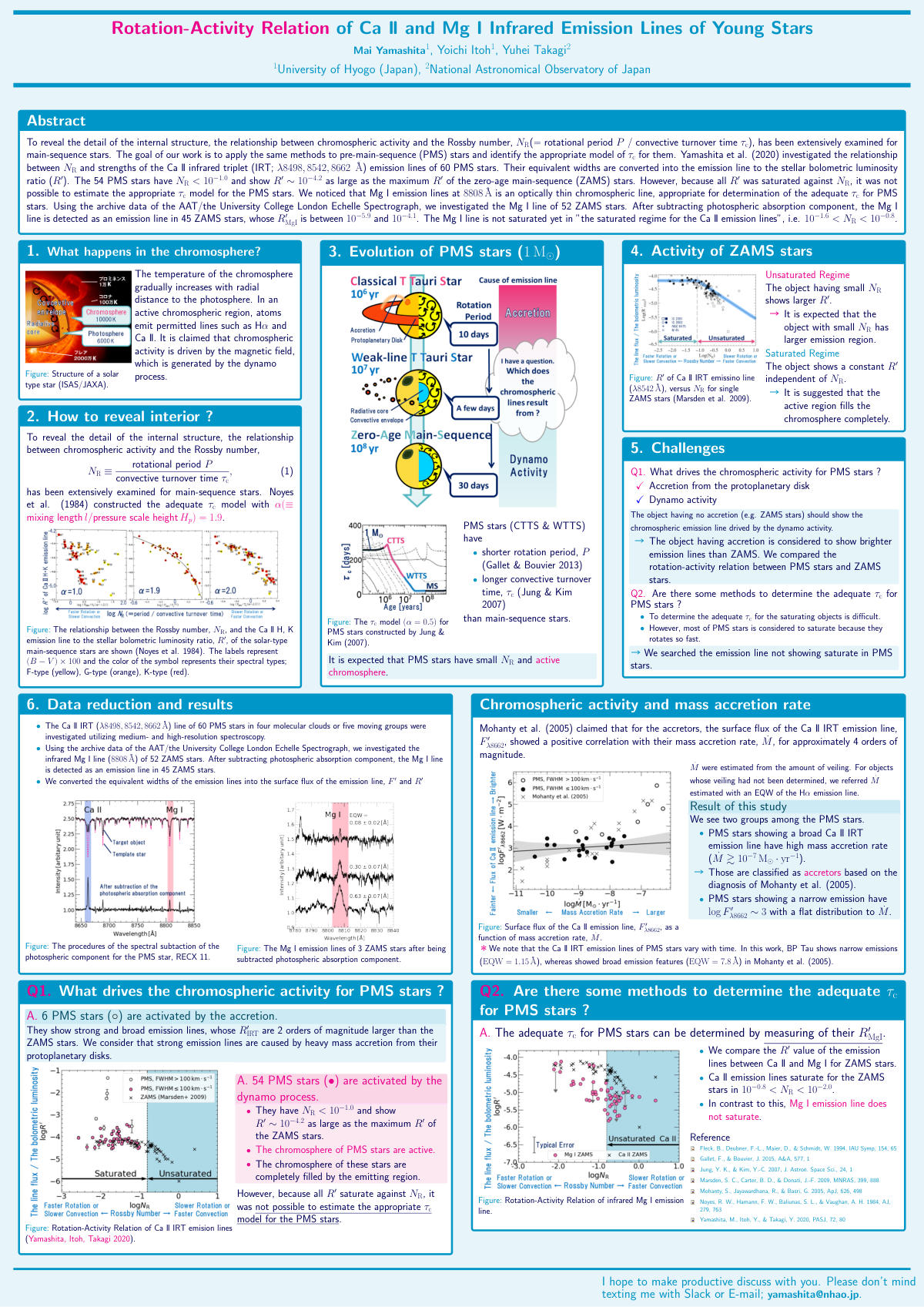
To reveal the detail of the internal structure, the relationship between chromospheric activity and the Rossby number, $N_{\rm R}$(= rotational period $P$ / convective turnover time $\tau_{\rm c}$), has been extensively examined for main-sequence stars. The goal of our work is to apply the same methods to pre-main-sequence (PMS) stars and identify the appropriate model of $\tau_{\rm c}$ for them. Yamashita et al. (2020) investigated the relationship between $N_{\rm R}$ and strengths of the Ca I\hspace{-.1em}I infrared triplet ($\lambda 8498, 8542, 8662 $ $\, \mathrm{\angstrom}$) emission lines of 60 PMS stars. Their equivalent widths are converted into the emission line to the stellar bolometric luminosity ratio ($R^{\prime}$). The 54 PMS stars have $N_{\rm R} < 10^{-1.0}$ and show $R^{\prime} \sim 10^{-4.2}$ as large as the maximum $R^{\prime}$ of the zero-age main-sequence (ZAMS) stars. However, because all $R^{\prime}$ was saturated against $N_{\rm R}$, it was not possible to estimate the appropriate $\tau_{\rm c}$ model for the PMS stars. We noticed that Mg I emission lines at $8807.8 \, \mathrm{\angstrom}$ is an optically thin chromospheric line, appropriate for determination of the adequate $\tau_{\rm c}$ for PMS stars. Using the archive data of the AAT/the University College London Echelle Spectrograph, we investigated the Mg I line of 52 ZAMS stars. After subtracting photospheric absorption component, the Mg I line is detected as an emission line in 45 ZAMS stars, whose $R^{\prime}_{\rm Mg I}$ is between $10^{-5.9}$ and $10^{-4.1}$. The Mg I line is not saturated yet in "the saturated regime for the Ca I\hspace{-.1em}I emission lines", i.e. $10^{-1.6} < N_{\rm R} < 10^{-0.8}$. Therefore, the adequate $\tau_{\rm c}$ for PMS stars can be determined by measuring of their $R^{\prime}_{\rm Mg I}$ values.
Conference Information
The 20.5th Cambridge Workshops on Cool Stars, Stellar Systems, and the Sun
Identifiers
Authors
Mai Yamashita
University of Hyogo
Yoichi Itoh
University of Hyogo
Yuhei Takagi
National Astronomical Observatory of Japan