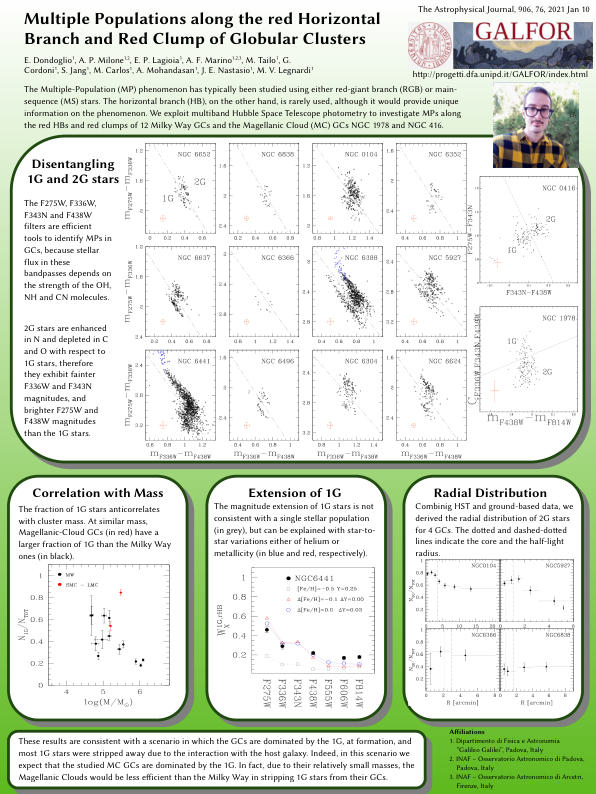
Description
We exploit multiband Hubble Space Telescope photometry to investigate multiple populations (MPs) along the red horizontal branches (HBs) and red clumps of 14 metal-rich globular clusters (GCs), including 12 Milky Way GCs and the Magellanic Cloud GCs NGC 1978 and NGC 416. Based on appropriate two-color diagrams, we find that the fraction of first-generation (1G) stars in Galactic GCs correlates with cluster mass, confirming previous results based on red-giant branch (RGB) stars. Magellanic Cloud GCs show higher fractions of 1G stars than Galactic GCs with similar masses, thus suggesting that the environment affects the MP phenomenon. We compared and combined our population fractions based on the HB with previous estimates from the MS and RGB, and we used ground-based UBVI photometry (available for NGC 104, NGC 5927, NGC 6366, and NGC 6838) to extend the investigation over a wide field of view. All studied GCs are consistent with flat distributions of 1G and second- generation (2G) stars within ∼1′ from the cluster center except NGC 416, where the 2G is more centrally concentrated. 2G stars of NGC 104 and NGC 5927 are more centrally concentrated than the 1G stars, whereas the distribution is flat for NGC 6366 and NGC 6838. We discover that most of the analyzed GCs exhibit extended sequences of 1G stars along the red HB, not consistent with a simple population. The comparison between appropriate synthetic and observed CMDs reveals that these extended distributions are consistent with either star- to-star variation in helium or with an internal metallicity spread, recalling the inhomogeneity of 1G stars along the chromosome maps.
Conference Information
The 20.5th Cambridge Workshop on Cool Stars, Stellar Systems, and the Sun (CS20.5)
Identifiers
Authors
Emanuele Dondoglio
Dipartimento di Fisica e Astronomia "Galileo Galilei," Università di Padova, Italy
ORCID: https://orcid.org/0000-0001-8415-8531
Antonino Paolo Milone
Dipartimento di Fisica e Astronomia "Galileo Galilei," Università di Padova, Italy
ORCID: https://orcid.org/0000-0001-7506-930X
Edoardo Prospero Lagioia
Dipartimento di Fisica e Astronomia "Galileo Galilei," Università di Padova, Italy
ORCID: https://orcid.org/0000-0003-1713-0082
Anna Fabiola Marino
INAF - Osservatorio Astrofisico di Arcetri, Firenze, Italy
ORCID: https://orcid.org/0000-0002-1276-5487
Marco Tailo
Dipartimento di Fisica e Astronomia "Galileo Galilei," Università di Padova, Italy
ORCID: https://orcid.org/0000-0002-1128-098X
Giacomo Cordoni
Dipartimento di Fisica e Astronomia "Galileo Galilei," Università di Padova, Italy
ORCID: https://orcid.org/0000-0002-7690-7683
Sohee Jang
Dipartimento di Fisica e Astronomia "Galileo Galilei," Università di Padova, Italy
ORCID: https://orcid.org/0000-0002-1562-7557
Marilla Carlos
Dipartimento di Fisica e Astronomia "Galileo Galilei," Università di Padova, Italy
ORCID: https://orcid.org/0000-0003-1757-6666
Maria Vittoria Legnardi
Dipartimento di Fisica e Astronomia "Galileo Galilei," Università di Padova, Italy
Anjana Mohandasan
Dipartimento di Fisica e Astronomia "Galileo Galilei," Università di Padova, Italy
J. E. Nastasio
Dipartimento di Fisica e Astronomia 'Galileo Galilei', Padova, Italy