Time-resolved spectroscopy and photometry of an M dwarf flare star YZ Canis Minoris with OISTER and TESS: Blue asymmetry in Hα line during the non-white light flare
Description
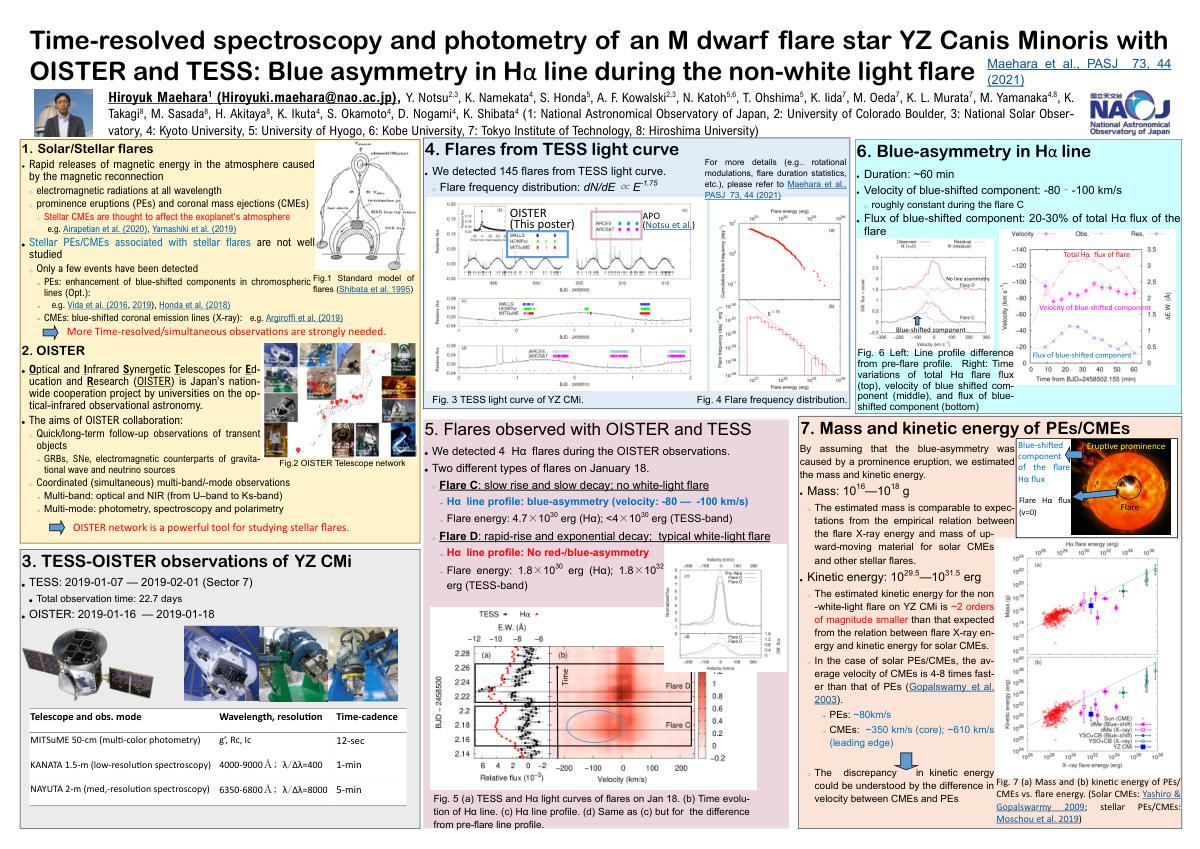
Flares are thought to be the rapid releases of magnetic energy through magnetic reconnection in the corona. Blue asymmetries (enhancement of the blue wing) in chromospheric lines have been widely observed during flares on M dwarfs. They are thought to be caused by the upward motions of cool plasma (e.g., chromospheric evaporations, filament/prominence eruptions). As observed on the Sun, stellar filament/prominence eruptions can evolve into stellar CMEs (coronal mass ejections). Here we report the results from spectroscopic and photometric observations of the M-type flare star YZ CMi in the framework of the Optical and Infrared Synergetic Telescopes for Education and Research (OISTER) collaborations during the Transiting Exoplanet Survey Satellite (TESS) observation period. We detected 145 white-light flares from the TESS light curve and 4 H\(\alpha\) flares from the OISTER observations performed between 2019-01-16 and 2019-01-18. Among them, 3 H\(\alpha\) flares were associated with white-light flares. However, one of them did not show clear brightening in continuum; during this flare, the H\(\alpha\) line exhibited blue-asymmetry which has lasted for \(\sim 60\) min. The line of sight velocity of the blue-shifted component is \(-80\) - \(-100\) km s-1. By assuming that the blue-asymmetry in H\(\alpha\) line was caused by a prominence eruption on YZ CMi, we estimated the mass and kinetic energy of the upward-moving material to be \(10^{16}\) - \(10^{18}\) g and \(10^{29.5}\) - \(10^{31.5}\) erg, respectively. Although, the estimated mass is comparable to expectations from the empirical relation between the flare X-ray energy and mass of upward-moving material for solar CMEs, the estimated kinetic energy for the non-white-light flare on YZ CMi is roughly 2 orders of magnitude smaller than that expected from the relation between flare X-ray energy and kinetic energy for solar CMEs. This could be understood by the difference in the velocity between CMEs and prominence eruptions.
Conference Information
The 20.5th Cambridge Workshops of Cool Stars, Stellar Systems and the Sun
Identifiers
Authors
Hiroyuki Maehara
National Astronomical Observatory
ORCID: https://orcid.org/0000-0003-0332-0811
Yuta Notsu
University of Colorado Boulder
ORCID: https://orcid.org/0000-0002-0412-0849
Kousuke Namekata
Kyoto University
ORCID: https://orcid.org/0000-0002-1297-9485
Satoshi Honda
University of Hyogo
Adam F. Kowalski
University of Colorado Boulder
Noriyuki Katoh
Kobe University
Tomohito Ohshima
University of Hyogo
Kota Iida
Tokyo Institute of Technology
Motoki Oeda
Tokyo Institute of Technology
Katsuhiro L. Murata
Tokyo Institute of Technology
Masayuki Yamanaka
Kyoto University
ORCID: https://orcid.org/0000-0001-9456-3709
Kengo Takagi
Hiroshima University
Mahito Sasada
Hiroshima University
ORCID: https://orcid.org/0000-0001-5946-9960
Hiroshi Akitaya
Hiroshima University
Kai Ikuta
Kyoto University
Soshi Okamoto
Kyoto University
Daisaku Nogami
Kyoto University
Kazunari Shibata
Kyoto University