Description
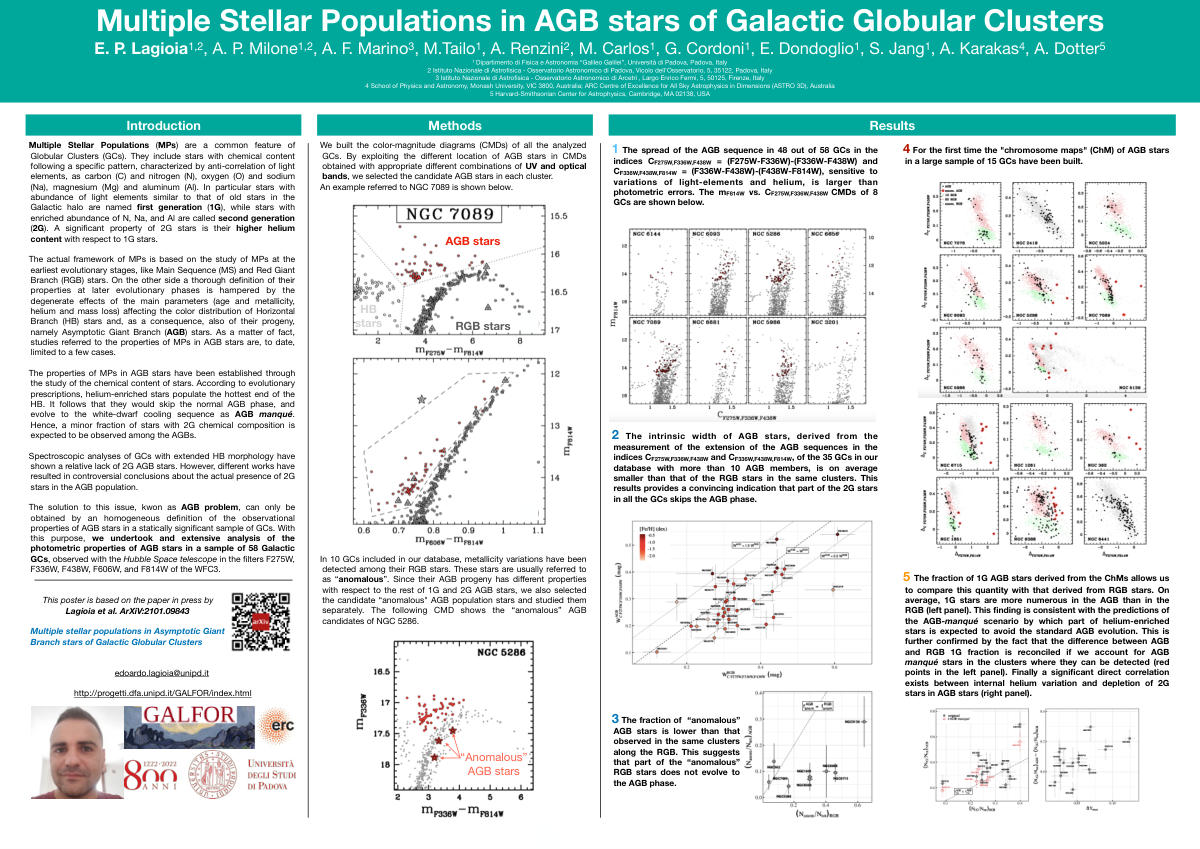
Multiple stellar populations (MPs) are a common feature of Globular Clusters (GCs). Their general properties have been widely studied among main-sequence, red giant branch (RGB) and horizontal branch (HB) stars, but a common framework is still missing at later evolutionary stages. We studied the MP phenomenon along the asymptotic giant branch (AGB) sequences in 58 GCs, observed with the Hubble Space Telescope in UV and optical bands. Using UV-optical color-magnitude diagrams, we selected the AGB members of each cluster and identified the AGB candidates. We studied the photometric properties of the AGB stars and found that: 1) the spread of AGB stars in photometric indices sensitive to chemical variations of light-elements and helium is typically larger than that expected from photometric errors; 2) the fraction of metal-enhanced ("anomalous") stars in the AGB is on average lower than in the RGB ; 3) the fraction of 1G stars derived from the chromosome map of AGB stars in 15 GCs is larger than that in RGB stars; 4) the AGB/HB frequency correlates with the average mass of the most helium-enriched population. These findings represent a clear evidence of the presence of MPs along the AGB of Galactic GCs and indicate that a significant fraction of helium-enriched stars do not evolve to the AGB phase, leaving the HB sequence toward higher effective temperatures, as predicted by the AGB manqué scenario.
Identifiers
Funding Information
European Commission
The formation of the Galaxy: constraints from globular clusters
Grant: 716082
Award detailsAuthors
E. P. Lagioia
University of Padova, Padova, Italy
ORCID: https://orcid.org/0000-0003-1713-0082
A. P. Milone
University of Padova, Padova, Italy
ORCID: https://orcid.org/0000-0001-7506-930X
A. F. Marino
Osservatorio di Arcetri, Firenze - Italy
ORCID: https://orcid.org/0000-0002-1276-5487
M. Tailo
University of Padova, Padova, Italy
ORCID: https://orcid.org/0000-0002-1128-098X
A. Renzini
Osservatorio di Padova - Italy
ORCID: https://orcid.org/0000-0002-7093-7355
M. Carlos
University of Padova, Padova, Italy
ORCID: https://orcid.org/0000-0003-1757-6666
G. Cordoni
University of Padova, Padova, Italy
ORCID: https://orcid.org/0000-0002-7690-7683
E. Dondoglio
University of Padova, Padova, Italy
ORCID: https://orcid.org/0000-0001-8415-8531
S. Jang
University of Padova, Padova, Italy
ORCID: https://orcid.org/0000-0002-1562-7557
A. Karakas
Monash University, Clayton, -Australia
ORCID: https://orcid.org/0000-0002-3625-6951
A. Dotter
Harvad-Smithsonian Institute, Washington - USA
ORCID: https://orcid.org/0000-0002-4442-5700