Description
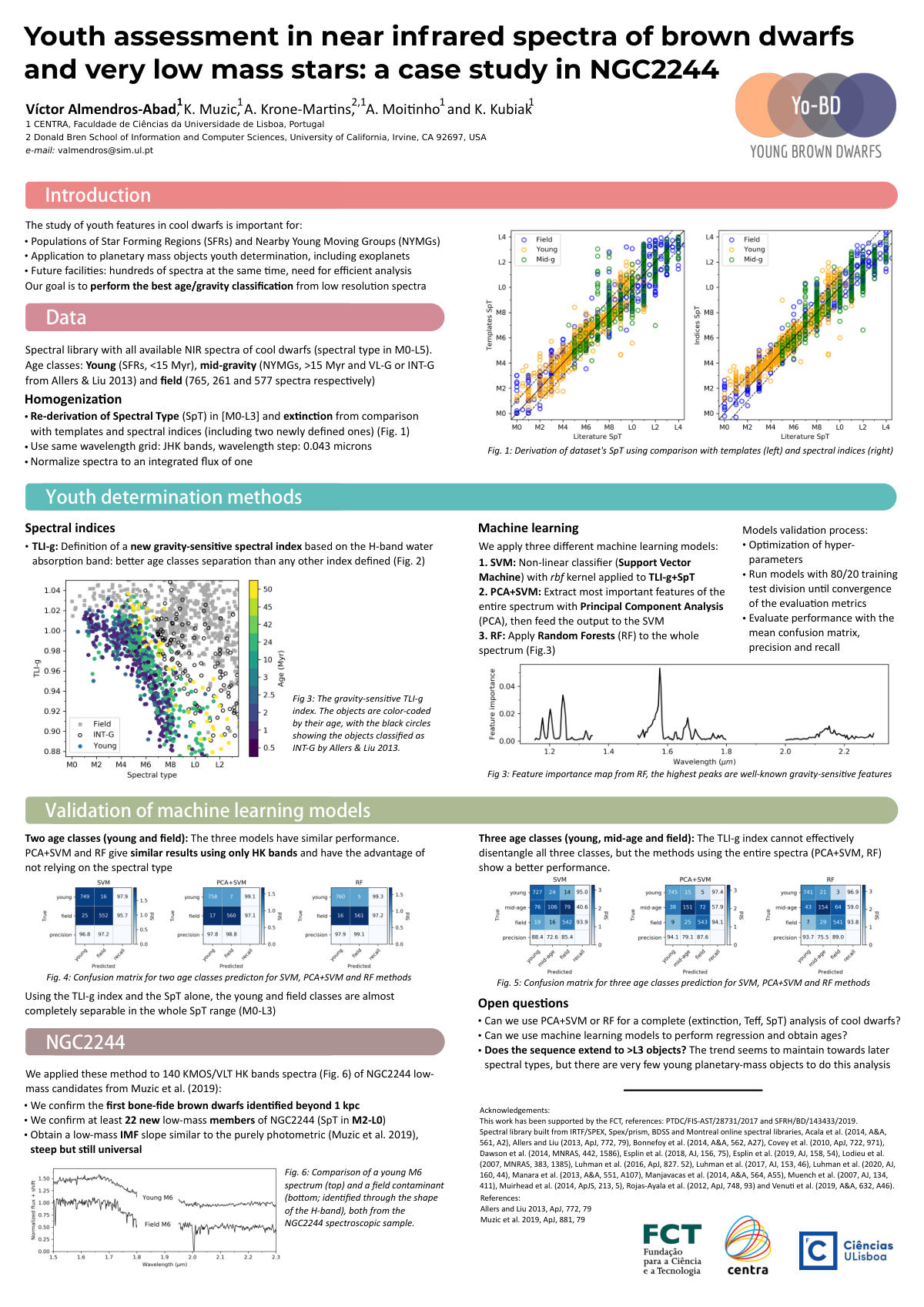
Studies of young brown dwarf populations are crucial to understand their formation mechanisms, but also to grasp all the channels through which star and planet formation processes may go. When searching for young brown dwarfs in star forming regions, the main obstacle is the determination of cluster membership, which cannot be established by photometry alone. Spectroscopic follow-up is an indispensable step to obtain robust samples of low-gravity, young members. I will present a new method for the analysis of very-low mass object spectra with spectral types between M0 and L2, using near-infrared J-, H- and K-bands (1.1-2.4 $\mu$m). We define a new gravity-sensitive spectral index, which performs consistently well over the spectral range of interest, unlike any of the previously defined indices. We also evaluate the performance of machine learning methods for youth assessment using the entire object spectrum. Finally, we apply our methods to 140 KMOS/VLT spectra of very-low mass candidates in the 2 Myr old cluster NGC 2244, part of a bigger project that aims at testing the effects of the environment in substellar formation. We report the discovery of the first spectroscopically confirmed brown dwarfs located at kpc distances.
Identifiers
Authors
Víctor Almendros-Abad Almendros-Abad
CENTRA, Faculdade de Ciências da Universidade de Lisboa, Portugal
Kora Muzic
CENTRA, Faculdade de Ciências da Universidade de Lisboa, Portugal
André Moitinho
CENTRA, Faculdade de Ciências da Universidade de Lisboa, Portugal
Alberto Krone-Martins
Donald Bren School of Information and Computer Sciences, University of California, Irvine, CA 92697, USA
Karolina Kubiak
CENTRA, Faculdade de Ciências da Universidade de Lisboa, Portugal
A. Krone-Martins
CENTRA, Faculdade de Ciências da Universidade de Lisboa, Portugal
A. Moitinho
CENTRA, Faculdade de Ciências da Universidade de Lisboa, Portugal