Description
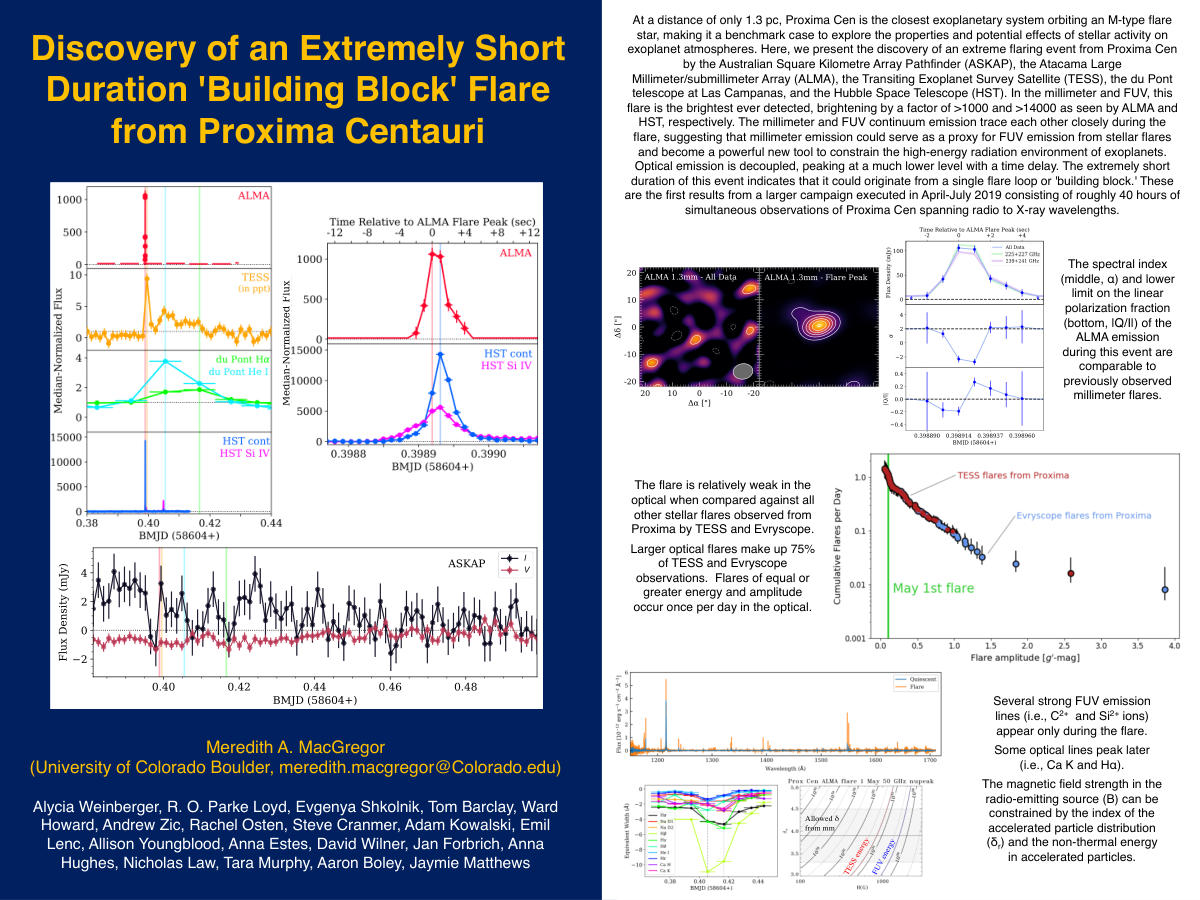
At a distance of only 1.3 pc, Proxima Cen is the closest exoplanetary system orbiting an M-type flare star, making it a benchmark case to explore the properties and potential effects of stellar activity on exoplanet atmospheres. Here, we present the discovery of an extreme flaring event from Proxima Cen by the Australian Square Kilometre Array Pathfinder (ASKAP), the Atacama Large Millimeter/submillimeter Array (ALMA), the Transiting Exoplanet Survey Satellite (TESS), the du Pont telescope at Las Campanas, and the Hubble Space Telescope (HST). In the millimeter and FUV, this flare is the brightest ever detected, brightening by a factor of >1000 and >14000 as seen by ALMA and HST, respectively. The millimeter and FUV continuum emission trace each other closely during the flare, suggesting that millimeter emission could serve as a proxy for FUV emission from stellar flares and become a powerful new tool to constrain the high-energy radiation environment of exoplanets. Optical emission is decoupled, peaking at a much lower level with a time delay. The extremely short duration of this event indicates that it could originate from a single flare loop or 'building block.' These are the first results from a larger campaign executed in April-July 2019 consisting of roughly 40 hours of simultaneous observations of Proxima Cen spanning radio to X-ray wavelengths.
Conference Information
The 20.5th Cambridge Workshop on Cool Stars, Stellar Systems, and the Sun
Identifiers
Authors
Meredith A. MacGregor
University of Colorado Boulder
Alycia Weinberger
R. O. Parke Loyd
Evgenya Shkolnik
Tom Barclay
Ward Howard
Andrew Zic
Rachel Osten
Steve Cranmer
Adam Kowalski
Emil Lenc
Allison Youngblood
Anna Estes
David Wilner
Jan Forbrich
Anna Hughes
Nicholas Law
Tara Murphy
Aaron Boley
Jaymie Matthews