Description
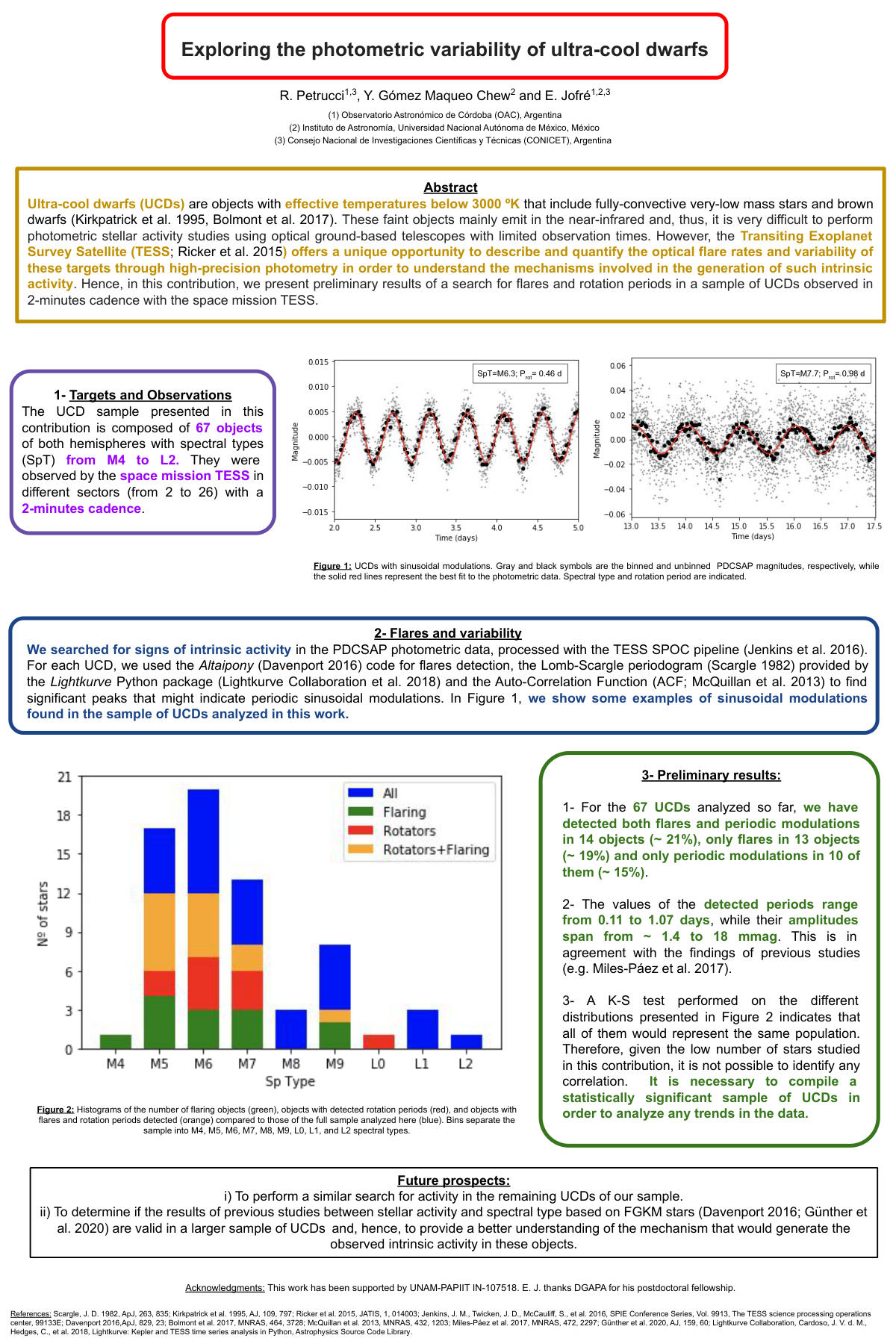
Ultra-cool dwarfs (UCDs) are objects with effective temperatures below 3000 K that include fully-convective, very-low mass stars and brown dwarfs. These faint objects mainly emit in the near-infrared and, thus, it is very difficult to perform photometric stellar activity studies using optical ground-based telescopes with limited observation times. However, the Transiting Exoplanet Survey Satellite (TESS) offers a unique opportunity to describe and quantify the optical flare rates and variability of these targets through high-precision photometry in order to understand the mechanisms involved in the generation of such intrinsic activity. Hence, in this contribution, we present preliminary results of a search for flares and rotation periods in a sample of UCDs observed in 2-minutes cadence with the space mission TESS.
Conference Information
The 20.5th Cambridge Workshop on Cool Stars, Stellar Systems, and the Sun
Identifiers
Authors
Romina Petrucci
OAC-CONICET
Yilen Gómez Maqueo Chew
IA-UNAM
Emiliano Jofré
IA-UNAM