Description
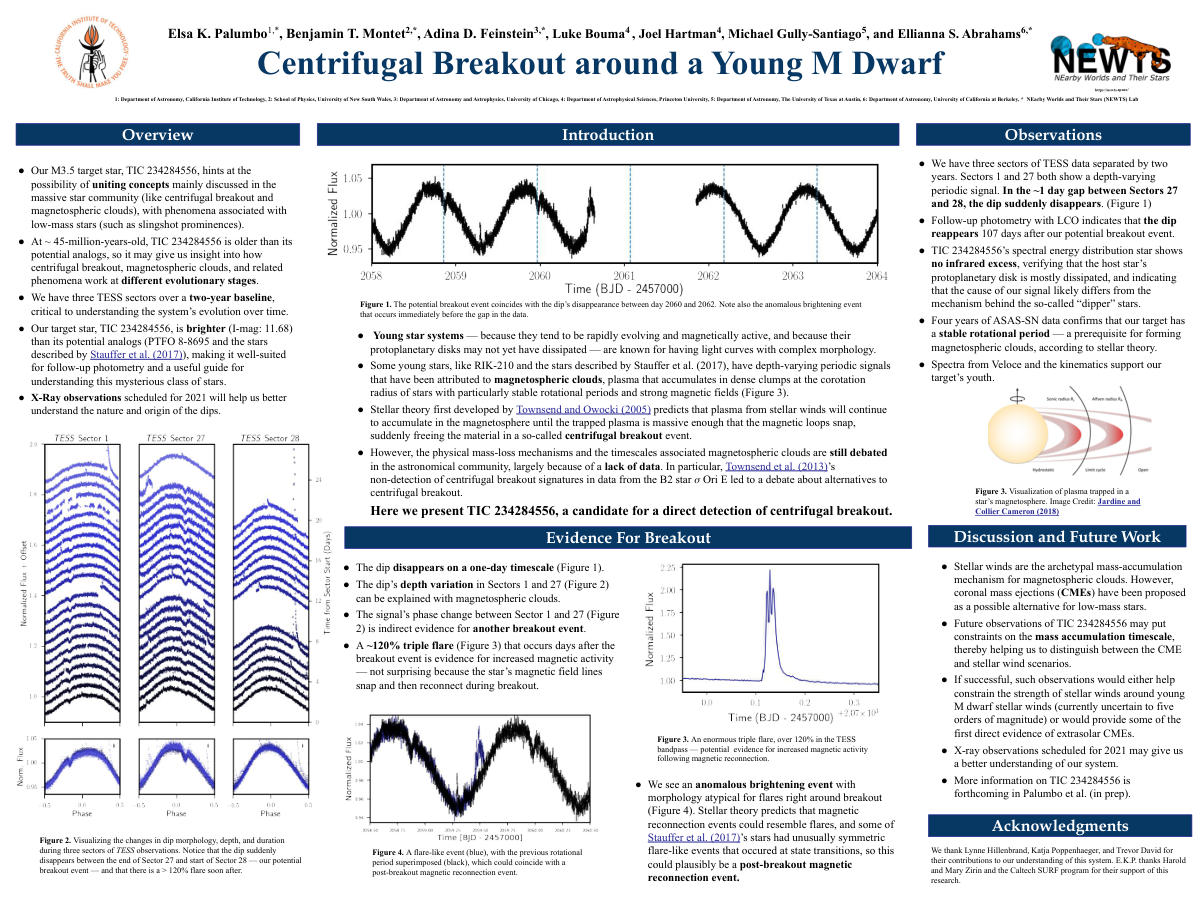
Magnetospheric clouds, plasma that accumulates in dense clumps at a star's corotation radius, have been proposed as an explanation for depth-varying dips in the light curves of young stars such as 𝜎 Ori E and RIK-210. However, the stellar theory that first predicted magnetospheric clouds also anticipated an associated mass-loss mechanism known as centrifugal breakout for which there has been limited empirical evidence. Based on data from TESS, Gaia, LCO, ASAS-SN, and Veloce, we propose that TIC 234284556, a 45-million-year-old M3.5 star, is a candidate for a direct detection of centrifugal breakout. To assess this hypothesis, we examine the changes in the dip parameters over three sectors of TESS data, analyze rotational amplitudes and optical flaring as a proxy for magnetic activity, and interpret the presence of an anomalous brightening event that precedes the disappearance of the dip. We then consider TIC 234284556 in the context of other young stars. Finally, we consider possible mass-accumulation mechanisms and discuss how future observations may help us constrain M dwarfs’ wind mass loss rates or give us valuable data about extra-solar CMEs.
Identifiers
Authors
Elsa K. Palumbo
California Institute of Technology
ORCID: https://orcid.org/0000-0001-7967-1795
Benjamin T. Montet
University of New South Wales
ORCID: https://orcid.org/0000-0001-7516-8308
Adina D. Feinstein
University of Chicago
ORCID: https://orcid.org/0000-0002-9464-8101
Luke Bouma
Princeton University
Joel Hartman
Princeton University
Michael Gully-Santiago
The University of Texas at Austin
Ellianna S. Abrahams
University of California, Berkeley