Description
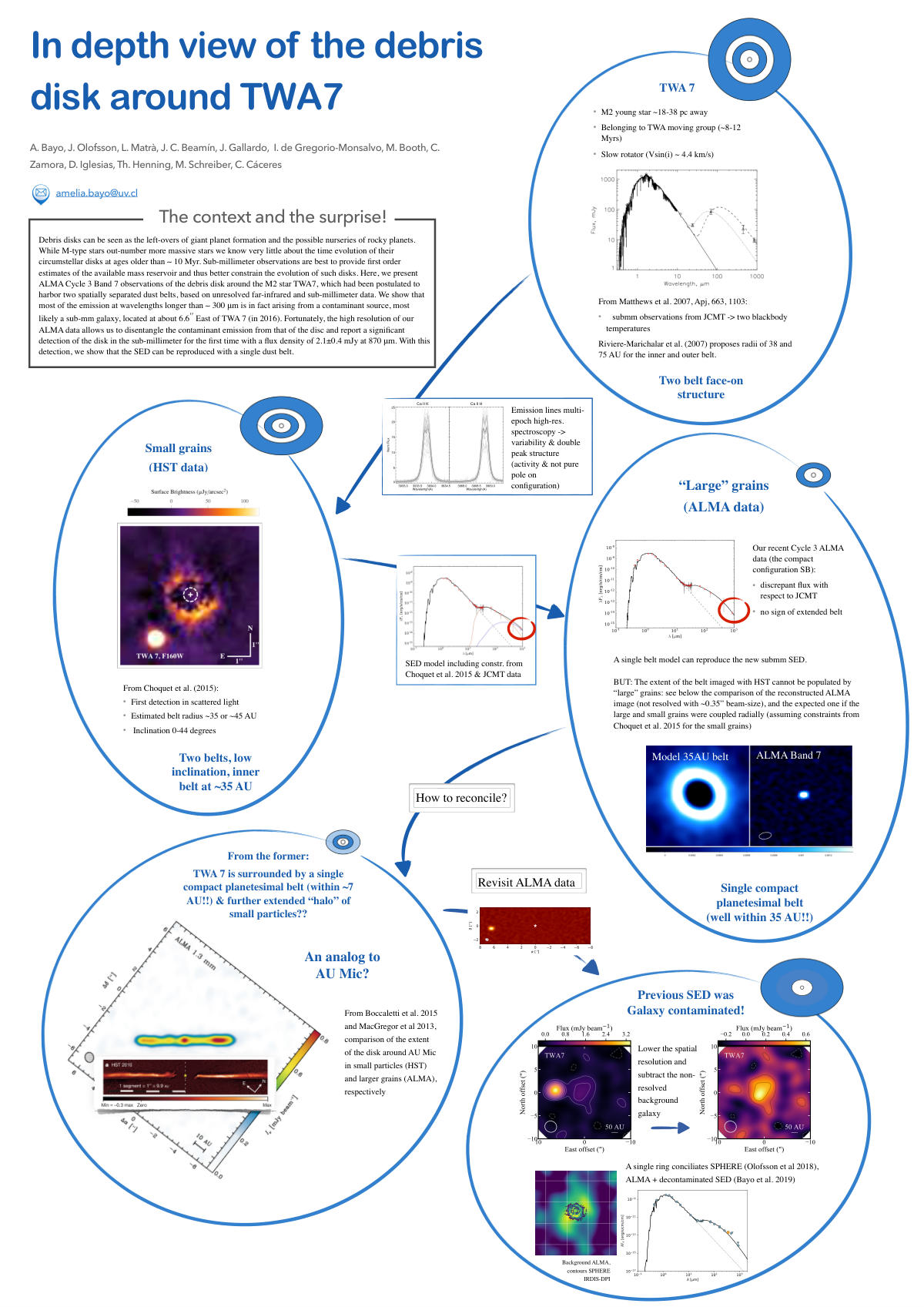
Debris disks can be seen as the left-overs of giant planet formation and the possible nurseries of rocky planets. While M-type stars out-number more massive stars we know very little about the time evolution of their circumstellar disks at ages older than ∼ 10 Myr. Sub-millimeter observations are best to provide first order estimates of the available mass reservoir and thus better constrain the evolution of such disks. Here, we present ALMA Cycle 3 Band 7 observations of the debris disk around the M2 star TWA7, which had been postulated to harbor two spatially separated dust belts, based on unresolved far-infrared and sub-millimeter data. We show that most of the emission at wavelengths longer than ∼ 300 μm is in fact arising from a contaminant source, most likely a sub-mm galaxy, located at about 6.6ʹʹ East of TWA 7 (in 2016). Fortunately, the high resolution of our ALMA data allows us to disentangle the contaminant emission from that of the disc and report a significant detection of the disk in the sub-millimeter for the first time with a flux density of 2.1±0.4 mJy at 870 μm. With this detection, we show that the SED can be reproduced with a single dust belt.
Identifiers
Authors
Amelia Bayo
Universidad de Valparaíso / Núcleo Milenio de Formación Planetaria
ORCID: https://orcid.org/0000-0001-7868-7031
Johan Olofsson
Universidad de Valparaíso / Núcleo Milenio de Formación Planetaria
Luca Matra
SCHOOL OF PHYSICS, NUI GALWAY, IRELAND
Juan Carlos Beamin
Universidad Autónoma / Núcleo Milenio de Formación Planetaria
José Gallardo
1. ALMA
Itziar Gregorio-Monsalvo de Gregorio-Monsalvo
ESO/ALMA
Mark Booth
University of Jena
Catalina Zamora
Universidad de Valparaíso / Núcleo Milenio de Formación Planetaria
Daniela Iglesias
University of Leeds
Thomas Henning
MPIA
Matthias R Schreiber
UTFSM / Núcleo Milenio de Formación Planetaria
Claudio Caceres
Universidad Andres Bello / Núcleo Milenio de Formación Planetaria
Th. Henning
University of Valparaíso