Description
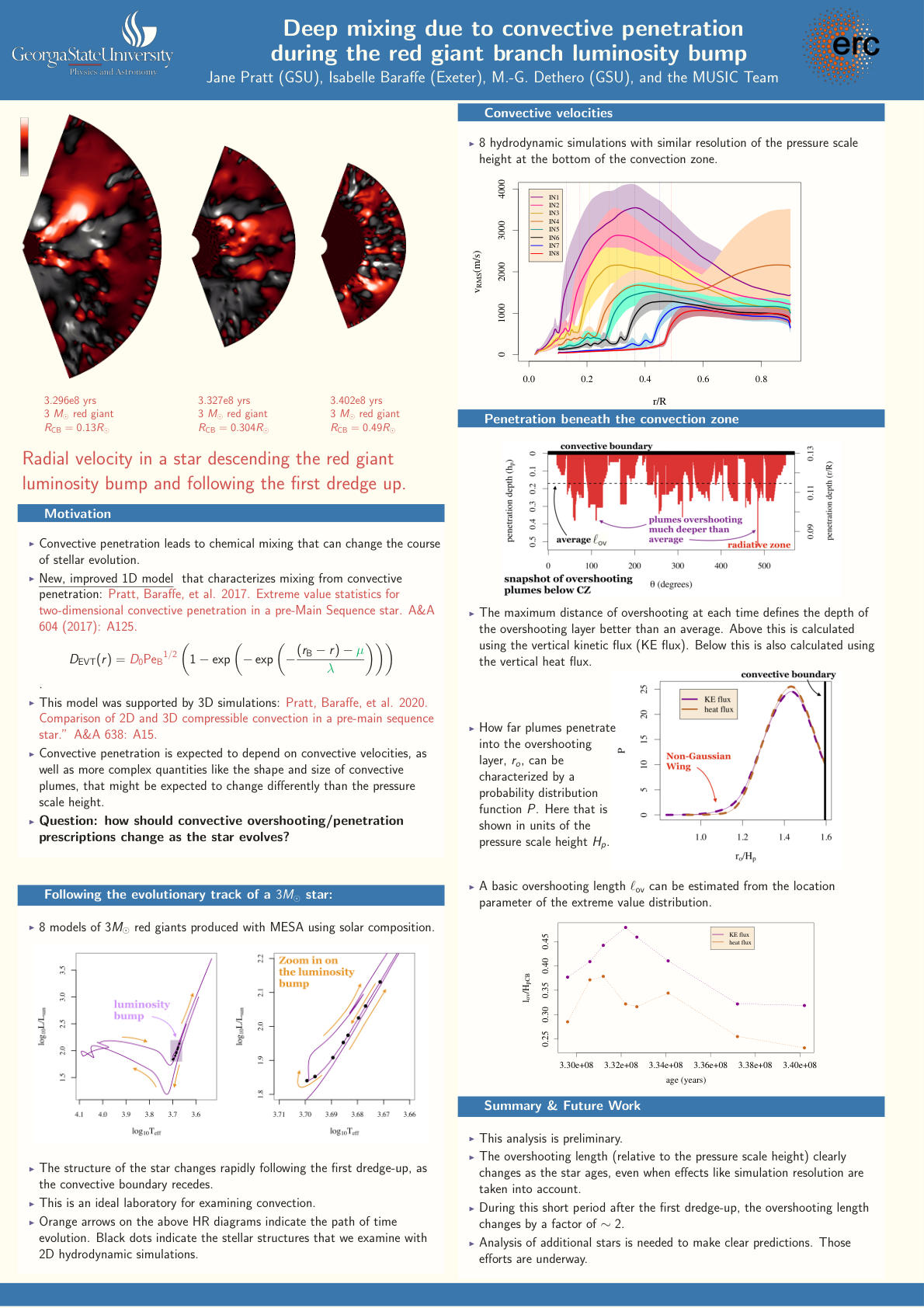
To interpret the wide variation in observed chemical abundances during the red giant phase of evolution, it is necessary to develop theoretical and computational modeling of convection under realistic stellar conditions. In this contribution we quantify mixing due to convective penetration in the deep stellar interior through global hydrodynamic simulations. We produce the evolutionary track of a 3 solar mass red giant using the 1D stellar evolution code MESA. We select models from this evolutionary track at different points in time, beginning at the first dredge-up and spanning the brief period of time of the red giant luminosity bump. The realistic stratification in density, temperature, and luminosity of these models is then used to produce global simulations of the stellar interior with the multi-dimensional, time implicit, fully compressible, hydrodynamic, implicit large eddy simulation code MUSIC. We compare the changing amount of mixing using a sophisticated enhanced diffusion model for convective penetration (Pratt et al 2017), targeted for one dimensional stellar evolution calculations.
Conference Information
The 20.5 Cambridge Workshop on Cool Stars, Stellar Systems, and the Sun (CS20.5)
Identifiers
Authors
Jane Pratt
Georgia State University
ORCID: https://orcid.org/0000-0003-2707-3616
Isabelle Baraffe
University of Exeter
ORCID: https://orcid.org/0000-0001-8365-5982
Mary Geer Dethero
Georgia State University
ORCID: https://orcid.org/0000-0003-1617-3697
MUSIC Team