Description
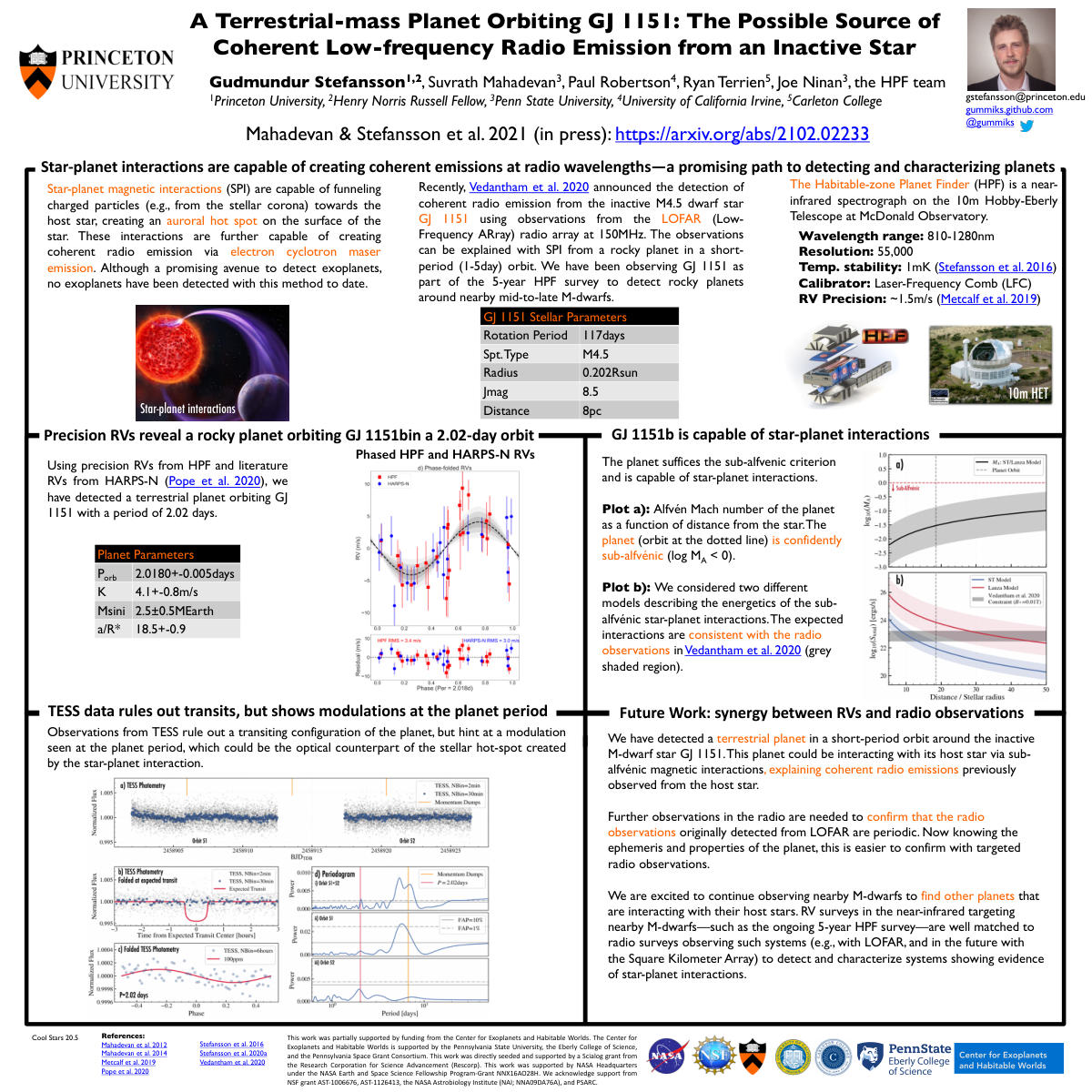
The coherent low-frequency radio emission detected by LOFAR from the quiescent M4.5 dwarf star GJ 1151 is consistent with theoretical expectations of star-planet interactions for an Earth-sized planet on a 1-5 day orbit. Using precise near-infrared radial velocities (RVs) with the Habitable-zone Planet Finder (HPF) on the 10m Hobby-Eberly Telescope at McDonald Observatory along with literature RVs from HARPS-N, we reveal a periodic Doppler signature consistent with a 2.5 Earth mass planet in a 2.02-day orbit. Precise photometry from the Transiting Exoplanet Survey Satellite (TESS) shows no flares or activity signature, consistent with a quiescent M dwarf. While no planetary transit is detected in the TESS data, a weak photometric modulation is detectable in the photometry at a ~2 day period. This independent detection of a planet signal with the RV technique adds further weight to the claim to one of the first detection of star-exoplanet interactions at radio wavelengths, and helps validate this emerging technique for the detection of exoplanets.
Conference Information
The 20.5th Cambridge Workshop on Cool Stars, Stellar Systems, and the Sun
Identifiers
Authors
Gudmundur Stefansson
Princeton University
ORCID: https://orcid.org/0000-0001-7409-5688
Suvrath Mahadevan
Penn State University
ORCID: https://orcid.org/0000-0001-9596-7983
Paul Robertson
University of California, Irvine
ORCID: https://orcid.org/0000-0003-0149-9678
Ryan Terrien
Carleton College
ORCID: https://orcid.org/0000-0002-4788-8858
Joe Ninan
Penn State University
ORCID: https://orcid.org/0000-0001-8720-5612
Rae Holcomb
University of California, Irvine
ORCID: https://orcid.org/0000-0002-5034-9476
Samuel Halverson
Jet Propulsion Laboratory
ORCID: https://orcid.org/0000-0003-1312-9391
William Cochran
University of Texas, Austin
ORCID: https://orcid.org/0000-0001-9662-3496
Shubham Kanodia
Penn State University
ORCID: https://orcid.org/0000-0001-8401-4300
Lawrence Ramsey
Penn State University
ORCID: https://orcid.org/0000-0002-4289-7958
Alexander Wolszczan
Penn State University
ORCID: https://orcid.org/0000-0003-1915-5670
Michael Endl
University of Texas, Austin
ORCID: https://orcid.org/0000-0002-7714-6310
Chad Bender
University of Arizona
ORCID: https://orcid.org/0000-0003-4384-7220
Scott Diddams
University of Colorado Boulder
ORCID: https://orcid.org/0000-0002-2144-0764
Connor Frederick
University of Colorado Boulder
ORCID: https://orcid.org/0000-0002-0560-1433
Frederick Hearty
Penn State University
ORCID: https://orcid.org/0000-0002-1664-3102
Andrew Monson
Penn State University
ORCID: https://orcid.org/0000-0002-0048-2586
Andrew Metcalf
Air Force Research Laboratory
ORCID: https://orcid.org/0000-0001-5000-1018
Arpita Roy
Space Telescope Science Institute
ORCID: https://orcid.org/0000-0001-8127-5775
Christian Schwab
Macquarie University
ORCID: https://orcid.org/0000-0002-4046-987X