Description
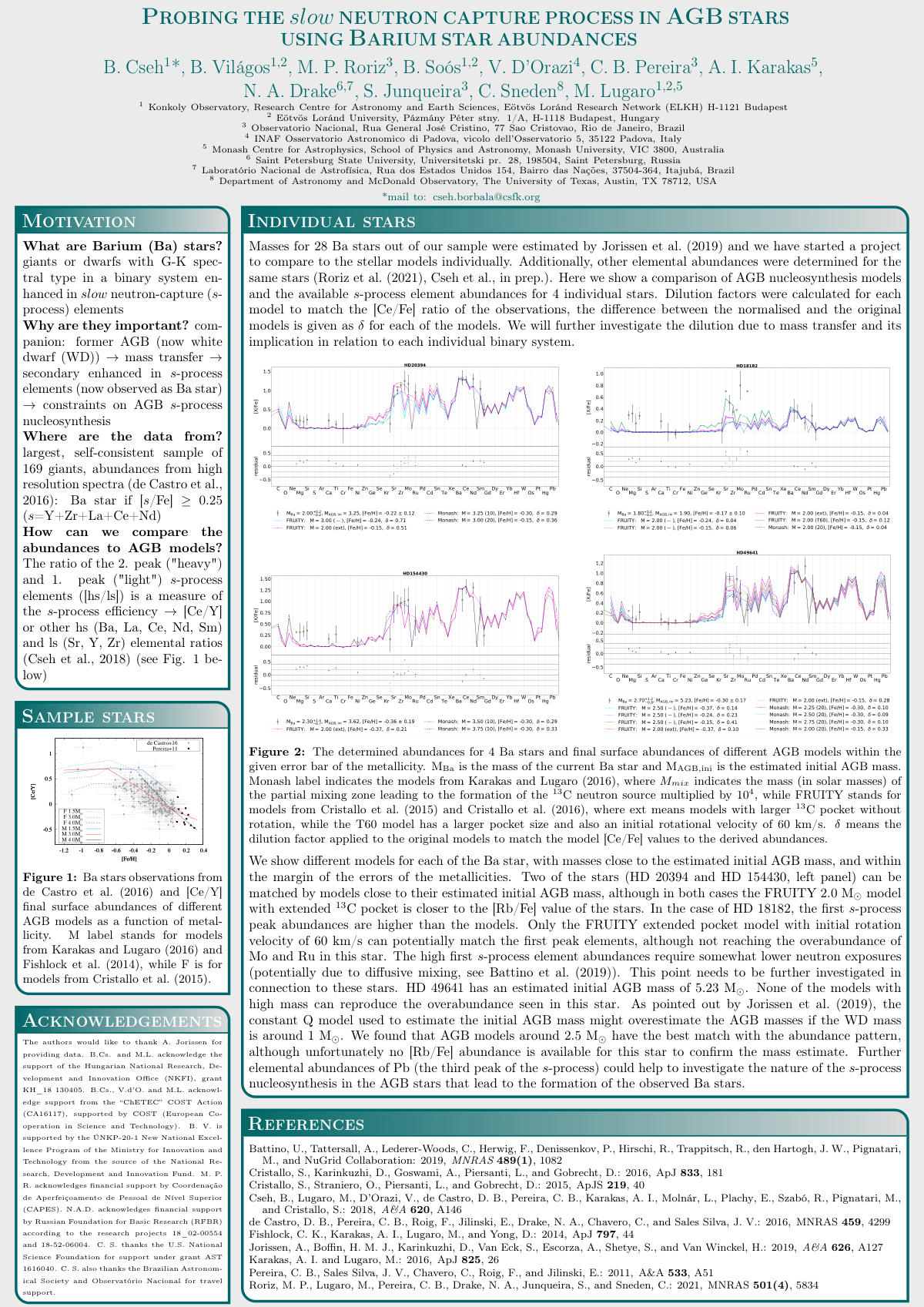
The Barium (Ba) star phenomenon is unmissable from the study and understanding of nucleosynthetic processes occuring in AGB stars. Ba stars belong to binary systems, where the former AGB polluted the companion, a less evolved star, which became enriched with material produced through the slow neuton capture process (s process). While the AGB has evolved to a white dwarf, the currently observed Ba star preserves the abundance pattern of the AGB, allowing us to test the imprints of the $s$ process. Comparing different AGB nucleosynthetic models and Ba star abundances, we are able to constrain the effect of the rotation velocity or the neutron source in the interior of the AGB star. The trend in the Ba star observations is predicted by non-rotating AGB models where 13C is the main neutron source. The results of the comparison of models with initial AGB masses from an independent source and the analysis of 28 Ba giant star abundances confirm that the polluting AGBs are of low mass.
Identifiers
Authors
Borbála Cseh
Konkoly Observatory, ELKH CSFK
Blanka Világos
Konkoly Observatory, ELKH CSFK
Michelle P. Roriz
Observatorio Nacional, Rua General José Cristino, 77 Sao Cristovao, Rio de Janeiro, Brazil
Soós Benjámin
Konkoly Observatory, ELKH CSFK
Valentina D'Orazi
INAF-Osservatorio Astronomico di Padova, vicolo dell'Osservatorio 5, 35122 Padova, Italy
Claudio B. Pereira
Observatorio Nacional, Rua General José Cristino, 77 Sao Cristovao, Rio de Janeiro, Brazil
Amanda I. Karakas
Monash Centre for Astrophysics, School of Physics and Astronomy, Monash University, VIC 3800, Australia
Natalia A. Drake
St Petersburg University
Selma Junqueira
Observatorio Nacional, Rua General José Cristino, 77 Sao Cristovao, Rio de Janeiro, Brazil
Chris Sneden
Department of Astronomy and McDonald Observatory, The University of Texas, Austin, TX 78712, USA
Maria Lugaro
Konkoly Observatory, ELKH CSFK