Description
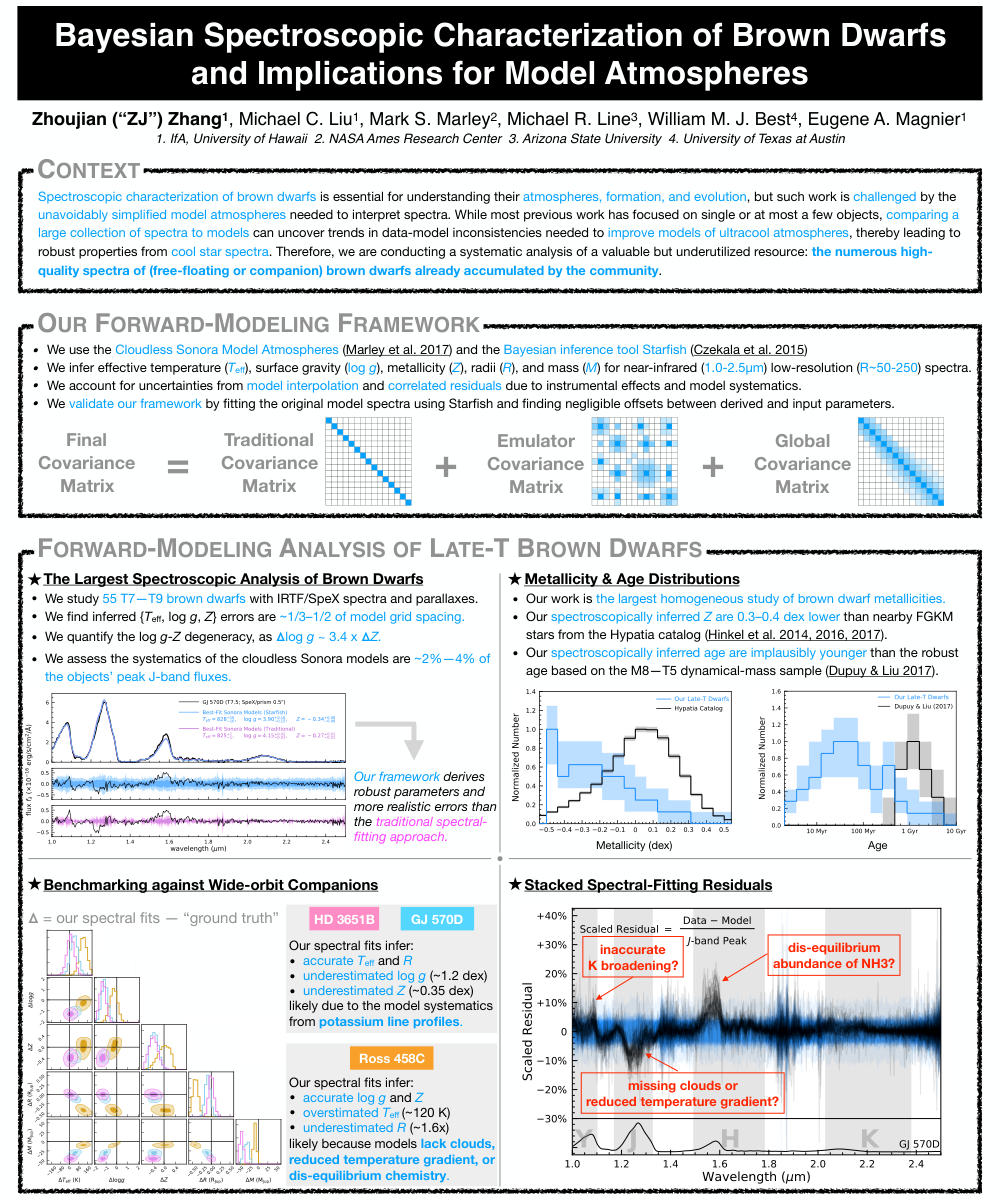
Spectroscopic characterization of brown dwarfs is essential for understanding their atmospheres, formation, and evolution, but such work is challenged by the unavoidably simplified model atmospheres needed to interpret spectra. While most previous work has focused on single or at most a few objects, comparing a large collection of spectra to models can uncover trends in data-model inconsistencies needed to improve models of ultracool atmospheres, thereby leading to robust properties from cool star spectra. Therefore, we are conducting a systematic analysis of a valuable but underutilized resource: the numerous high-quality spectra of (free-floating or companion) brown dwarfs already accumulated by the community. Focusing on the cool-temperature end, we have constructed a Bayesian modeling framework using the new Sonora-Bobcat model atmospheres and have applied it to study near-infrared low-resolution spectra of >50 late-T brown dwarfs (≈600-1200 K, ≈10-70 MJup) and to infer their physical properties (temperature, surface gravity, metallicity, radii, mass). By virtue of having such a large sample of high-quality spectra, our analysis identifies the systematic offsets between observed and model spectra as a function of wavelength and physical properties to pinpoint specific shortcomings in model predictions. We have also found that the spectroscopically inferred metallicities, ages, and masses of our sample all considerably deviate from expectations, suggesting the physical and chemical assumptions made within these models need to be improved to fully interpret data. Our work has established the most systematic validation of cloudless model atmospheres to date and we discuss extending such analysis to wider temperature and wavelength (e.g., JWST) ranges, as well as finding new brown dwarf benchmarks, in order to validate models of cool stars over larger parameter space.
Conference Information
The 20.5th Cambridge Workshops of Cool Stars, Stellar Systems and the Sun
Identifiers
Authors
Zhoujian Zhang
IfA, University of Hawaii
ORCID: https://orcid.org/0000-0002-3726-4881
Michael C. Liu
IfA, University of Hawaii
ORCID: https://orcid.org/0000-0003-2232-7664
Mark S. Marley
NASA Ames Research Center
ORCID: https://orcid.org/0000-0002-5251-2943
Michael R. Line
Arizona State University
ORCID: https://orcid.org/0000-0002-2338-476X
William M. J. Best
University of Texas at Austin
ORCID: https://orcid.org/0000-0003-0562-1511
Eugene A. Magnier
IfA, University of Hawaii
ORCID: https://orcid.org/0000-0002-7965-2815