Description
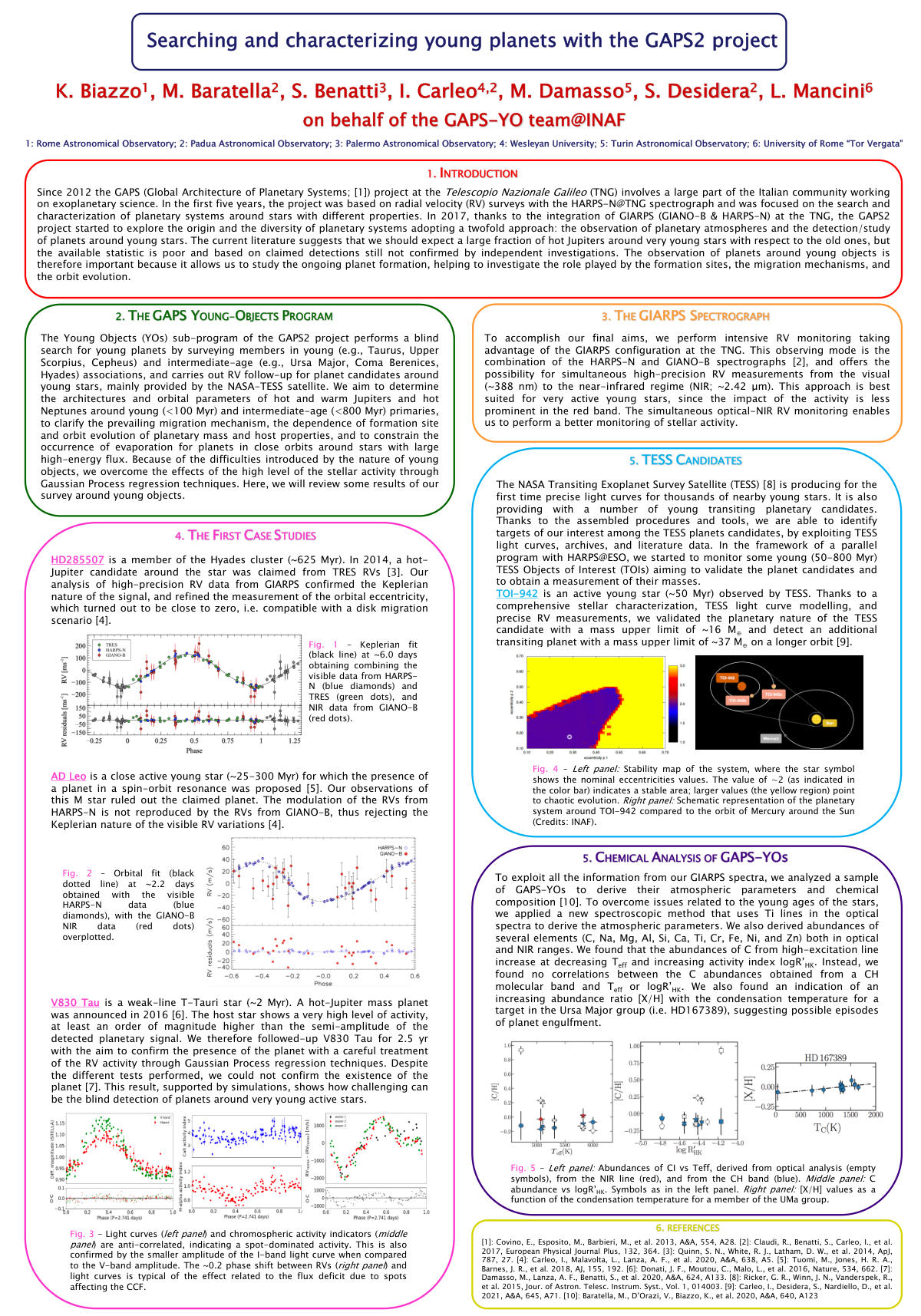
Since 2012 the GAPS (Global Architecture of Planetary Systems) project at the Telescopio Nazionale Galileo (TNG) involves a large part of the Italian community working on exoplanetary science. In the first five years, the project was based on radial velocity (RV) surveys with the HARPS-N@TNG spectrograph and was focused on the search and characterization of planetary systems around stars with different properties. In 2017, thanks to the integration of GIARPS (GIANO-B & HARPS-N) at the TNG, the GAPS2 project started to explore the origin and the diversity of planetary systems adopting a twofold approach: the observation of planetary atmospheres and the detection/study of planets around young stars. The current literature suggests that we should expect a large fraction of hot Jupiters around very young stars with respect to the old ones, but the available statistic is poor and based on claimed detections still not confirmed by independent investigations. The observation of planets around young objects is therefore important because it allows us to study the ongoing planet formation, helping to investigate the role played by the formation sites, the migration mechanisms, and the orbit evolution.
Conference Information
The 20th (and a half) Cambridge Workshop on Cool Stars, Stellar Systems, and the Sun
Identifiers
Authors
Katia Biazzo
Astronomical Observatory of Rome
ORCID: https://orcid.org/0000-0002-1892-2180
Martina Baratella
Padua Astronomical Observatory
Serena Benatti
Palermo Astronomical Observatory
Ilaria Carleo
Wesleyan University
Mario Damasso
Turin Astronomical Observatory
Silvano Desidera
Padua Astronomical Observatory
Luigi Mancini
University of Rome
on behalf of the GAPS-YO team@INAF