Description
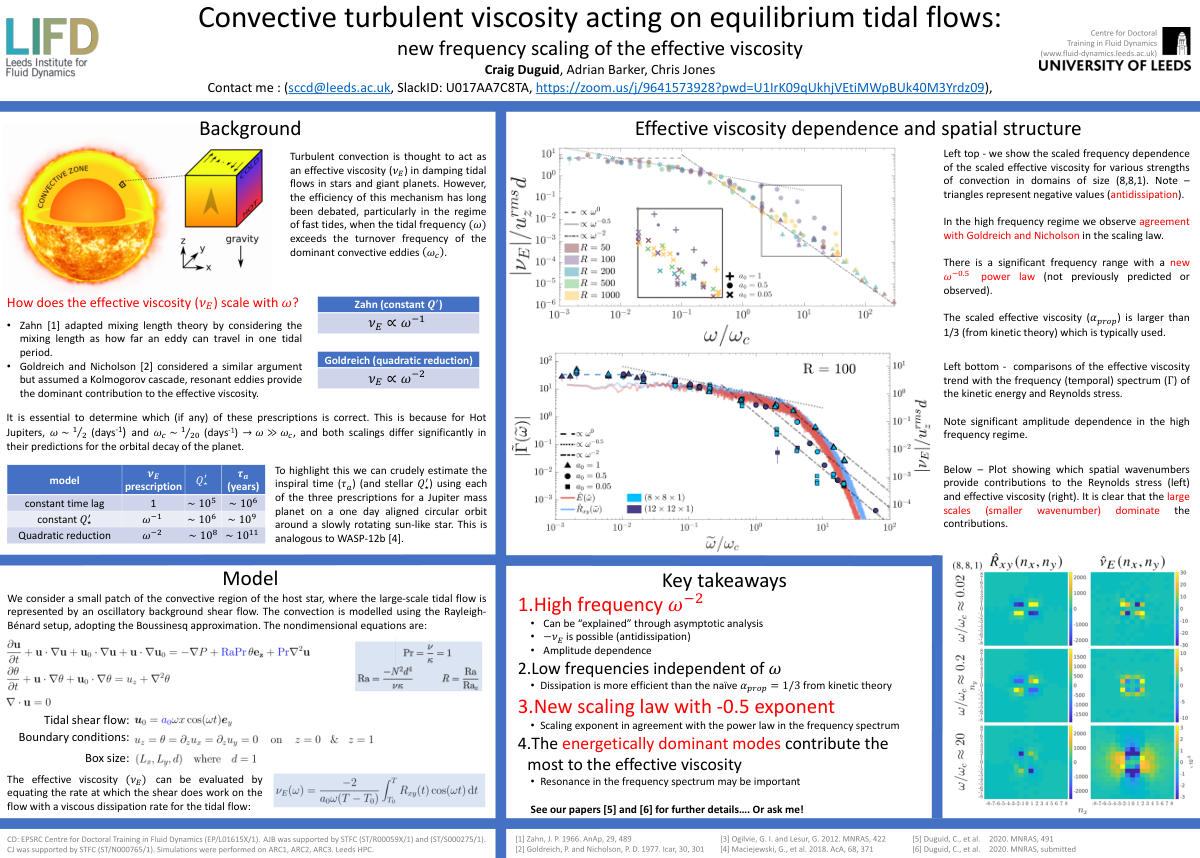
Tidal interactions are important in driving spin and orbital evolution in various astrophysical systems such as hot Jupiters, close binary stars and planetary satellites. However, the fluid dynamical mechanisms responsible for tidal dissipation in giant planets and stars remain poorly understood. One key mechanism is the interaction between tidal flows and turbulent convection which is thought to act as an eddy viscosity (\(\nu_E\)) dampening the large scale tidal flow. The efficiency of this mechanism has long been debated, particularly in the regime of fast tides, when the tidal frequency (\(\omega\)) exceeds the turnover frequency of the dominant convective eddies (\(\omega_c\)). The pioneering work of Zahn (1966) proposed that while Goldreich & Nicholson (1977) found . Using hydrodynamical simulations we investigate the dissipation of the large scale (non-wavelike) equilibrium tide as a result of its interaction with convection. Our approach is to conduct a wide parameter survey in order to study the interaction between an oscillatory background shear flow, which represents a large-scale tidal flow, and the convecting fluid inside a small patch of a star or planet. We simulate Rayleigh-Bénard convection in this Cartesian model and explore how the effective viscosity of the turbulence depends on the tidal (shear) frequency. We will present the results from our simulations to determine the effective viscosity, and its dependence on the tidal frequency in both laminar and weakly turbulent regimes. The main result is a new scaling law for the frequency dependence of the effective viscosity which has not previously been observed in simulations or predicted by theory and occurs for shear frequencies smaller than those in the fast tides regime. These results have important implications for tidal dissipation in convection zones of stars and planets, and indicate that the classical tidal theory of the equilibrium tide in stars and giant planets should be revisited.
Conference Information
The 20.5th Cambridge Workshop on Cool Stars, Stellar Systems, and the Sun
Identifiers
Authors
Craig Duguid
University of Newcastle Australia
ORCID: https://orcid.org/0000-0003-1199-3469
Adrian J Barker
University of Leeds
ORCID: https://orcid.org/0000-0003-4397-7332
C A Jones
University of Leeds
Chris Jones
University of Leeds