Description
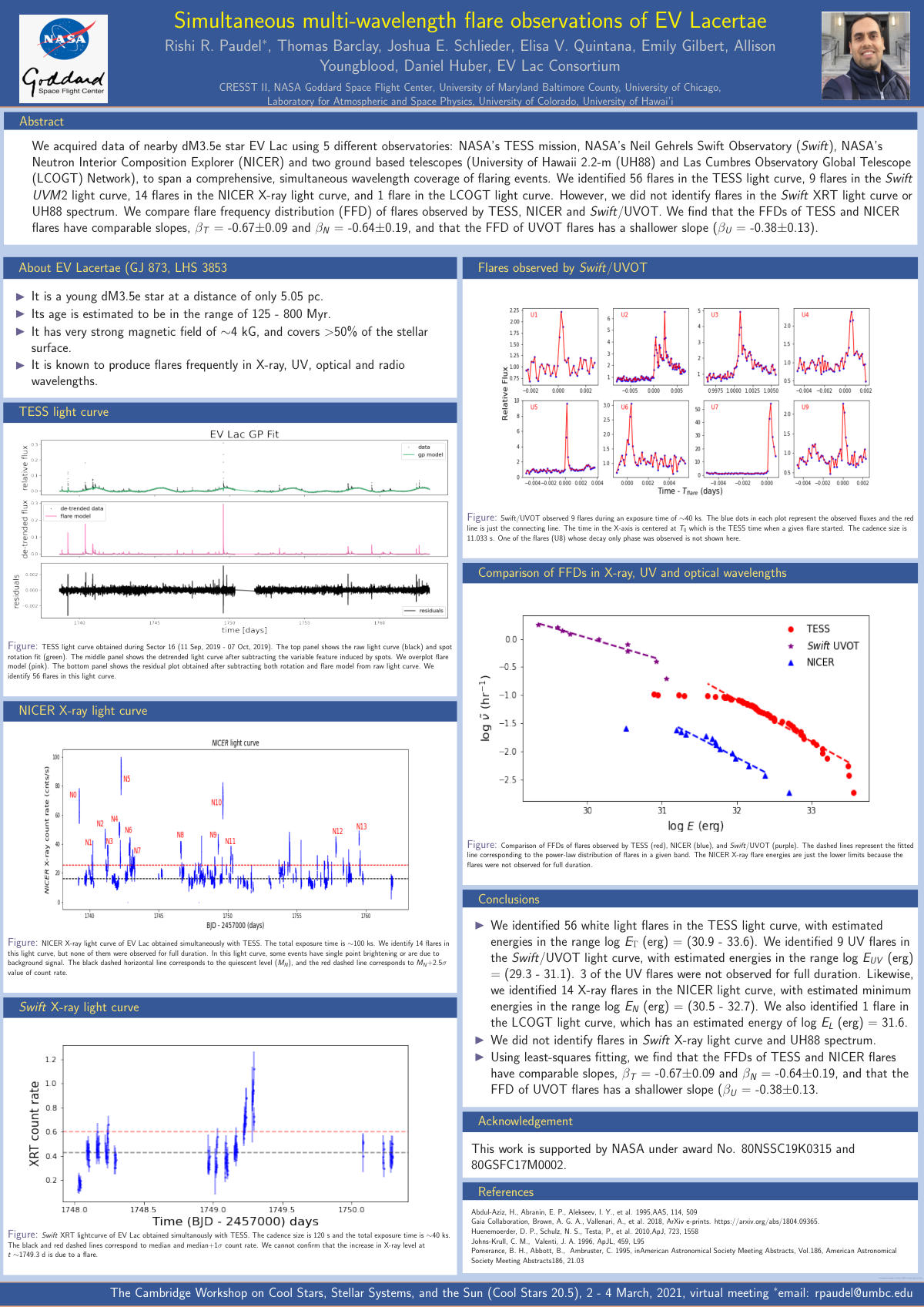
We acquired data of nearby dM3.5e star EV Lac using 5 different observatories: NASA's TESS mission, NASA's Neil Gehrels Swift Observatory ($Swift$), NASA's Neutron Interior Composition Explorer (NICER) and two ground based telescopes (University of Hawaii 2.2-m (UH88) and Las Cumbres Observatory Global Telescope (LCOGT) Network), to span a comprehensive, simultaneous wavelength coverage of flaring events. We identified 56 flares in the TESS light curve, 9 flares in the $Swift$ $UVM2$ light curve, 14 flares in the NICER X-ray light curve, and 1 flare in the LCOGT light curve. However, we did not identify flares in the $Swift$ XRT light curve or UH88 spectrum. We compare flare frequency distribution (FFD) of flares observed by TESS, NICER and $Swift$/UVOT. We find that the FFDs of TESS and NICER flares have comparable slopes, $\beta_{T}$ = -0.67$\pm$0.09 and $\beta_{N}$ = -0.64$\pm$0.19, and that the FFD of UVOT flares has a shallower slope ($\beta_{U}$ = -0.38$\pm$0.13).
Conference Information
The Cambridge Workshop on Cool Stars, Stellar Systems, and the Sun (Cool Stars 20.5)
Identifiers
Authors
Rishi R. Paudel
NASA Goddard Space Flight Center, University of Maryland, Baltimore County
Thomas Barclay
NASA Goddard Space Flight Center, University of Maryland, Baltimore County
Joshua E. Schlieder
NASA Goddard Space Flight Center
Elisa V. Quintana
NASA Goddard Space Flight Center
Emily Gilbert
University of Chicago
Allison Youngblood
Laboratory of Atmospheric and Space Physics, University of Colorado
Daniel Huber
University of Hawaii
EV Lac Consortium