Description
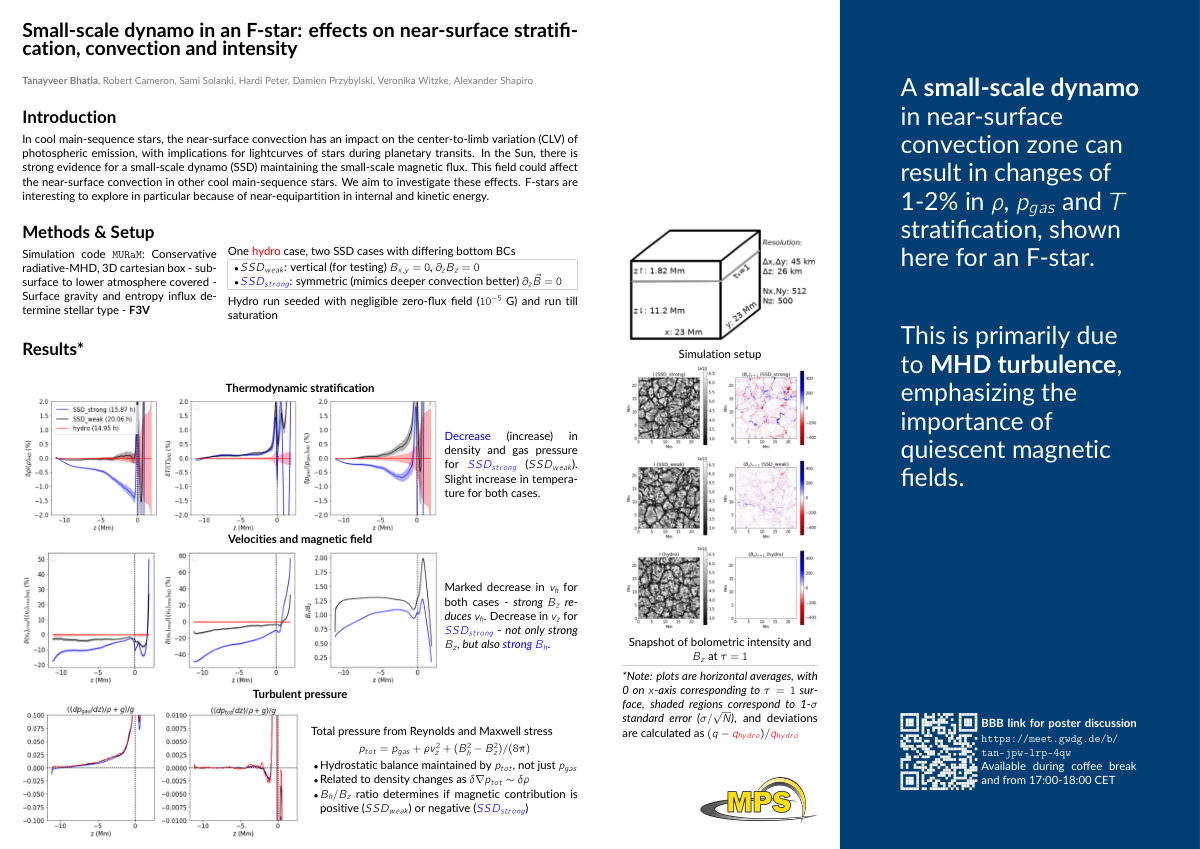
The emission from the photosphere of stars shows a systematic center-to-limb variation. In cool main-sequence stars, the near-surface convection has an impact on this variation, with implications for lightcurves of stars during planetary transits. In the Sun, there is strong evidence for a small-scale dynamo (SSD) maintaining the small-scale magnetic flux. We aim to investigate what additional effects such a field would play for other cool main-sequence stars. In our work we first concentrate on F-stars. This is because they have sonic velocities near the surface, implying a rough equipartition between internal and kinetic energies. In addition, an SSD might create a significant magnetic energy density to impact the results. We investigate the interplay between internal, kinetic and magnetic energies in 3D cartesian box MHD models of a F3V-star in the near-surface convection, using the MURaM radiative-MHD simulation code. Along with a reference hydrodynamic run, two MHD models with self-consistently generated magnetic fields with two different lower boundary conditions are considered. We find that the SSD process creates a magnetic field with energy within an order of magnitude of the internal and the kinetic energy. Compared to the hydrodynamic run, we find slight (~1-3%) but significant deviations in density, gas pressure and temperature stratification. At the surface, this corresponds to a temperature difference of ~130 K. As expected, there is a significant reduction in kinetic energy flux once the SSD is operational. The changes in intensity are more subtle, both in total intensity and granulation pattern. From this we conclude that the presence of an SSD will have a significant impact on the atmospheric structure and intensity characteristics seen at the surface. This makes it clear that it would be important to consider the spatially and temporally averaged effects of the SSD also for global stellar models.
Conference Information
The 20.5th Cambridge Workshop on Cool Stars, Stellar systems and the Sun
Identifiers
Authors
Tanayveer Bhatia
Robert Cameron
Sami Solanki
Hardi Peter
Damien Przybylski
Veronika Witzke
Alexander Shapiro