Description
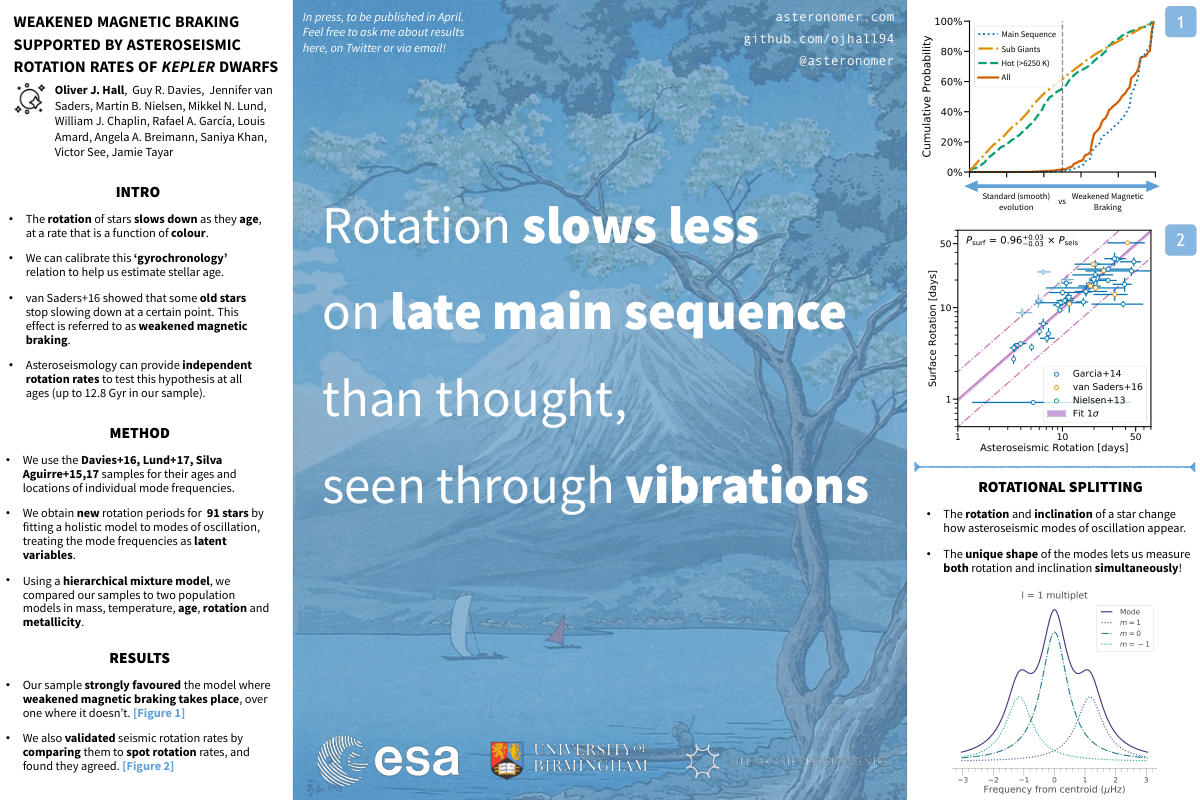
Studies using asteroseismic ages and rotation rates from star-spot rotation have indicated that standard age-rotation relations may break down roughly half-way through the main sequence lifetime, a phenomenon referred to as weakened magnetic braking. While rotation rates from spots can be difficult to determine for older, less active stars, rotational splitting of asteroseismic oscillation frequencies can provide rotation rates for both active and quiescent stars, and so can confirm whether this effect really takes place on the main sequence. In this talk, I’ll show how we obtained asteroseismic rotation rates of 91 main sequence stars showing high signal-to-noise modes of oscillation. Using these new rotation rates, along with effective temperatures, metallicities and seismic masses and ages, we built a hierarchical Bayesian mixture model that showed that our new ensemble more closely agreed with weakened magnetic braking, over a standard rotational evolution scenario.
Conference Information
The 20.5th Cambridge Workshop on Cool Stars, Stellar Systems, and the Sun
Identifiers
Authors
Oliver James Hall
ESA/ESTEC
ORCID: https://orcid.org/0000-0002-0468-4775
Guy R. Davies
University of Birmingham
Jennifer van Saders
University of Hawai'i
Martin B. Nielsen
University of Birmingham
Mikkel N. Lund
Stellar Astrophysics Centre, Aarhus University
William J. Chaplin
University of Birmingham
Rafael A. Garcia
Université Paris-Saclay
Louis Amard
University of Exeter
Angela A. Breimann
University of Exeter
Saniya Khan
University of Birmingham
Victor See
University of Exeter
Jamie Tayar
University of Hawai'i