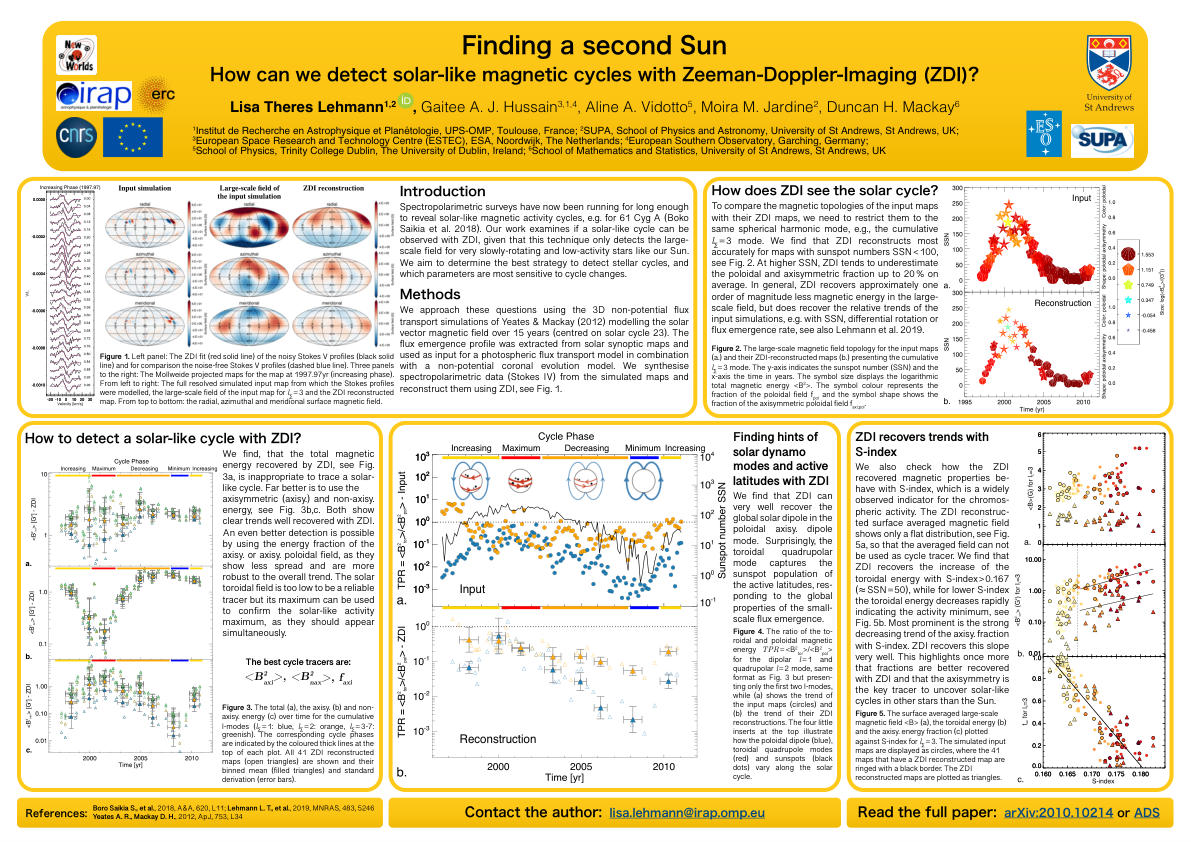
Description
Spectropolarimetric surveys have now been running for long enough to reveal solar-like magnetic activity cycles, e.g., for 61 Cyg A (Boko Saikia et al. 2018). Our work examines if a solar-like cycle can be observed with ZDI, given that this technique only detects the large-scale field for very slowly-rotating and low-activity stars like our Sun. We aim to determine the best strategy to detect stellar cycles, and which parameters are most sensitive to cycle changes. This poster presents our paper: Lehmann, L. T., et al., 2021, MNRAS, 500, 1243 (https://ui.adsabs.harvard.edu/abs/2021MNRAS.500.1243L)
Conference Information
The 20.5th Cambridge Workshop On Cool Stars, Stellar Systems, and the Sun
Identifiers
Funding Information
European Commission
The influence of stellar outflows on exoplanetary mass loss
Grant: 817540
Award detailsUK Research and Innovation
Astronomy at St Andrews 2015-2018
Grant: ST/M001296/1
European Commission
The Whole Sun Project: Untangling the complex physical mechanisms behind our eruptive star and its twins
Grant: 810218
Award detailsAuthors
Lisa Theres Lehmann
Institut de Recherche en Astrophysique et Planétologie, UPS-OMP, Toulouse, France
ORCID: https://orcid.org/0000-0001-7264-0734
Gaitee A. J. Hussain
European Space Research and Technology Centre (ESA ESTEC)
ORCID: https://orcid.org/0000-0003-3547-3783
Aline A. Vidotto
School of Physics, Trinity College Dublin, The University of Dublin, Ireland
ORCID: https://orcid.org/0000-0001-5371-2675
Moira M. Jardine
SUPA, School of Physics & Astronomy, University of St Andrews
ORCID: https://orcid.org/0000-0002-1466-5236
Duncan H. Mackay
School of Mathematics and Statistics, University of St Andrews, St Andrews, UK
ORCID: https://orcid.org/0000-0001-6065-8531