Description
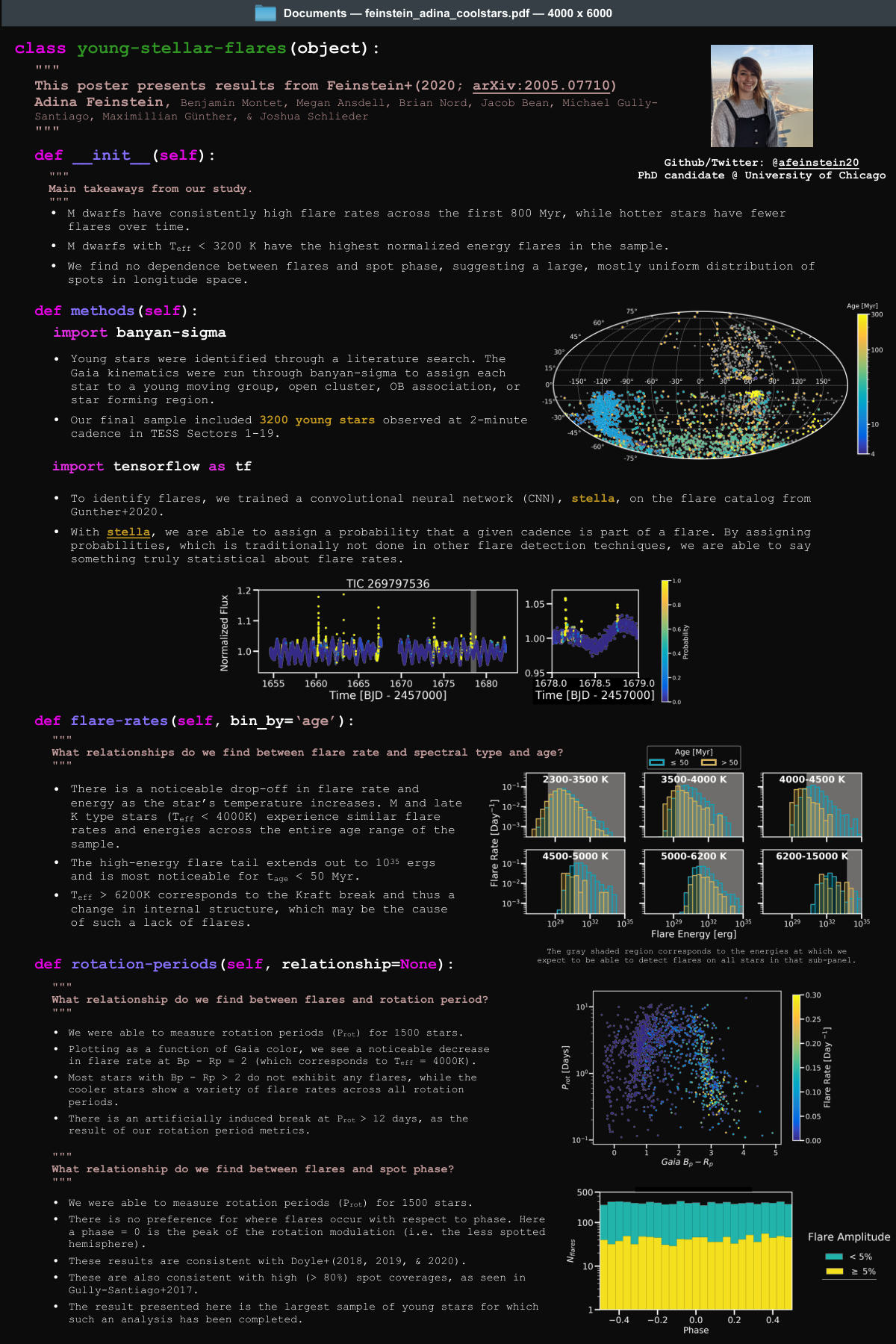
The evolution of young stellar magnetic fields is not well understood. By studying observable proxies, such as stellar flares and starspots, we can begin to better understand such mechanisms. All-sky photometric time-series missions have allowed for the monitoring of thousands of young stars to understand the evolution of stellar activity. We have developed a convolutional neural network, stella, specifically trained to find flares in TESS short-cadence data. We applied the network to 3200 young stars to evaluate flare rates as a function of age and spectral type. We also measured rotation periods for 1500 of our targets and found that flares of all amplitudes are present across all spot phases, suggesting high spot coverage across the entire surface. Additionally, flare rates and amplitudes decrease for stars older than 50 Myr across all temperatures hotter than 4000 K, while cooler stars show no evolution across 800 Myr. Cooler stars also show higher flare rates and amplitudes across all ages, particularly those that are fully convective.
Identifiers
Authors
Adina Feinstein
University of Chicago
ORCID: https://orcid.org/0000-0002-9464-8101
Benjamin Montet
University of New South Wales
ORCID: https://orcid.org/0000-0001-7516-8308
Megan Ansdell
NASA HQ
ORCID: https://orcid.org/0000-0003-4142-9842
Brian Nord
Fermi National Accelerator Laboratory, Kavli Institute for Cosmological Physics, University of Chicago
ORCID: https://orcid.org/0000-0001-6706-8972
Jacob Bean
University of Chicago
ORCID: https://orcid.org/0000-0003-4733-6532
Maximillian Günther
Massachusetts Institute of Technology
ORCID: https://orcid.org/0000-0002-3164-9086
Michael Gully-Santiago
The University of Texas at Austin
ORCID: https://orcid.org/0000-0002-4020-3457
Joshua Schlieder
NASA Goddard Space Flight Center
ORCID: https://orcid.org/0000-0001-5347-7062