Description
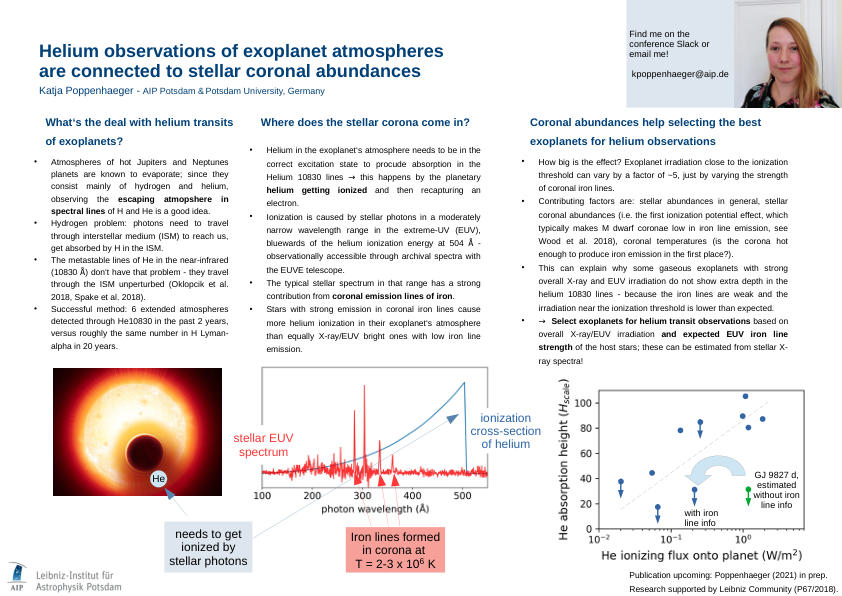
Transit observations in the helium lines near 10830 Angstrom are a new successful tool to study exoplanetary atmospheres and their mass loss. Forming those lines requires ionization and recombination of helium in the exoplanetary atmosphere. This ionization is caused by stellar photons in the extreme UV (EUV); however, no currently active telescopes can observe this part of the stellar spectrum. The stellar spectrum close to the helium ionization threshold consists of individual emission lines, many of which are formed by iron at coronal temperatures. Coronal elemental abundances exhibit distinct patterns related to the first ionization potential (FIP) of those elements, with elements like iron being strongly depleted for high-activity low-mass stars. I show that stars with high versus low coronal iron abundances follow different scaling laws that tie together their X-ray emission and the EUV flux close to the helium ionization threshold. I also show that the currently observed large scatter in the relationship of EUV irradiation with exoplanetary helium transit depths can be reduced by taking coronal iron abundances into account, allowing us to target exoplanets with well-observable helium signatures with much higher confidence.
Conference Information
The 20.5th Cambridge Workshop on Cool Stars, Stellar Systems, and the Sun
Identifiers
Authors
Katja Poppenhaeger
Leibniz Institute for Astrophysics Potsdam (AIP)
ORCID: https://orcid.org/0000-0003-1231-2194