Description
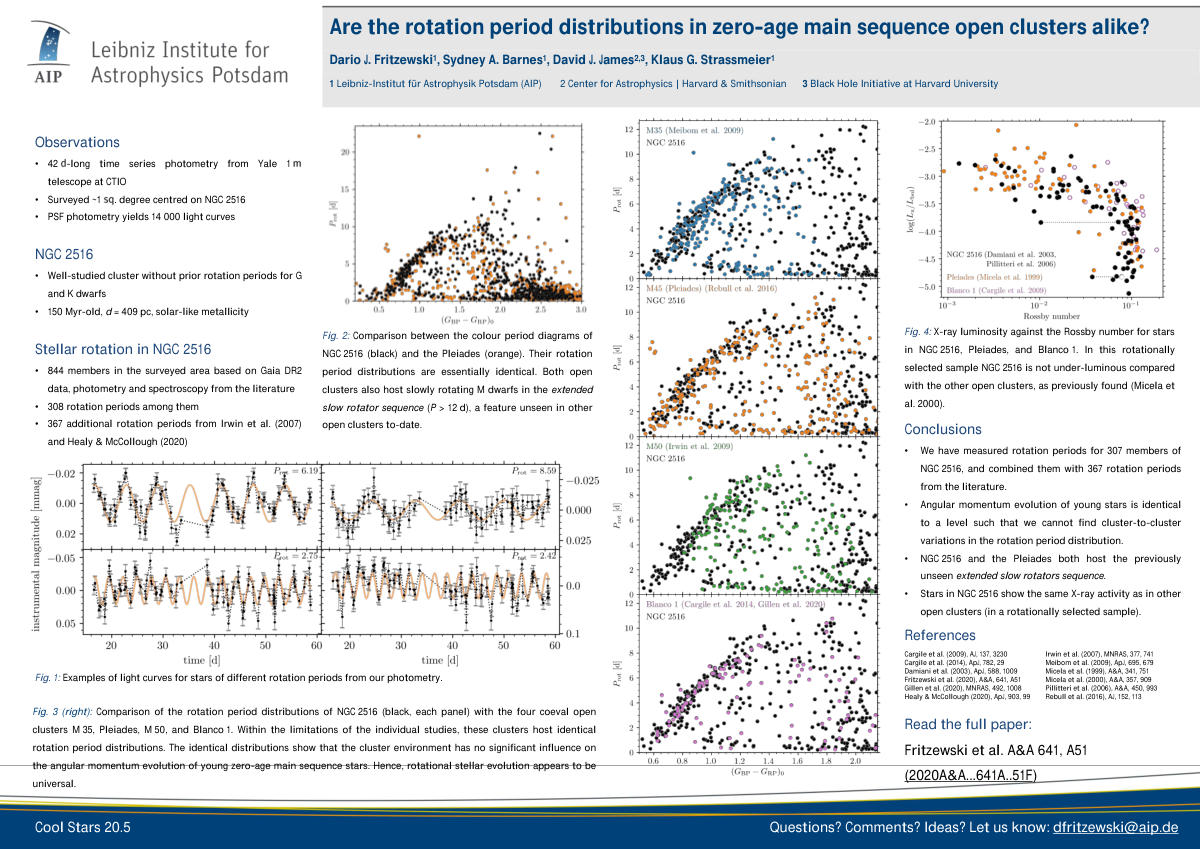
The universality of stellar evolution is fundamental to our understanding of stars. The evolution of angular momentum can also be used to test this concept because rotation changes significantly with stellar age, and can be probed sensitively using stellar rotation periods. We present new rotation periods measured from photometric time series observations for stars in the 150Myr-old open cluster NGC 2516. Among the members, selected using Gaia data, radial velocities and multi-colour photometry, we find 308 stars with rotation periods ranging from 0.25d to 25d. Combined with rotation periods for M dwarfs from the literature, our sample contains 555 periods for stars between G and mid-M. This large sample enables a detailed comparison with the K2-based rotation period distribution of the Pleiades and also the corresponding X-Ray activity diagrams. Comparison between NGC 2516 and Pleiades shows that the two open clusters can be considered twins because in addition to the classical parameters, their rotation period distributions are almost indistinguishable across the colour and period ranges. Both clusters also host a group of slowly-rotating M dwarfs with P>15d, unseen before in other open clusters, that constitute what we call the "extended slow rotator sequence". Further comparison between NGC 2516 and the other nearly coeval open clusters M35, Blanco 1 and M50 shows that these rotation period distributions are also substantially similar to that for NGC 2516, at least to the extent that the limitations of the individual studies permit. Based on empirical comparison of these five different open clusters, our study suggests that coeval open clusters of similar composition have identical rotation period distributions, the strongest evidence to date against cluster-to-cluster variations. We conclude that the star formation process in different cluster environments is likely universal enough to result in substantially identical rotation period distributions at the ZAMS.
Conference Information
The 20.5th Cambridge Workshop on Cool Stars, Stellar Systems, and the Sun
Identifiers
Authors
Dario J. Fritzewski
Leibniz-Institut für Astrophysik Potsdam (AIP)
ORCID: https://orcid.org/0000-0002-2275-3877
Sydney A. Barnes
Leibniz-Institut für Astrophysik Potsdam (AIP)
David J. James
Black Hole Initiative at Harvard University
ORCID: https://orcid.org/0000-0001-5160-4486
Klaus G. Strassmeier
Leibniz-Institut für Astrophysik Potsdam (AIP)