Description
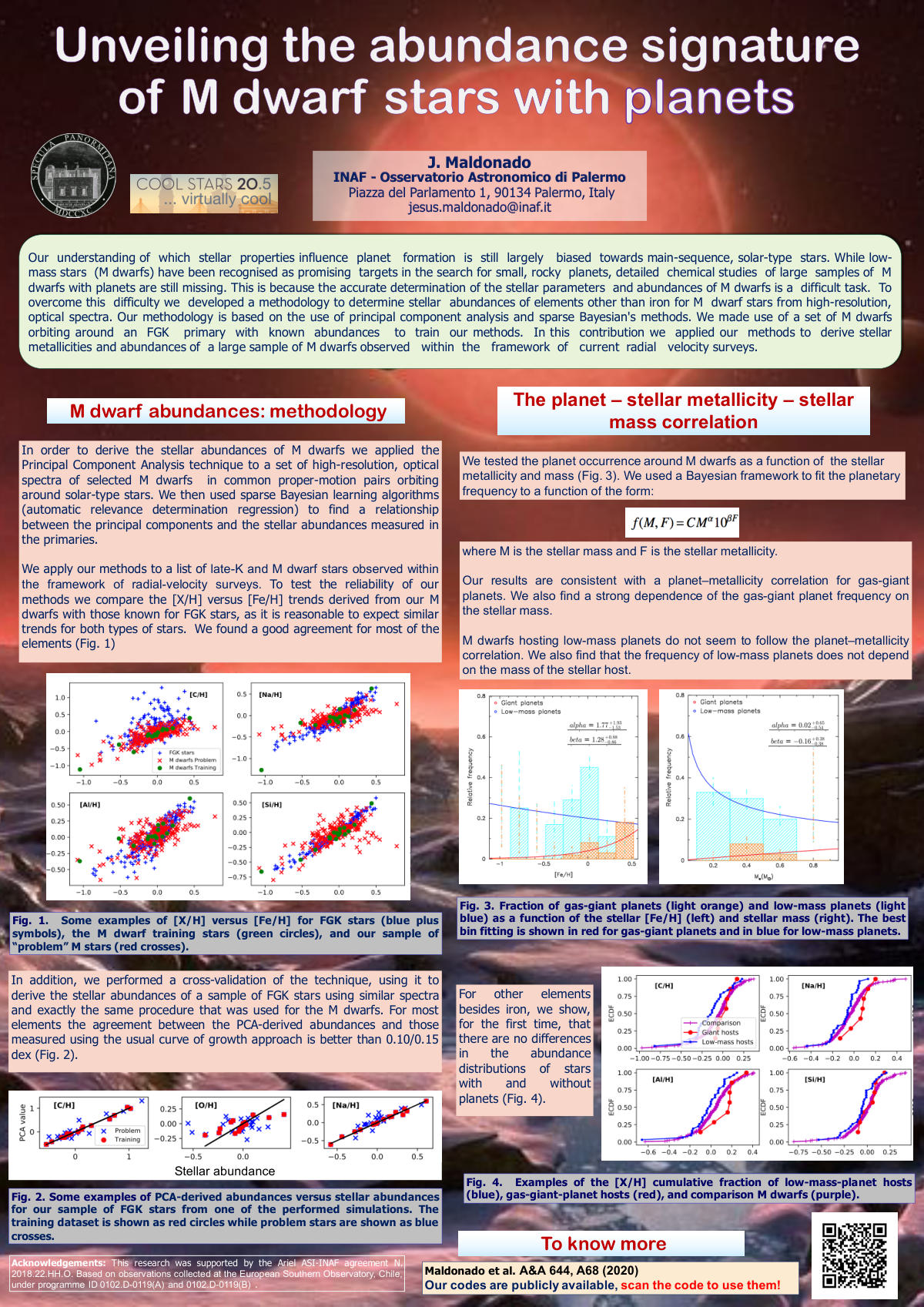
Planetary systems are found around a wide variety of stellar hosts. However, our understanding of which stellar properties influence planet formation is still largely biased towards main-sequence, solar-type stars. While low-mass stars (M dwarfs) have been recognised as promising targets in the search for small, rocky planets, detailed chemical studies of large samples of M dwarfs with planets are still missing. This is because the accurate determination of the stellar parameters and abundances of M dwarfs is a difficult task. To overcome this difficulty we developed a methodology to determine stellar abundances of elements other than iron for M dwarf stars form high-resolution, optical spectra. Our methodology is based on the use of principal component analysis and sparse Bayesian's method. We made use of a set of M dwarfs orbiting around an FGK primary with known abundances to train our methods. In this contribution we applied our methods to derive stellar metallicities and abundances of a large sample of M dwarfs observed within the framework of current radial velocity surveys. We discuss whether the correlations between the metallicity, individual chemical abundances, and mass of the star and the presence of different type of planets found for FGK stars still holds for the less massive M dwarf stars and set the results into the context of current planet formation models.
Identifiers
Authors
Jesus Maldonado
INAF - Osservatorio Astronomico di Palermo