Description
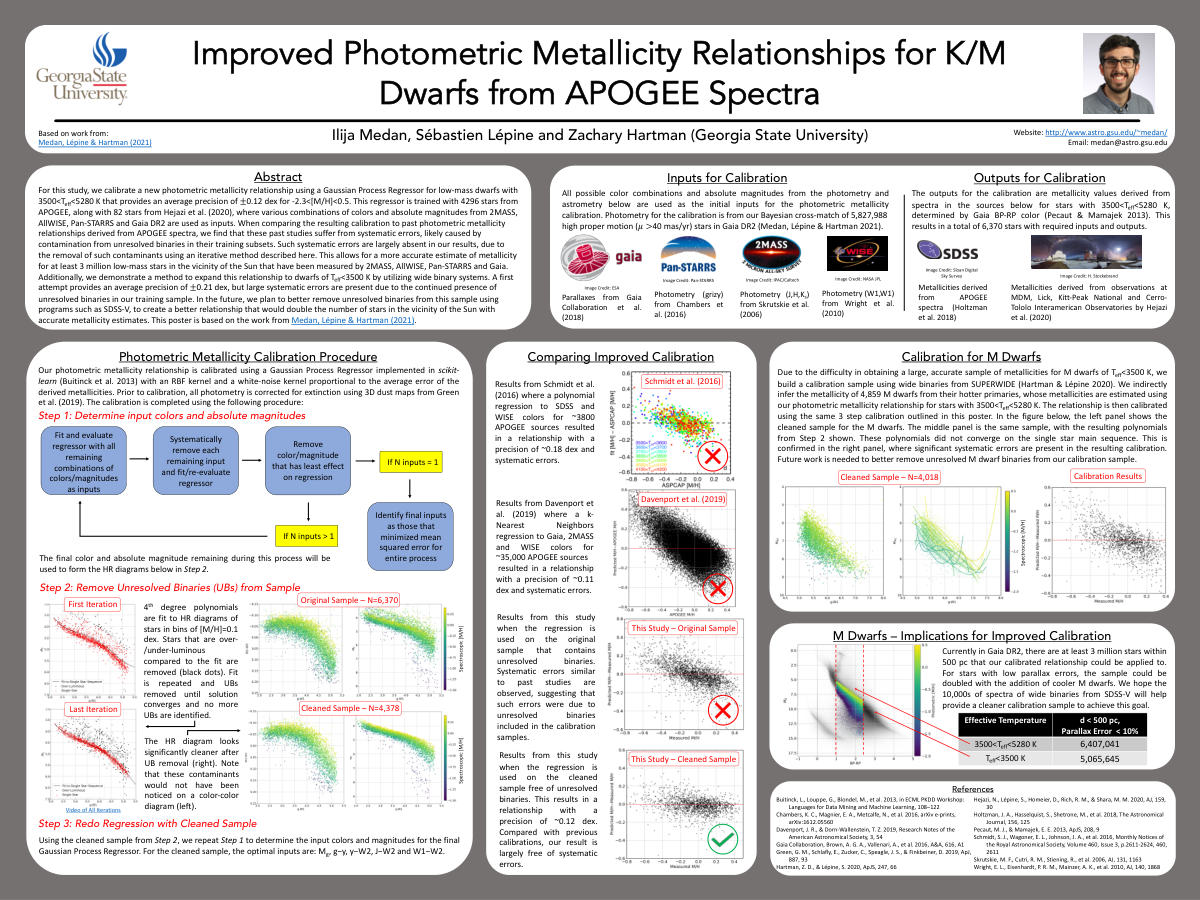
For this study, we calibrate a new photometric metallicity relationship using a Gaussian Process Regressor for low-mass dwarfs with 3500<Teff<5280 K that provides an average precision of ±0.12 dex for -2.3<[M/H]<0.5. This regressor is trained with 4296 stars from APOGEE, along with 82 stars from Hejazi et al. (2020), where various combinations of colors and absolute magnitudes from 2MASS, AllWISE, Pan-STARRS and Gaia DR2 are used as inputs. When comparing the resulting calibration to past photometric metallicity relationships derived from APOGEE spectra, we find that these past studies suffer from systematic errors, likely caused by contamination from unresolved binaries in their training subsets. Such systematic errors are largely absent in our results, due to the removal of such contaminants using an iterative method described here. This allows for a more accurate estimate of metallicity for at least 3 million low-mass stars in the vicinity of the Sun that have been measured by 2MASS, AllWISE, Pan-STARRS and Gaia. Additionally, we demonstrate a method to expand this relationship to dwarfs of Teff<3500 K by utilizing wide binary systems. A first attempt provides an average precision of ±0.21 dex, but large systematic errors are present due to the continued presence of unresolved binaries in our training sample. In the future, we plan to better remove unresolved binaries from this sample using programs such as SDSS-V, to create a better relationship that would double the number of stars in the vicinity of the Sun with accurate metallicity estimates.
Conference Information
The 20.5th Cambridge Workshop on Cool Stars, Stellar Systems, and the Sun
Identifiers
Authors
Ilija Medan
Georgia State University
ORCID: https://orcid.org/0000-0003-3410-5794
Sebastien Lepine
Georgia State University
ORCID: https://orcid.org/0000-0002-2437-2947
Zach Hartman
Georgia State University
ORCID: https://orcid.org/0000-0003-4236-6927
Zachary Hartman
Georgia State University