Description
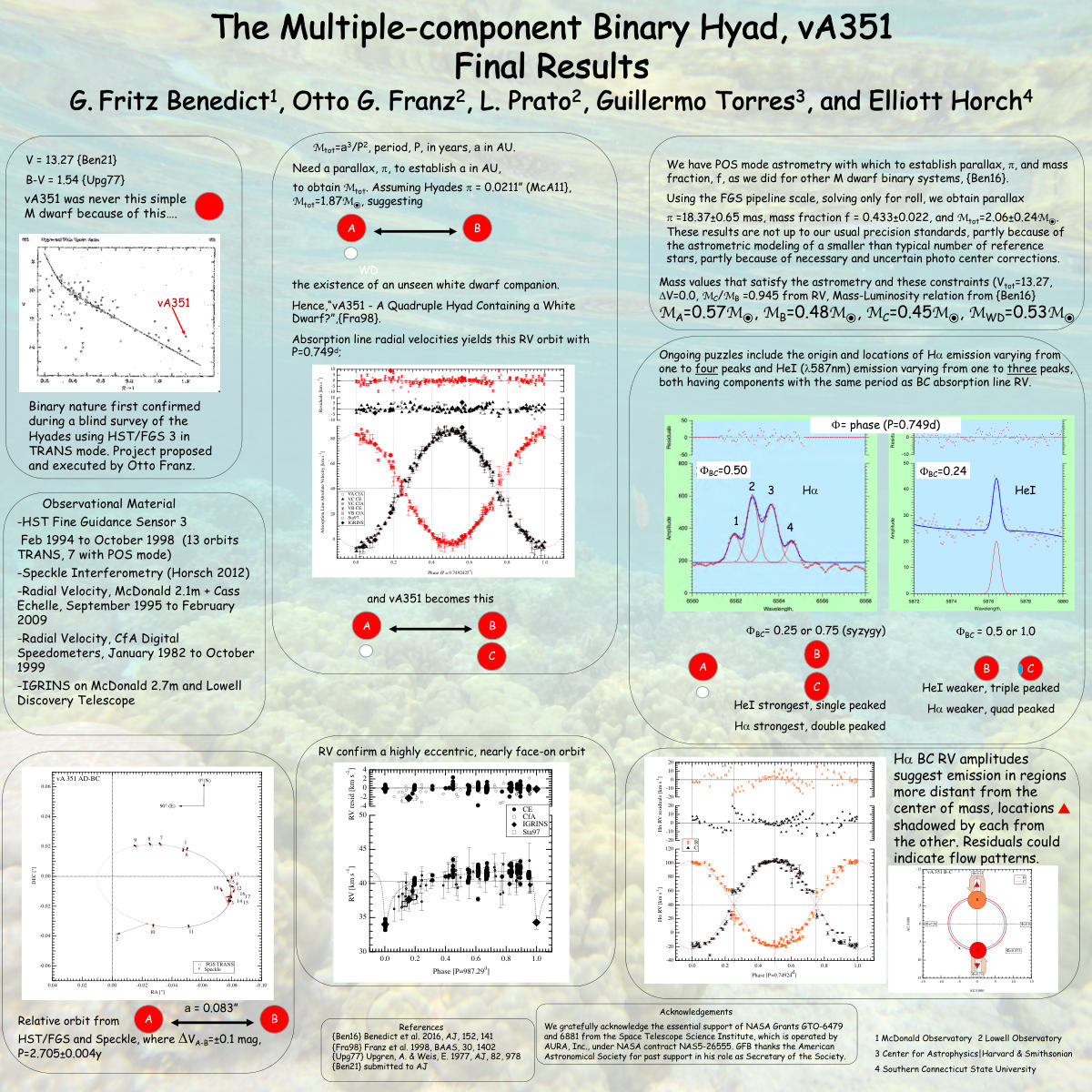
We extend results first announced by Franz et al. (1998), that identified vA351 = H346 in the Hyades as a multiple star system containing a white dwarf. With Hubble Space Telescope Fine Guidance Sensor fringe tracking and scanning, and more recent speckle observations, all spanning 20.7 years, we establish a parallax, relative orbit, and mass fraction for two components, with a period, P = 2.70y and total mass 2.1M⊙. With ground-based radial velocities, we find that component B consists of BC, two M dwarf stars orbiting with a very short period (PBC = 0.749 days), having a mass ratio MC/MB=0.95. We confirm that the total mass of the system can only be reconciled with the distance and component photometry by including a fainter, higher mass component. The quadruple system consists of three M dwarfs (A,B,C) and one white dwarf (D); MA=0.57M⊙, MB=0.48M⊙, and MC=0.45M⊙. The WD mass, 0.53M⊙, comes from cooling models, an assumed Hyades age of 670My, and consistency with all previous and derived astrometric, photometric, and RV results. Velocities from Hα and He I emission lines confirm the BC period derived from absorption lines, with similar (HeI) and higher (Hα) velocity amplitudes. We ascribe the larger Hα amplitude to emission from a region each component shadows from the other, depending on the line of sight.
Identifiers
Authors
G. Fritz Benedict
McDonald Observatory
Otto Franz
Lowell Observatory
Elliot Horch
Southern Connecticut State University
Guillermo Torres
Harvard & Smithsonian
L. Prato
Lowell Observatory