Description
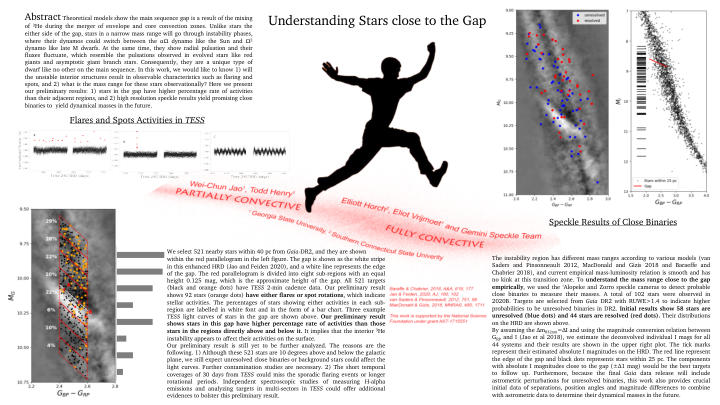
Theoretical models show the main sequence gap is a result of the mixing of 3He during the merger of envelope and core convection zones. Unlike stars the either side of the gap, stars in a narrow mass range will go through instability phases, where their dynamos could switch between the αΩ dynamo like the Sun and Ω2 dynamo like late M dwarfs. At the same time, they show radial pulsation and their fluxes fluctuate, which resemble the pulsations observed in evolved stars like red giants and asymptotic giant branch stars. Consequently, they are a unique type of dwarf like no other on the main sequence. In this work, we would like to know 1) will the unstable interior structures result in observable characteristics such as flaring and spots, and 2) what is the mass range for these stars observationally? Here we present our preliminary results: 1) stars in the gap have higher percentage rate of activities than their adjacent regions, and 2) high resolution speckle results yield promising close binaries to yield dynamical masses in the future.
Identifiers
Authors
Wei-Chun Jao
Georgia State University
ORCID: https://orcid.org/0000-0003-0193-2187
Todd Henry
Georgia State University
Elliott Horch
Southern Connecticut State University
Eliot Vrijmoet
Georgia State University
Gemini Speckle Team