Description
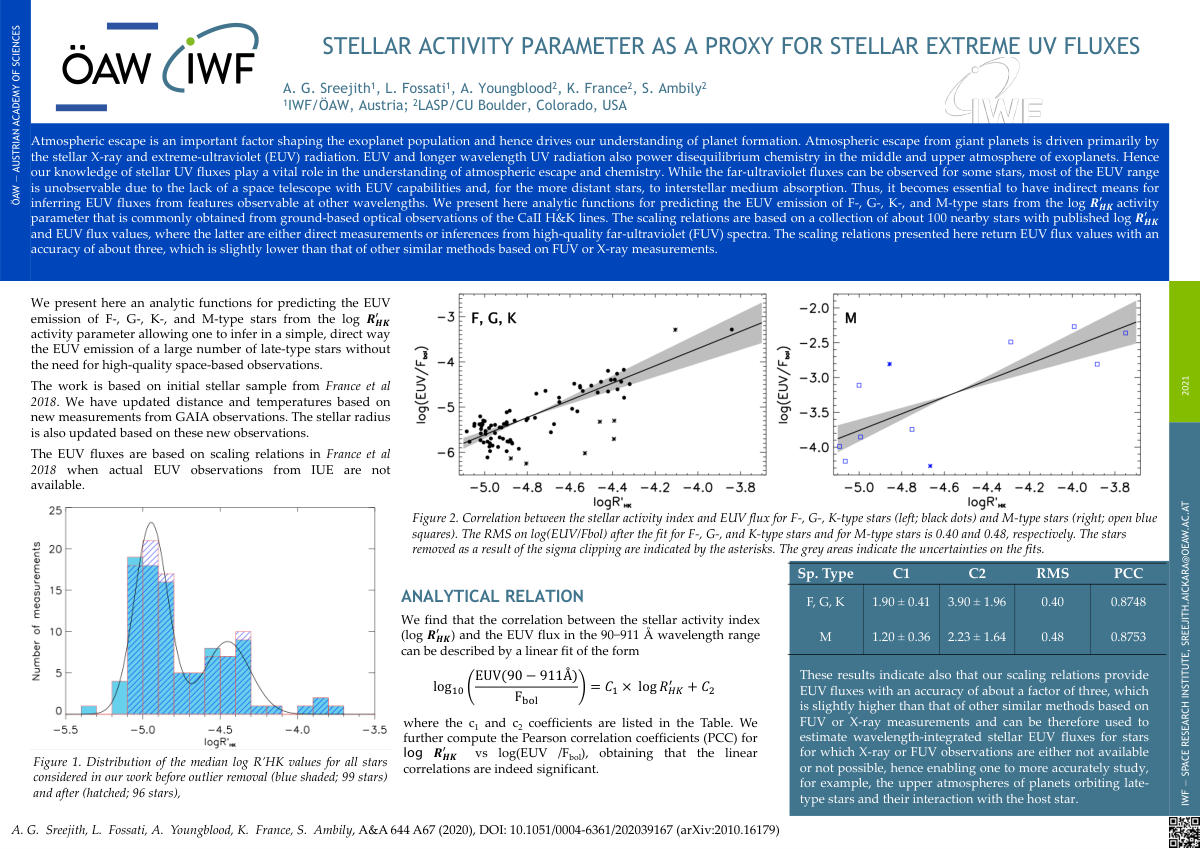
Atmospheric escape is an important factor shaping the exoplanet population and hence drives our understanding of planet formation. Atmospheric escape from giant planets is driven primarily by the stellar X-ray and extreme-ultraviolet (EUV) radiation. EUV and longer wavelength UV radiation also power disequilibrium chemistry in the middle and upper atmosphere of exoplanets. Hence our knowledge of stellar UV fluxes play a vital role in the understanding of atmospheric escape and chemistry. While the far-ultraviolet fluxes can be observed for some stars, most of the EUV range is unobservable due to the lack of a space telescope with EUV capabilities and, for the more distant stars, to interstellar medium absorption. Thus, it becomes essential to have indirect means for inferring EUV fluxes from features observable at other wavelengths. We present here analytic functions for predicting the EUV emission of F-, G-, K-, and M-type stars from the log R'HK activity parameter that is commonly obtained from ground-based optical observations of the CaII H&K lines. The scaling relations are based on a collection of about 100 nearby stars with published log R'HK and EUV flux values, where the latter are either direct measurements or inferences from high-quality far-ultraviolet (FUV) spectra. The scaling relations presented here return EUV flux values with an accuracy of about three, which is slightly lower than that of other similar methods based on FUV or X-ray measurements.spheric escape is an important factor shaping the exoplanet population and hence drives our understanding of planet formation. Atmospheric escape from giant planets is driven primarily by the stellar X-ray and extreme-ultraviolet (EUV) radiation. EUV and longer wavelength UV radiation also power disequilibrium chemistry in the middle and upper atmosphere of exoplanets. Hence our knowledge of stellar UV fluxes play a vital role in the understanding of atmospheric escape and chemistry. While the far-ultraviolet fluxes can be observed for some stars, most of the EUV range is unobservable due to the lack of a space telescope with EUV capabilities and, for the more distant stars, to interstellar medium absorption. Thus, it becomes essential to have indirect means for inferring EUV fluxes from features observable at other wavelengths. We present here analytic functions for predicting the EUV emission of F-, G-, K-, and M-type stars from the log R'HK activity parameter that is commonly obtained from ground-based optical observations of the CaII H&K lines. The scaling relations are based on a collection of about 100 nearby stars with published log R'HK and EUV flux values, where the latter are either direct measurements or inferences from high-quality far-ultraviolet (FUV) spectra. The scaling relations presented here return EUV flux values with an accuracy of about three, which is slightly lower than that of other similar methods based on FUV or X-ray measurements.
Conference Information
2021 IWF — SPACE
Identifiers
Authors
A. G. Sreejith
Space Research Institute, Austrian Academy of Sciences, Graz, Austria
L. Fossati
A. Youngblood
K. France
S. Ambily