Description
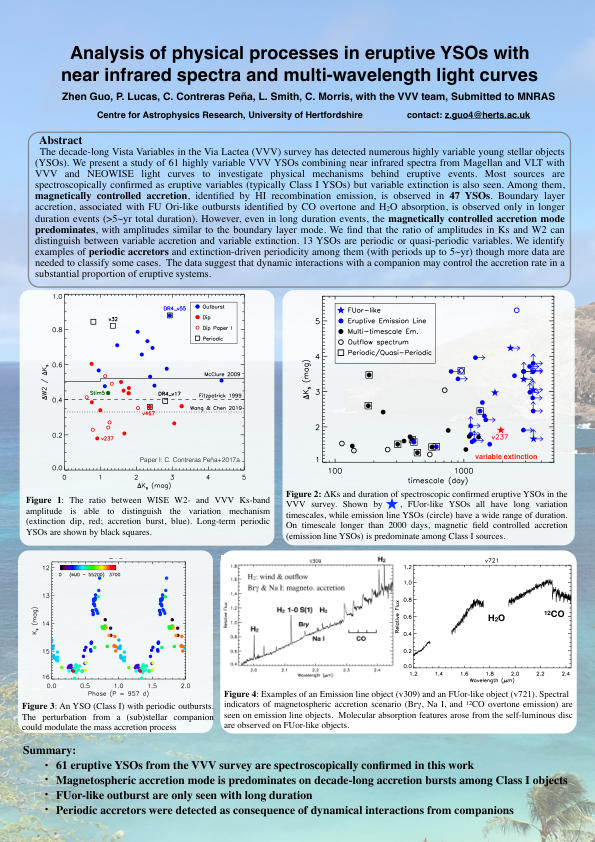
The decade-long Vista Variables in the Via Lactea (VVV) survey has detected numerous highly variable young stellar objects (YSOs). We present a study of 61 highly variable VVV YSOs combining near-infrared spectra from Magellan and VLT with VVV and NEOWISE light curves to investigate the physical mechanisms behind eruptive events. Most sources are spectroscopically confirmed as eruptive variables (typically Class I YSOs) but variable extinction is also seen. Among them, magnetically controlled accretion, identified by HI recombination emission, is observed in 47 YSOs. Boundary layer accretion, associated with FU Ori-like outbursts identified by CO overtone and H2O absorption, is observed only in longer duration events (> 5 yr total duration). However, even in long-duration events, the magnetically controlled accretion mode predominates, with amplitudes similar to the boundary layer mode. We find that the ratio of amplitudes in Ks and W2 can distinguish between variable accretion and variable extinction. 13 YSOs are periodic or quasi-periodic variables. We identify examples of periodic accretors and extinction-driven periodicity among them (with periods up to 5 yr) though more data are needed to classify some cases. The data suggest that dynamic interactions with a companion may control the accretion rate in a substantial proportion of eruptive systems.
Conference Information
MNRAS
Identifiers
Authors
Zhen Guo
University of Hertfordshire
ORCID: https://orcid.org/0000-0003-0292-4832
Philip Lucas
University of Hertfordshire
Carlos Contreras Pena
University of Exeter
Leigh Smith
University of Cambridge
Calum Morris
University of Hertfordshire
The VVV team