Description
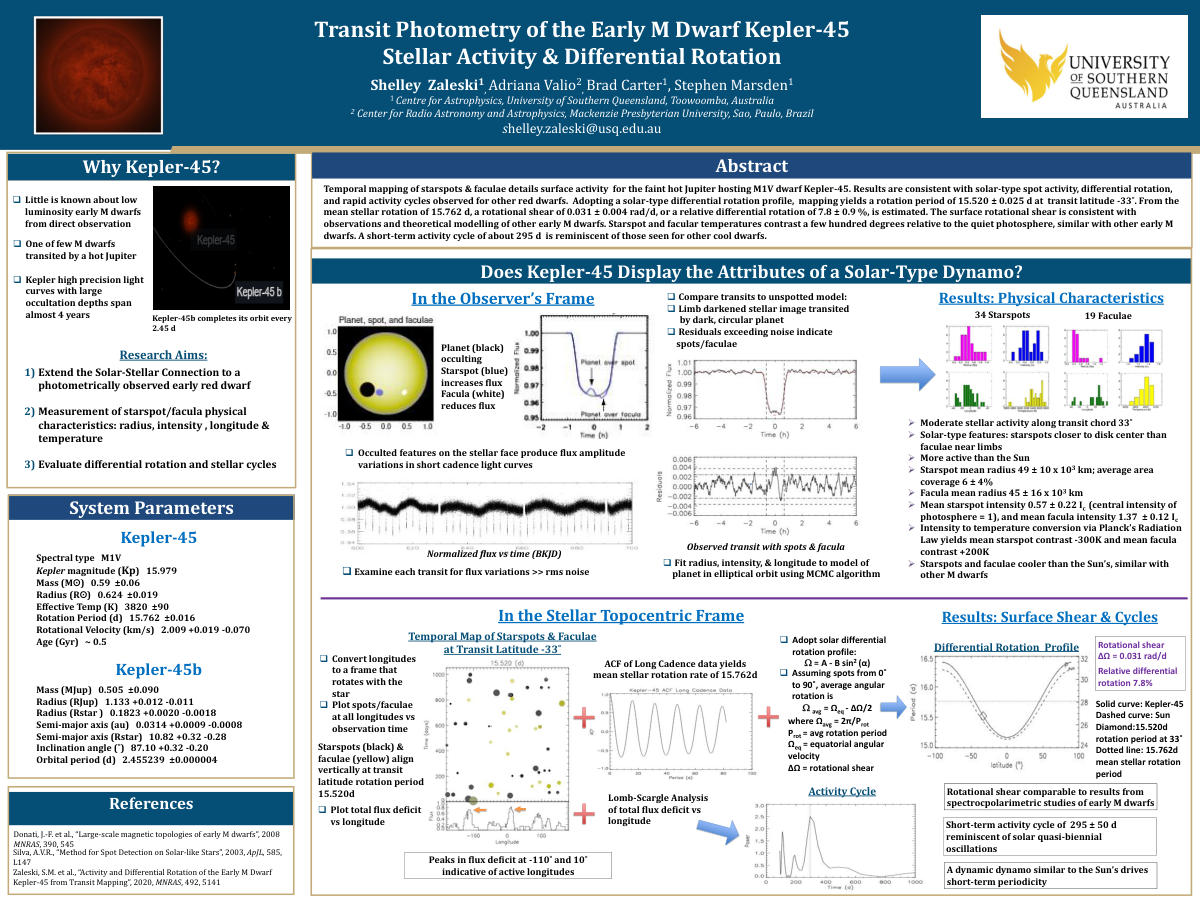
Temporal mapping of starspots & faculae details surface activity for the faint hot Jupiter hosting M1V dwarf Kepler-45. Results are consistent with solar-type spot activity, differential rotation, and rapid activity cycles observed for other red dwarfs. Adopting a solar-type differential rotation profile, mapping yields a rotation period of 15.520 ± 0.025 d at transit latitude -33˚. From the mean stellar rotation of 15.762 d, a rotational shear of 0.031 ± 0.004 rad/d, or a relative differential rotation of 7.8 ± 0.9 %, is estimated. The surface rotational shear is consistent with observations and theoretical modelling of other early M dwarfs. Starspot and facular temperatures contrast a few hundred degrees relative to the quiet photosphere, similar with other early M dwarfs. A short-term activity cycle of about 295 d is reminiscent of those seen for other cool dwarfs.
Conference Information
The 20.5th Cambridge Workshop on Cool Stars, Stellar Systems, and the Sun
Identifiers
Authors
Shelley Zaleski
University of Southern Queensland
ORCID: https://orcid.org/0000-0002-7266-1540
Adriana Valio
Universidade Presbiteriana Mackenzie
Brad Carter
University of Southern Queensland
Stephen Marsden
University of Southern Queensland